
• Wrong document? Swap it for free
  • Written by students who passed
  • Immediately available after payment
  • Read online or as PDF
Sell
Where do you study
Your language
Document preview thumbnail
Preview 2 out of 7 pages
Exam (elaborations)

NIGP-CPP Bridge Questions & Answers

Document preview thumbnail
Preview 2 out of 7 pages

NIGP-CPP Bridge Questions & Answers Disadvantaged Business Entity Business in which majority ownership belongs to members determined to be historically underprivileged because of a predetermined social advantage small business an independently owned firm, corporation, or establishment having a small number of employees, low volume of sales, small amount of assets and limited impact on the market Small Business Administration Congress created this administration, whose function is to "aid, counsel, assist and protect, insofar as is possible, the interests of small business concerns." Micro business employs fewer than five people (including the owner) Greenwashing disinformation disseminated by an organization so as to present an environmentally responsible public image. Sustainable construction The practice of creating structures and using processes that are environmentally responsible and resource-efficient throughout the lifecycle of the building. Leadership in Energy and Environmental Design (LEED) An internationally recognized green building certification system and is one of the most popular green building certification programs used worldwide. acquisition The process of acquiring property or services that are already in existence, or that must be created, developed, demonstrated and evaluated. Strategic Planning A course of action to achieve long-range goals, generally up to five years. Reflects the company's direction and its purpose as stated in its mission statement. Tactical planning A course of action to achieve short-term goals, generally within a year or less. They are concerned with what the units beneath top management must do, how they must do it and who has the responsibility. They have shorter time frames and narrower scopes that the strategic plans. regulation A statement by a governmental body to implement, interpret, or prescribe law or policy, or to describe the organization, procedure, or practice, often promulgated in accordance with an administrative procedure act. policy A governing principle or plan that establishes the general parameters for an organization to follow in carrying out its responsibilities. procedure An established or official way of doing something Common Law (civil law) a law established by following earlier judicial decisions responsible A business entity or individual who has the integrity and reliability as well as the financial and technical capacity to perform the requirements of the solicitation and subsequent contract. Responsive A bid or proposal that fully conforms in all material respects to the Invitation for Bids/ Request for Proposals and all of its requirements, including all forms and substance. Actual Authority Specific right to perform acts and make decision or prescribe rules governing the conduct of others as given to an agent by a principal. Express Authority the authority of an agent, stated in the document or agreement creating the agency Implied Authority Authority that is not expressed or written into the contract, but is only determined by inferences and reasonable deductions about actions that are necessary to perform the expressly authorized acts. Can consider the conduct of the principal regarding historical actions in the past. Apparent authority Occurs when a principal allows or permits a person to function in a capacity that creates the illusion that the person is an authorized agent of the principal. PESTEL Analysis The examination of political, economic, social, technological, environmental, and legal factors and their implications for an organization. The use of PESTEL analysis may require the planning team to perform such research or gather data. Mission Statement Useful because it defines not only where the organization is at present but also identifies the future of the organization as well. Vision Statement An organizational statement that clearly and concisely addresses the future nature and purpose of the entity. A short statement that tells who the organization is and where they are going. policy manual Key provisions of enabling legislation or ordinance and are used to forge a direct relationship between the legal foundation of an agency's procurement program and the procurement rules and policies that guide the agency. Procedure manual manual providing detailed information relative to the performance of tasks within the job description 1- procurement goals, objectives and responsibilities 2- step-by-step outline of procurement process 3- guidelines and steps for preparing requisitions, developing requisitions, receiving and inspection, and documenting vendor performance. 4- property and supply management programs including inventory control and processes for transfer and disposal of surplus property. 5- cooperative purchasing programs and payment processes 6- A listing of important forms used in the procurement process, instructions to bidders and general conditions governing contracting, and a glossary of procurement terms. Strategic Sourcing subset of an entity's strategic procurement plan is a strategic sourcing plan. Strategic sourcing is a methodology and process that enables procurement professionals to analyze what and how they acquire products and services with the objectives of lowering costs to the entity and improving supply fulfillment from the producer level to the end user Standardization Establishing agreement on the characteristics, quality, design, and performance of products and services to be purchased. Outsourcing A decision by a corporation to turn over much of the responsibility for production to independent suppliers. Privatization To change from government or public ownership or control to private ownership or control. Best Value Procurement method emphasizing value or price. RFP value analysis method directed at all functions of a product or service to satisfy the requirement of the lowest possible cost to the entity. Price Analysis The process of comparing suppliers prices against each other or an external benchmark Cost Analysis Procedure that determines the costs of each service including, labor, overheadddddd profit. Spend Analysis Collecting, classifying, and reporting the expenditures of an organization. proactive approach Rather than react to a PR, procurement partners with department during planning to share market trends, knowledge, and strategies. determining true cost Determine operating cycle for equipment, identify and quantify the factors that affect cost., calculate all costs at current rates and prices, estimate future costs that will be incurred, total all costs and benefits to obtain the life cycle cost. Types of risk proposal, surety/liability, schedule, price, contractual, performance, Sourcing strategies Alternative procurement plans that give guidance to assess, evaluate, and manage the supply base in ways that are consistent with overall entity objectives Performance Specifications Describes the desired outcome or intended use of a commodity and how the commodity will perform (# of items, distance to travel, time required) Design specifications Establishes characteristics an item must possess, including details including how it is to be manufactures. May include plans or drawings, and blueprints Combination specifications This type of specification includes the elements of both design and performance specifications. IFB Competitive sealed responses when price is the basis for award RFP The document used to solicit proposals from potential providers for goods and services. Price is usually not a primary evaluation factor. RFQu A document which is issued by a procurement entity to obtain statements of the qualification of potential responders to gauge a potential competition in the marketplace. Used prior to issuing a solicitation. Tariff A government tax or duty on imports or exports Embargo an official ban on trade or other commercial activity with a particular country. EXW (ex works) delivery takes place at the seller's premises or another named place. Seller doesn't need to load goods on collecting vehicle, nor does it clear the goods for export, where such clearance is applicable. FCA (Free Carrier) seller delivers the goods to the carrier or another person nominated by the buyer at the seller's premises or another named place. The parties are well advised to specify as clearly as possible the point within the named place of delivery, as the risk passes to the buyer at that point. CPT (Carriage Paid To) the seller delivers the goods to the carrier or another person nominated by the seller at an agreed place (if any such place is agreed between parties) and that the seller must contract for and pay the costs of carriage necessary to bring the goods to the named place of destination. CIP (Carriage and Insurance Paid To) The seller delivers the goods to the carrier or another person nominated by the seller at an agreed place (if any such place is agreed between parties) and that the seller must contract for and pay the costs of carriage necessary to bring the goods to the named place of destination. 'The seller also contracts for insurance cover against the buyer's risk of loss of or damage to the goods during the carriage. The buyer should note that under CIP the seller is required to obtain insurance only on minimum cover. Should the buyer wish to have more insurance protection, it will need either to agree as much expressly with the seller or to make its own extra insurance arrangements." DAT (Delivered at Terminal) Seller delivers when the goods, once unloaded from the arriving means of transport, are placed at the disposal of the buyer at a named terminal at the named port or place of destination. "Terminal" includes a place, whether covered or not, such as a quay, warehouse, container yard or road, rail or air cargo terminal. The seller bears all risks involved in bringing the goods to and unloading them at the terminal at the named port or place of destination. DAP (Delivered at Place) Seller delivers when the goods are placed at the disposal of the buyer on the arriving means of transport ready for unloading at the named place of destination. The seller bears all risks involved in bringing the goods to the named place. DDP (Delivered Duty Paid) seller delivers the goods when the goods are placed at the disposal of the buyer, cleared for import on the arriving means of transport ready for unloading at the named place of destination. The seller bears all the costs and risks involved in bringing the goods to the place of destination and has an obligation to clear the goods not only for export but also for import, to pay any duty for both export and import and to carry out all customs formalities. Logistics management The discipline responsible for the movement, routing, distribution, transportation, and coordination of activities that apply to goods delivery and/or service performance delivery mode / method Method of delivery Carload the minimum weight, as defined by law, of a shipment entitled to a reduced freight rate. The shipment amount that fills a freight car or truck. A load that fills the maximum capacity of a transporting unit. Truckload A quantity of freight to which truckload rates apply. Indicates full truckload as opposed to LT less than truckload shipment. Motor carriers will charge less per CWT if a shipper is moving full truckloads Third party A contractor or supplier who ultimately receives monetary payment (grant funds) from the grantee as a result of rendering contractual goods or services in satisfaction of a contract that was funded by the grant. latent damage occurs when a device is partially degraded during the manufacturing and handling yet it meets product test specifications and is ultimately shipped to a customer demurrage Fee charged by a carrier against a consignee, consignor, or other responsible party to compensate for the detention of the carrier's equipment in excess of allowable free time for loading, unloading, reconsigning, or stopping in transit. Dunnage loose wood, matting, or similar material used to keep a cargo in position in a ship's hold.

Content preview

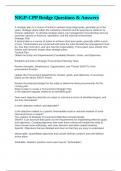
NIGP-CPP Bridge Questions & Answers
A strategic plan is a course of action to achieve long-range goals, generally up to five
years. Strategic plans reflect the company's direction and its purpose as stated in its
mission statement. To develop strategic plans, top management must develop and use
summary reports on finances, operations, and the external environment.
Strategic Plan
A tactical plan is a course of action to achieve short-term goals, generally within a year
or less. Tactical plans are concerned with what the units beneath top management must
do, how they must do it, and who has the responsibility. These plans have shorter time
frames and narrower scopes than strategic plans.
Tactical Plan
Obtain the Entity and Departmental (if available) Mission, Goals, and Objectives.

Establish and train a Strategic Procurement Planning Team.

Review Strengths, Weaknesses, Opportunities, and Threats (SWOT) of the
procurement function.

Update the Procurement Department's mission, goals, and objectives, if necessary,
based on the above SWOT review.

Review the projected budget for the entity to determine likely procurements for the
coming year.
Steps to take to create a Procurement Strategic Plan
Is the objective logically related to an identified goal?

Does each objective describe an output or outcome in terms of identified targets, and
are they time based?

Is each objective realistic and attainable?

Is the objective related to a specific foreseeable result or outcome instead of some
internal process or output?
The creation of Strategic Procurement Objectives should include:
SMART is an acronym that spells out the requirements for establishing effective goals
and objectives. Creating objectives that meet these criteria will enable the entity to
move forward more efficiently, with clear direction and within stated timelines.
Specific: Objectives that are detailed and clear so that they are easy to understand.

Measurable: Quantifiable objectives that include definite numbers and well-defined
action plans.

Attainable: Realistic (another word used may be "Achievable").

, Relevant: The objective matters and it matches our overall goals.

Time Bound: Set a specific time frame to accomplish your objectives.
SMART
Obtain input from key stakeholders (those to whom performance will be reported).

Ensure that measures are simple and relevant to the intended audience (e.g., public,
stakeholders, elected officials).

Ensure that measures are specific, consistently applied, and within the control of the
procurement function.

Identify any dependencies among other stakeholders, functions, or departments that will
be related to the measures.

Define a specific time period for reporting measures that is directly related to the
attainment of goals and objectives in the strategic plan (e.g., 6 months, 1 year).

Utilize measures in the decision-making process that support informed decision making
and lead to appropriate action. The measures should represent a balance of the types
of measures critical to achieving specific objectives and goals.
In order for procurement managers to know "what" they are measuring, accurate
planning must be completed before the process of developing the performance metrics.
Is descriptive and conceptual. Qualitative data can be categorized based on traits and
characteristics. Example: Provide response options for feedback on the pCard program
survey such as: Highly effective, effective, ineffective, highly ineffective.
Qualitative Feedback
Can be counted, measured, and expressed using numbers. Example: Provide response
options for feedback such as the number of solicitations awarded or time it took to
process an award.
Quantitative Feedback
Is a more organized and documented communication.
Formal Feedback
Is the everyday casual conversation regarding the work being done.
Informal Feedback
Qualitative Feedback: Focus groups center their attention on processes related to an
issue and how to improve them.

Quantitative Feedback: Surveys focused on measuring satisfaction with Procurement
Department.

Formal Feedback: A formal annual review of procurement performance each year.

Informal Feedback: Staff check-in with internal clients to receive informal feedback on
new processes implemented.


Document information

Uploaded on
March 2, 2025
Number of pages
7
Written in
2024/2025
Type
Exam (elaborations)
Contains
Questions & answers
$13.49

Wrong document? Swap it for free Within 14 days of purchase and before downloading, you can choose a different document. You can simply spend the amount again.
Written by students who passed
Immediately available after payment
Read online or as PDF

Seller avatar
Reputation scores are based on the amount of documents a seller has sold for a fee and the reviews they have received for those documents. There are three levels: Bronze, Silver and Gold. The better the reputation, the more your can rely on the quality of the sellers work.
Pogba119
4.0
(15)
Sold
66
Followers
2
Items
5635
Last sold
2 weeks ago


Why students choose Stuvia

Created by fellow students, verified by reviews

Quality you can trust: written by students who passed their tests and reviewed by others who've used these notes.

Didn't get what you expected? Choose another document

No worries! You can instantly pick a different document that better fits what you're looking for.

Pay as you like, start learning right away

No subscription, no commitments. Pay the way you're used to via credit card and download your PDF document instantly.

Student with book image

“Bought, downloaded, and aced it. It really can be that simple.”

Alisha Student

Working on your references?

Create accurate citations in APA, MLA and Harvard with our free citation generator.

Working on your references?

Frequently asked questions
