NURS 513 Exam 2
Study online at https://quizlet.com/_gi5sq4
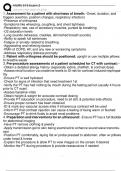
1. Assessment for a patient with shortness of breath: -Onset, duration, and
triggers (exertion, position changes, respiratory infection)
-Presence of orthopnea
-Symptoms like wheezing, coughing, and chest tightness
-Respiratory rate, use of accessory muscles, pursed lip breathing
-O2 saturation levels
-Lung sounds (wheezes, crackles, diminished breath sounds)
-Ability to speak full sentences
-Fatigue or anxiety related to breathing
-Aggravating and relieving factors
-PMH of COPD, HF, and any new or worsening symptoms
-Address respiratory distress promptly
2. Patient with orthopnea should be positioned: upright or use multiple pillows
to breathe easier
3. Pre-procedure assessments of a patient scheduled for CT with contrast: -
-Obtain a detailed allergy history (especially iodine, shellfish, & contrast dyes)
-Assess renal function via creatinine levels to ID risk for contrast induced nephropa-
thy
-Ensure PT is well hydrated
-Check for signs of infection that need treatment 1st
-Verify the PT has had nothing by mouth during the fasting period (usually 4 hours
prior to CT scan)
-Assess baseline vitals
-Obtain height & weight for accurate contrast dosing
-Provide PT education on procedure, need to sit still, & potential side effects
-Ensure proper consent has been obtained
-ID & mark any vascular access sites if intravenous contrast will be used
-Inform PT that contrast injection can cause a feeling of being warm or flushed
-Encourage PT to drink fluids to avoid renal problems
4. Preparation and interventions for an ultrasound: -Ensure PT has a full bladder
for abdominal imaging
-Have PT remove clothing & jewelry
-Apply transmission gel to skin being examined to enhance sound wave transmis-
sion
-Position PT comfortably, laying flat w/ probe pressed to abdomen, often w/ pillows
under head & knees
-Explain the procedure & allow PT to view images on the screen if desired
-Monitor the PT during procedure & provide reassurance if needed
, NURS 513 Exam 2
Study online at https://quizlet.com/_gi5sq4
-Document findings thoroughly & report any abnormalities
-Proper prep enhances image quality & PT comfort
5. Positioning the patient for respiratory diagnostic tests: Pulmonary function
test: Have PT sit upright w/ good posture w/ feet flat on the floor, as this allows full
chest expansion & avoids restricting airflow
(Ex. spirometry)
6. Positioning the patient for respiratory diagnostic tests: Chest X-ray: Position
the PT standing or sitting upright, with chest against imaging plate
-Arms should be raised and hands placed on the head to move the scapulae
posteriorly and allow better visualization of the lung apices
-Instruct them to hold their breath after full inhalation
7. Positioning the patient for respiratory diagnostic tests: Lung auscultation-
: Position patient sitting upright or in a semirecumbent position, leaning slightly
forward (brings posterior lung field closer to the surface)
8. Positioning the patient for respiratory diagnostic tests: Arterial blood gas
sample: Position the patient comfortably, either sitting upright, lying on their side,
lying flat or semirecumbent
-Extend the arm being used for the arterial puncture and support it on a firm surface
-Immobilize the wrist and extend the fingers to help visualize and palpate the radial
artery
9. Positioning the patient for respiratory diagnostic tests: Good lung: -Good
lung should be position down if they have a 1 sided lung problem (PT lying on side)
-Blood pools in the bottom lung alveoli allowing for better oxygenation of blood
-Secretions can drain out of the affected lung, so they can be removed via suctioning
10. Postoperative care - bronchoscopy: -Monitor PT closely for respiratory dis-
tress or complications
-Assess vitals, SPO2, & breath sounds frequently
-Provide supplemental oxygen
-Suction any secretions
-Encourage coughing & deep breathing
-Watch for signs of bleeding, infection, or pneumothorax & report any concerns
-PT may experience a sore throat, hoarseness, or mild bleeding after the procedure
-Offer lozenges or sprays to soothe throat discomfort
-Instruct the patient to increase fluid intake & avoid smoking for at least 24 hours
-Watch for signs of infection like fever or increased sputum production
-Keep PT NPO until gag reflex returns
-Monitor for recovery from sedation
-Blood-tinged mucus can be normal if biopsy was done (monitor for hemorrhaging)
-Offer reassurance, pain control, & assistance with oral intake
, NURS 513 Exam 2
Study online at https://quizlet.com/_gi5sq4
11. Bronchoscopy: the visual examination of the bronchi using a bronchoscope
12. Clinical manifestations in metabolic acidosis: • Headache
• Confusion (can lead to coma)
• Restlessness
• Lethargy
• Weakness
• Stupor/coma
• Kussmaul respirations (rapid, deep breathing)
• Nausea and vomiting
• Warm, flushed skin
• Seizures
• Twitching
• Peripheral vasodilation
• Anorexia
• Nausea, vomiting, diarrhea, abdominal discomfort
• If severe: dysrhythmia, hypotension, & death
13. metabolic acidosis: -low pH, low HCO3
-Body attempts to compensate by increasing respiratory rate to lower CO2 levels
-Occurs when acid other than carbonic acid accumulates in the body or when
bicarbonate is lost in body fluids
-To compensate the kidneys try to excrete excess acid & the lungs increase CO2
exertion by increasing respirations
14. Lab findings for metabolic acidosis: -pH < 7.35
-low HCO3 < 22 mEq/L
-Increased anion gap > 12 mmol/L (diabetic ketoacidosis or lactic acidosis)
-PaCO2 (Normal is uncompensated, decreases if not compensated)
15. Nursing actions based on SpO2 levels: 95-100%: No supplemental oxygen
needed & occasional monitoring
16. Nursing actions based on SpO2 levels: 90-94%: Administer oxygen via nasal
cannula 1-3 L/min & reassess & increase flow if SPO2 does not improve
17. Nursing actions based on SpO2 levels: 85-89%: Administer oxygen via face
mask or non-rebreather mask at 6-10 L/min & notify provider if SPO2 does not
improve
18. Nursing actions based on SpO2 levels: <85%: Administer high flow oxygen
at 10-15 L/min via non-rebreather mask or consider mechanical ventilation & MUST
notify provider
19. Normal Arterial Blood Gas Values: pH- 7.35-7.45
PaO2- 80-100
Study online at https://quizlet.com/_gi5sq4
1. Assessment for a patient with shortness of breath: -Onset, duration, and
triggers (exertion, position changes, respiratory infection)
-Presence of orthopnea
-Symptoms like wheezing, coughing, and chest tightness
-Respiratory rate, use of accessory muscles, pursed lip breathing
-O2 saturation levels
-Lung sounds (wheezes, crackles, diminished breath sounds)
-Ability to speak full sentences
-Fatigue or anxiety related to breathing
-Aggravating and relieving factors
-PMH of COPD, HF, and any new or worsening symptoms
-Address respiratory distress promptly
2. Patient with orthopnea should be positioned: upright or use multiple pillows
to breathe easier
3. Pre-procedure assessments of a patient scheduled for CT with contrast: -
-Obtain a detailed allergy history (especially iodine, shellfish, & contrast dyes)
-Assess renal function via creatinine levels to ID risk for contrast induced nephropa-
thy
-Ensure PT is well hydrated
-Check for signs of infection that need treatment 1st
-Verify the PT has had nothing by mouth during the fasting period (usually 4 hours
prior to CT scan)
-Assess baseline vitals
-Obtain height & weight for accurate contrast dosing
-Provide PT education on procedure, need to sit still, & potential side effects
-Ensure proper consent has been obtained
-ID & mark any vascular access sites if intravenous contrast will be used
-Inform PT that contrast injection can cause a feeling of being warm or flushed
-Encourage PT to drink fluids to avoid renal problems
4. Preparation and interventions for an ultrasound: -Ensure PT has a full bladder
for abdominal imaging
-Have PT remove clothing & jewelry
-Apply transmission gel to skin being examined to enhance sound wave transmis-
sion
-Position PT comfortably, laying flat w/ probe pressed to abdomen, often w/ pillows
under head & knees
-Explain the procedure & allow PT to view images on the screen if desired
-Monitor the PT during procedure & provide reassurance if needed
, NURS 513 Exam 2
Study online at https://quizlet.com/_gi5sq4
-Document findings thoroughly & report any abnormalities
-Proper prep enhances image quality & PT comfort
5. Positioning the patient for respiratory diagnostic tests: Pulmonary function
test: Have PT sit upright w/ good posture w/ feet flat on the floor, as this allows full
chest expansion & avoids restricting airflow
(Ex. spirometry)
6. Positioning the patient for respiratory diagnostic tests: Chest X-ray: Position
the PT standing or sitting upright, with chest against imaging plate
-Arms should be raised and hands placed on the head to move the scapulae
posteriorly and allow better visualization of the lung apices
-Instruct them to hold their breath after full inhalation
7. Positioning the patient for respiratory diagnostic tests: Lung auscultation-
: Position patient sitting upright or in a semirecumbent position, leaning slightly
forward (brings posterior lung field closer to the surface)
8. Positioning the patient for respiratory diagnostic tests: Arterial blood gas
sample: Position the patient comfortably, either sitting upright, lying on their side,
lying flat or semirecumbent
-Extend the arm being used for the arterial puncture and support it on a firm surface
-Immobilize the wrist and extend the fingers to help visualize and palpate the radial
artery
9. Positioning the patient for respiratory diagnostic tests: Good lung: -Good
lung should be position down if they have a 1 sided lung problem (PT lying on side)
-Blood pools in the bottom lung alveoli allowing for better oxygenation of blood
-Secretions can drain out of the affected lung, so they can be removed via suctioning
10. Postoperative care - bronchoscopy: -Monitor PT closely for respiratory dis-
tress or complications
-Assess vitals, SPO2, & breath sounds frequently
-Provide supplemental oxygen
-Suction any secretions
-Encourage coughing & deep breathing
-Watch for signs of bleeding, infection, or pneumothorax & report any concerns
-PT may experience a sore throat, hoarseness, or mild bleeding after the procedure
-Offer lozenges or sprays to soothe throat discomfort
-Instruct the patient to increase fluid intake & avoid smoking for at least 24 hours
-Watch for signs of infection like fever or increased sputum production
-Keep PT NPO until gag reflex returns
-Monitor for recovery from sedation
-Blood-tinged mucus can be normal if biopsy was done (monitor for hemorrhaging)
-Offer reassurance, pain control, & assistance with oral intake
, NURS 513 Exam 2
Study online at https://quizlet.com/_gi5sq4
11. Bronchoscopy: the visual examination of the bronchi using a bronchoscope
12. Clinical manifestations in metabolic acidosis: • Headache
• Confusion (can lead to coma)
• Restlessness
• Lethargy
• Weakness
• Stupor/coma
• Kussmaul respirations (rapid, deep breathing)
• Nausea and vomiting
• Warm, flushed skin
• Seizures
• Twitching
• Peripheral vasodilation
• Anorexia
• Nausea, vomiting, diarrhea, abdominal discomfort
• If severe: dysrhythmia, hypotension, & death
13. metabolic acidosis: -low pH, low HCO3
-Body attempts to compensate by increasing respiratory rate to lower CO2 levels
-Occurs when acid other than carbonic acid accumulates in the body or when
bicarbonate is lost in body fluids
-To compensate the kidneys try to excrete excess acid & the lungs increase CO2
exertion by increasing respirations
14. Lab findings for metabolic acidosis: -pH < 7.35
-low HCO3 < 22 mEq/L
-Increased anion gap > 12 mmol/L (diabetic ketoacidosis or lactic acidosis)
-PaCO2 (Normal is uncompensated, decreases if not compensated)
15. Nursing actions based on SpO2 levels: 95-100%: No supplemental oxygen
needed & occasional monitoring
16. Nursing actions based on SpO2 levels: 90-94%: Administer oxygen via nasal
cannula 1-3 L/min & reassess & increase flow if SPO2 does not improve
17. Nursing actions based on SpO2 levels: 85-89%: Administer oxygen via face
mask or non-rebreather mask at 6-10 L/min & notify provider if SPO2 does not
improve
18. Nursing actions based on SpO2 levels: <85%: Administer high flow oxygen
at 10-15 L/min via non-rebreather mask or consider mechanical ventilation & MUST
notify provider
19. Normal Arterial Blood Gas Values: pH- 7.35-7.45
PaO2- 80-100