
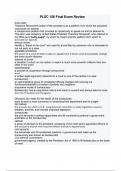
PLSC 156 Final Exam Review
bully pulpit Theodore Roosevelt's notion of the presidency as a platform from which the president could push an agenda a conspicuous position that provides an opportunity to speak out and be listened to. This term was coined by United States President Theodore Roosevelt, who referred to his office as a "bully pulpit", by which he meant a terrific platform from which to advocate an agenda. amicus curiae literally a "friend of the court" and used for a brief filed by someone who is interested in but not party to a case appellate jurisdiction the power of a court to hear a case on appeal from a lower court and possibly change the lower court's decision balance of power a situation in which no one nation or region is much more powerful militarily than any other in the world bipartisanship a process of cooperation through compromise brief a written legal argument presented to a court by one of the parties in a case bureaucracy an administrative group of nonelected officials charged with carrying out functionsconnected to a series of policies and programs acquisitive model of bureaucracy Bureaucracy has an acquisitive nature and wants to expand and always asks for more from the President and Congress. Decisions are made for the needs of the bureaucrats each division is most concerned w/ protecting their department and its budget bill markup the process by which a U.S. congressional committee or state legislative session debates, amends, and rewrites proposed legislation bureaucrats the civil servants or political appointees who fill nonelected positions in government andmake up the bureaucracy cabinet a group of advisers to the president, consisting of the most senior appointed officers of the executive branch who head the fifteen executive departments civil servants the individuals who fill nonelected positions in government and make up the bureaucracy;also known as bureaucrats Civil Service Commission government agency created by the Pendleton Act of 1883 to fill federal jobs on the basis of merit created by Pendleton Act to oversee examinations for potential government employees collective action How groups form and organize to pursue their goals or objectives, including how to get individuals and groups to participate and to cooperate. The term has many applications in the various social sciences such as political science, sociology, and economics. Collective goods and services When the government provides roads, parks, education & national defense Congressional Leadership Amongst the electorate political parties may be weak but inside our Congress they have never been stronger. The leadership structure inside the legislative branch is built upon the strength political parties. The political party with the most seats wins all of the major leadership positions. This means that the majority party controls the agenda of the legislative branch. If the leadership can adequately discipline its members a party agenda can be pushed despite loud opposition. The most important leaders are the Speaker of the House and the Majority Leader in the Senate. Throughout our history these leaders have wielded tremendous power. As one Speaker used to say, "Go along and get along." majority leader the leader of the majority party in either the House or Senate; in the House, the majority leader serves under the Speaker of the House, in the Senate, the majority leader is the functional leader and chief spokesperson for the majority party minority leader the party member who directs the activities of the minority party on the floor of either the House or the Senate whip in the House and in the Senate, a high leadership position whose primary duty is to enforce votingdiscipline in the chambers and conferences congressional representation allocation United States congressional apportionment is the process by which seats in the United States House of Representatives are distributed among the 50 states according to the most recent decennial census mandated by the United States Constitution. Each state is apportioned a number of seats which approximately corresponds to its share of the aggregate population of the 50 states. However, every state is constitutionally guaranteed at least one seat. The number of voting seats in the House of Representatives has been 435 since 1913, capped at that number by the Reapportionment Act of 1929—except for a temporary (1959–1962) increase to 437 when Alaska and Hawaii were admitted into the Union Speaker of the House the presiding officer of the House of Representatives and the leader of the majority party; the Speaker is second in the presidential line of succession, after the vice president Containment the effort by the United States and Western European allies, begun during the Cold War, toprevent the spread of communism divided government a condition in which one or more houses of the legislature is controlled by the party in opposition to the executive docket the list of cases pending on a court's calendar efficacy the belief that you make a difference and that government cares about you and your views executive agreements an international agreement between the president and another country made by the executive branch and without formal consent by the Senate filibusters a parliamentary maneuver used in the Senate to extend debate on a piece of legislation as long as possible, typically with the intended purpose of obstructing or killing it first-past-the-post a system in which the winner of an election is the candidate who wins the greatest number of votes cast, also known as plurality voting foreign policy a government's goals in dealing with other countries or regions and the strategy used toachieve them foreign policy outputs a. presidential summits b. military uses of force c. emergency spending measures d. public laws (homeland security act, patriot act) foreign policy powers of the president - The president is the commander in chief. - Appoints and receives ambassadors - Make/negotiate treaties and executive agreements. - Congress has the power to declare war - Appropriate money, ratify treaties, and confirm diplomatic appointments. - Commit troops - Recognize governments of foreign countries foreign policy powers of congress - Approve treaties - The power to declare war - Appropriate money - Regulate foreign commerce - The Senate must ratify treaties - Senate confirms diplomatic appointments. - They are shared with the president by generally letting the president take lead. cabinet members work most closely with the president on foreign policy - The secretary of state supervises all the diplomatic activities of the United States government. - The secretary of defense supervises the military activities of the United States government. examples of powers the Constitution expresses, implies, and denies to Congress. Expressed: - To impose and collect taxes - To regulate commerce Implied: - To pass laws - Minimum wage Denied: - Pass bills of ex post facto - Prohibit state-approved migration gerrymandering the manipulation of legislative districts in an attempt to favor a particular candidate goals of US foreign policy 1. National security` 2. Promote and Support democracy 3. Promote world peace 4. Human rights - provide aid to people in need 5. Economic grown - establish open trade government corporation a corporation that fulfills an important public interest and is therefore overseenby government authorities to a much larger degree than private businesses - us postal office - Amtrak - NASA implied powers the powers not specifically detailed in the U.S. Constitution but inferred as necessary to achieve the objectives of the national government Interest group an organized group of people with common objectives who actively try to influence policymaking iron triangle three-way relationship among congressional committees, interests groups, and the bureaucracy judicial review the power of the courts to review actions taken by the other branches of government and the states and to rule on whether those actions are constitutional appellate jurisdiction the power of a court to hear a case on appeal from a lower court and possibly change the lower court's decision original jurisdiction the power of a court to hear a case for the first time inside lobbying the act of contacting and taking the organization's message directly to lawmakers in an attempt to influence policy Lobbying Engaging in activities aimed at influencing public officials, especially legislators, and the policies they enact.
Document information
- Uploaded on
- February 21, 2025
- Number of pages
- 8
- Written in
- 2024/2025
- Type
- Exam (elaborations)
- Contains
- Questions & answers


