CHM 142 - Exam 1
Study online at https://quizlet.com/_gis3x0
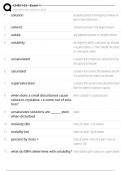
1. solution an evenly spread or homogenous mixture of
two or more substances
2. solvent substance present in the largest amount
3. solute any substance present in a smaller amount
4. solubility the degree to which a substance can dissolve
in a given solvent, i.e. how "soluble" the solute
is in that given solvent
5. unsaturated a solution that contains less solute than it has
the capacity to dissolve
6. saturated a solution that contains the maximum amount
of a solute than the solvent can dissolve
7. supersaturated a solution that contains more dissolved solute
than the solvent's maximum capacity
8. when does a small disturbance cause when a solution is supersaturated
solute to crystalize, i.e come out of solu-
tion?
9. unsaturates solutions are _______ even stable
when disturbed
10. molarity (M) moles of solute / L of solution
11. molality (m) moles of solute / kg of solvent
12. percent by mass = mass of solute / mass of solute + mass of
solvent x 100
13. what do IMFs determine with solubility? how soluble a given solute is in a given solvent
, CHM 142 - Exam 1
Study online at https://quizlet.com/_gis3x0
14. what IMFs can be present in solution for ion-dipole, hydrogen, dipole-dipole, and dis-
water? persion
15. what IMFs can be present in solution for dispersion, dipole induced, and ion-induced
a nonpolar solvent?
16. the larger the nonpolar molecule, the stronger
_________ these IMFs
17. _________ molecules generate larger larger
dipoles when they are induced
18. what is the complete list of IMFs in order ion-dipole, ion-induced dipole, hydrogen
from strongest to weakest? bonding, dipole-dipole, dipole-induced di-
pole, and dispersion
19. More IMFs means more __________- stability
20. solutes will more more soluble in a sol- they have greater IMFs
vent if....
21. dipole-induced dipole interaction an attraction between a polar and nonpolar
molecule, for example, CO2+H2O, water is po-
lar meaning it has a permanent dipole, and it
will induce CO2 to have a dipole as well
22. ion-induced dipole the charge of an ion induces a temporary par-
tial charge on a neighboring non polar mole-
cule or atom
23. dipole-dipole polar molecules
24. hydrogen bonding
Study online at https://quizlet.com/_gis3x0
1. solution an evenly spread or homogenous mixture of
two or more substances
2. solvent substance present in the largest amount
3. solute any substance present in a smaller amount
4. solubility the degree to which a substance can dissolve
in a given solvent, i.e. how "soluble" the solute
is in that given solvent
5. unsaturated a solution that contains less solute than it has
the capacity to dissolve
6. saturated a solution that contains the maximum amount
of a solute than the solvent can dissolve
7. supersaturated a solution that contains more dissolved solute
than the solvent's maximum capacity
8. when does a small disturbance cause when a solution is supersaturated
solute to crystalize, i.e come out of solu-
tion?
9. unsaturates solutions are _______ even stable
when disturbed
10. molarity (M) moles of solute / L of solution
11. molality (m) moles of solute / kg of solvent
12. percent by mass = mass of solute / mass of solute + mass of
solvent x 100
13. what do IMFs determine with solubility? how soluble a given solute is in a given solvent
, CHM 142 - Exam 1
Study online at https://quizlet.com/_gis3x0
14. what IMFs can be present in solution for ion-dipole, hydrogen, dipole-dipole, and dis-
water? persion
15. what IMFs can be present in solution for dispersion, dipole induced, and ion-induced
a nonpolar solvent?
16. the larger the nonpolar molecule, the stronger
_________ these IMFs
17. _________ molecules generate larger larger
dipoles when they are induced
18. what is the complete list of IMFs in order ion-dipole, ion-induced dipole, hydrogen
from strongest to weakest? bonding, dipole-dipole, dipole-induced di-
pole, and dispersion
19. More IMFs means more __________- stability
20. solutes will more more soluble in a sol- they have greater IMFs
vent if....
21. dipole-induced dipole interaction an attraction between a polar and nonpolar
molecule, for example, CO2+H2O, water is po-
lar meaning it has a permanent dipole, and it
will induce CO2 to have a dipole as well
22. ion-induced dipole the charge of an ion induces a temporary par-
tial charge on a neighboring non polar mole-
cule or atom
23. dipole-dipole polar molecules
24. hydrogen bonding