

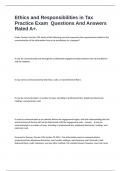
Ethics and Responsibilities in Tax
Practice Exam Questions And Answers
Rated A+.
Under Treasury Circular 230, which of the following correctly represents the requirements related to the
communication of fee information from a tax practitioner to a taxpayer?
It may be communicated only through the confidential engagement letter between the tax practitioner
and the taxpayer.
It may not be communicated by television, radio, or hand-delivered flyers.
It may be communicated in a number of ways, including in professional lists, telephone directories,
mailings, and electronic mail.
It must be communicated as an estimate before the engagement begins, with the understanding that the
actual amount of the fee will not be determined until the engagement ends. - Answer It may be
communicated in a number of ways, including in professional lists, telephone directories, mailings, and
electronic mail.
Pursuant to Treasury Circular 230, Section 10.30(c): "Fee information may be communicated in
professional lists, telephone directories, print media, mailings, and electronic mail, facsimile, hand
delivered flyers, radio, television, and any other method. The method chosen, however, must not cause
,the communication to become untruthful, deceptive, or otherwise in violation of this part. A practitioner
may not persist in attempting to contact a prospective client if the prospective client has made it known
to the practitioner that he or she does not desire to be solicited. In the case of radio and television
broadcasting, the broadcast must be recorded and the practitioner must retain a recording of the actual
transmission. In the case of direct mail and e-commerce communications, the practitioner must retain a
copy of the actual communication, along with a list or other description of persons to whom the
communication was mailed or otherwise distributed. The copy must be retained by the practitioner for a
period of at least 36 months from the date of the last transmission or use."
Hence, the communication of fee information may be communicated in a number of ways, including in
professional lists, telephone directories, mailings, and electronic mail.
In which of the following circumstances would a tax return preparer be prohibited from disclosing a
client's tax return information?
The information will be needed for a peer review.
The information will be provided in response to a court order.
The information will be provided to an IRC Section 501(c)(3) charity.
The information will be used to prepare state or local tax returns - Answer The information will be
provided to an IRC Section 501(c)(3) charity.
, IRC Section 7216 and the associated regulations govern the disclosure or use of information by preparers
of returns and provide a criminal penalty for tax return preparers who knowingly or recklessly disclose or
use tax return information for a purpose other than preparing a return.
Within the IRC Section 7216 regulations, these general rules shall not apply to any disclosure for the
following purposes, to name a few:
A quality or peer review to the extent necessary to accomplish the review
Pursuant to an order of a court or an administrative order
Used for preparation of a taxpayer's return (i.e., state or local tax returns)
Providing tax return information to an IRC Section 501(c)(3) charity is not listed as one of the reasons for
IRC Section 7216 to not apply per the regulations. Thus, a tax return preparer would be prohibited from
disclosing a client's tax return information to a Section 501(c)(3) charity.
However, there is small trick in this question: Within the IRC Section 7216 regulations, there is reference
to 501(c) organizations. There are some allowances of disclosure made in support of fundraising
activities conducted by volunteer return preparation programs or other organizations described in IRC
Section 501(c), but note that this is information coming from, and not to, a 501(c) organization.
error_outline First Time Score
Under Treasury Circular 230, in which of the following situations is a CPA prohibited from giving written
advice concerning one or more federal tax issues?
The CPA takes into account the possibility that a tax return will not be audited.
The CPA reasonably relies upon representations of the client.
Practice Exam Questions And Answers
Rated A+.
Under Treasury Circular 230, which of the following correctly represents the requirements related to the
communication of fee information from a tax practitioner to a taxpayer?
It may be communicated only through the confidential engagement letter between the tax practitioner
and the taxpayer.
It may not be communicated by television, radio, or hand-delivered flyers.
It may be communicated in a number of ways, including in professional lists, telephone directories,
mailings, and electronic mail.
It must be communicated as an estimate before the engagement begins, with the understanding that the
actual amount of the fee will not be determined until the engagement ends. - Answer It may be
communicated in a number of ways, including in professional lists, telephone directories, mailings, and
electronic mail.
Pursuant to Treasury Circular 230, Section 10.30(c): "Fee information may be communicated in
professional lists, telephone directories, print media, mailings, and electronic mail, facsimile, hand
delivered flyers, radio, television, and any other method. The method chosen, however, must not cause
,the communication to become untruthful, deceptive, or otherwise in violation of this part. A practitioner
may not persist in attempting to contact a prospective client if the prospective client has made it known
to the practitioner that he or she does not desire to be solicited. In the case of radio and television
broadcasting, the broadcast must be recorded and the practitioner must retain a recording of the actual
transmission. In the case of direct mail and e-commerce communications, the practitioner must retain a
copy of the actual communication, along with a list or other description of persons to whom the
communication was mailed or otherwise distributed. The copy must be retained by the practitioner for a
period of at least 36 months from the date of the last transmission or use."
Hence, the communication of fee information may be communicated in a number of ways, including in
professional lists, telephone directories, mailings, and electronic mail.
In which of the following circumstances would a tax return preparer be prohibited from disclosing a
client's tax return information?
The information will be needed for a peer review.
The information will be provided in response to a court order.
The information will be provided to an IRC Section 501(c)(3) charity.
The information will be used to prepare state or local tax returns - Answer The information will be
provided to an IRC Section 501(c)(3) charity.
, IRC Section 7216 and the associated regulations govern the disclosure or use of information by preparers
of returns and provide a criminal penalty for tax return preparers who knowingly or recklessly disclose or
use tax return information for a purpose other than preparing a return.
Within the IRC Section 7216 regulations, these general rules shall not apply to any disclosure for the
following purposes, to name a few:
A quality or peer review to the extent necessary to accomplish the review
Pursuant to an order of a court or an administrative order
Used for preparation of a taxpayer's return (i.e., state or local tax returns)
Providing tax return information to an IRC Section 501(c)(3) charity is not listed as one of the reasons for
IRC Section 7216 to not apply per the regulations. Thus, a tax return preparer would be prohibited from
disclosing a client's tax return information to a Section 501(c)(3) charity.
However, there is small trick in this question: Within the IRC Section 7216 regulations, there is reference
to 501(c) organizations. There are some allowances of disclosure made in support of fundraising
activities conducted by volunteer return preparation programs or other organizations described in IRC
Section 501(c), but note that this is information coming from, and not to, a 501(c) organization.
error_outline First Time Score
Under Treasury Circular 230, in which of the following situations is a CPA prohibited from giving written
advice concerning one or more federal tax issues?
The CPA takes into account the possibility that a tax return will not be audited.
The CPA reasonably relies upon representations of the client.


