2/17/25, 6:51 PM Fluid and Electrolyte Balance Exam Questions and Answers | Already Verified Answers | Graded A+ Flashcards | Quizlet
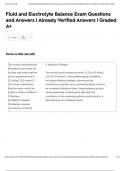
Fluid and Electrolyte Balance Exam Questions
and Answers | Already Verified Answers | Graded
A+
Save
Terms in this set (48)
The nurse is reviewing the 2. Addison's Disease
laboratory test results for
a client and notes that the The normal serum potassium level is 3.5 to 5.0 mEq/L
serum potassium level is (3.5 to 5.0 mmol/L). Many pathological conditions,
5.5 mEq/L (5.5 mmol/L). including Addison's disease, adrenocortical
The nurse understands insufficiency, anemia, burns, and ketoacidosis, result in
that this value would be an increased potassium level. Hyperkalemia can also
noted in which condition? cause abdominal cramping and diarrhea. The
1.Diarrhea conditions in the remaining options would result in a
2.Addison's disease decreased serum potassium level.
3.Diabetes insipidus
4.Dumping syndrome
https://quizlet.com/1006919373/fluid-and-electrolyte-balance-exam-questions-and-answers-already-verified-answers-graded-a-flash-cards/?new 1/33
,2/17/25, 6:51 PM Fluid and Electrolyte Balance Exam Questions and Answers | Already Verified Answers | Graded A+ Flashcards | Quizlet
A client has returned to 2. Calcium
the nursing unit after a
thyroidectomy. The nurse After surgery on the thyroid gland, the client may
notes that the client is experience a temporary calcium imbalance. This is
complaining of tingling due to transient malfunction of the parathyroid
sensations around the glands. The nurse also would assess for Chvostek's
mouth, fingers, and toes. and Trousseau's signs. The correct treatment is
On the basis of these administration of calcium gluconate or calcium
findings, the nurse should lactate. The remaining options are unrelated to the
next assess the results of client's complaints.
which serum laboratory
study?
1.Sodium
2.Calcium
3.Potassium
4.Magnesium
The nurse is reviewing the 1.Proteinuria
urinalysis results for a 2.Hematuria
client with 5.A dark and smoky appearance of the urine
glomerulonephritis. Which
findings should the nurse In the client with glomerulonephritis, characteristic
expect to note? Select all findings in the urinalysis report are gross proteinuria
that apply. and hematuria. The specific gravity is elevated, and
the urine may appear dark and smoky. Positive
1.Proteinuria ketones are not associated with this condition but may
2.Hematuria indicate a secondary problem.
3.Positive ketones
4.A low specific gravity
5.A dark and smoky
appearance of the urine
https://quizlet.com/1006919373/fluid-and-electrolyte-balance-exam-questions-and-answers-already-verified-answers-graded-a-flash-cards/?new 2/33
,2/17/25, 6:51 PM Fluid and Electrolyte Balance Exam Questions and Answers | Already Verified Answers | Graded A+ Flashcards | Quizlet
1. Thyroid
The thyroid gland is responsible for a number of
metabolic functions in the body. Among these are
A client with an endocrine metabolism of nutrients such as fats and
disorder has experienced carbohydrates. Increased metabolic function places a
recent weight loss and demand on the cardiovascular system for a higher
exhibits tachycardia. cardiac output. A client with increased activity of the
Based on the clinical thyroid gland will experience weight loss from the
manifestations, the nurse higher metabolic rate and will have an increased
should suspect pulse rate. The anterior pituitary gland produces
dysfunction of which growth hormone, luteinizing hormone, and follicle-
endocrine gland? stimulating hormone. Antidiuretic hormone (ADH) and
oxytocin are secreted by the posterior pituitary gland.
1.Thyroid Both ADH and oxytocin are synthesized by the
2.Pituitary hypothalamus and stored in the posterior pituitary
3.Parathyroid gland. These hormones are released as needed into
4.Adrenal cortex the bloodstream. Parathyroid hormone is responsible
for maintaining serum calcium and phosphorus levels
within normal range. The adrenal cortex is responsible
for the production of glucocorticoids and
mineralocorticoids.
https://quizlet.com/1006919373/fluid-and-electrolyte-balance-exam-questions-and-answers-already-verified-answers-graded-a-flash-cards/?new 3/33
, 2/17/25, 6:51 PM Fluid and Electrolyte Balance Exam Questions and Answers | Already Verified Answers | Graded A+ Flashcards | Quizlet
The nurse is planning care 1.Restrict fluids as prescribed.
for a child with hemolytic-
uremic syndrome who has Hemolytic-uremic syndrome is thought to be
been anuric and will be associated with bacterial toxins, chemicals, and
receiving peritoneal viruses that result in acute kidney injury in children.
dialysis treatment. The Clinical manifestations of the disease include acquired
nurse should plan to hemolytic anemia, thrombocytopenia, renal injury, and
implement which central nervous system symptoms. A child with
measure? hemolytic-uremic syndrome undergoing peritoneal
1.Restrict fluids as dialysis because of anuria would be on fluid
prescribed. restriction. Pain is not associated with hemolytic-
2.Care for the uremic syndrome, and potassium would be restricted,
arteriovenous fistula. not encouraged, if the child is anuric. Peritoneal
3.Encourage foods high in dialysis does not require an arteriovenous fistula (only
potassium. hemodialysis).
4.Administer analgesics as
prescribed.
https://quizlet.com/1006919373/fluid-and-electrolyte-balance-exam-questions-and-answers-already-verified-answers-graded-a-flash-cards/?new 4/33
Fluid and Electrolyte Balance Exam Questions
and Answers | Already Verified Answers | Graded
A+
Save
Terms in this set (48)
The nurse is reviewing the 2. Addison's Disease
laboratory test results for
a client and notes that the The normal serum potassium level is 3.5 to 5.0 mEq/L
serum potassium level is (3.5 to 5.0 mmol/L). Many pathological conditions,
5.5 mEq/L (5.5 mmol/L). including Addison's disease, adrenocortical
The nurse understands insufficiency, anemia, burns, and ketoacidosis, result in
that this value would be an increased potassium level. Hyperkalemia can also
noted in which condition? cause abdominal cramping and diarrhea. The
1.Diarrhea conditions in the remaining options would result in a
2.Addison's disease decreased serum potassium level.
3.Diabetes insipidus
4.Dumping syndrome
https://quizlet.com/1006919373/fluid-and-electrolyte-balance-exam-questions-and-answers-already-verified-answers-graded-a-flash-cards/?new 1/33
,2/17/25, 6:51 PM Fluid and Electrolyte Balance Exam Questions and Answers | Already Verified Answers | Graded A+ Flashcards | Quizlet
A client has returned to 2. Calcium
the nursing unit after a
thyroidectomy. The nurse After surgery on the thyroid gland, the client may
notes that the client is experience a temporary calcium imbalance. This is
complaining of tingling due to transient malfunction of the parathyroid
sensations around the glands. The nurse also would assess for Chvostek's
mouth, fingers, and toes. and Trousseau's signs. The correct treatment is
On the basis of these administration of calcium gluconate or calcium
findings, the nurse should lactate. The remaining options are unrelated to the
next assess the results of client's complaints.
which serum laboratory
study?
1.Sodium
2.Calcium
3.Potassium
4.Magnesium
The nurse is reviewing the 1.Proteinuria
urinalysis results for a 2.Hematuria
client with 5.A dark and smoky appearance of the urine
glomerulonephritis. Which
findings should the nurse In the client with glomerulonephritis, characteristic
expect to note? Select all findings in the urinalysis report are gross proteinuria
that apply. and hematuria. The specific gravity is elevated, and
the urine may appear dark and smoky. Positive
1.Proteinuria ketones are not associated with this condition but may
2.Hematuria indicate a secondary problem.
3.Positive ketones
4.A low specific gravity
5.A dark and smoky
appearance of the urine
https://quizlet.com/1006919373/fluid-and-electrolyte-balance-exam-questions-and-answers-already-verified-answers-graded-a-flash-cards/?new 2/33
,2/17/25, 6:51 PM Fluid and Electrolyte Balance Exam Questions and Answers | Already Verified Answers | Graded A+ Flashcards | Quizlet
1. Thyroid
The thyroid gland is responsible for a number of
metabolic functions in the body. Among these are
A client with an endocrine metabolism of nutrients such as fats and
disorder has experienced carbohydrates. Increased metabolic function places a
recent weight loss and demand on the cardiovascular system for a higher
exhibits tachycardia. cardiac output. A client with increased activity of the
Based on the clinical thyroid gland will experience weight loss from the
manifestations, the nurse higher metabolic rate and will have an increased
should suspect pulse rate. The anterior pituitary gland produces
dysfunction of which growth hormone, luteinizing hormone, and follicle-
endocrine gland? stimulating hormone. Antidiuretic hormone (ADH) and
oxytocin are secreted by the posterior pituitary gland.
1.Thyroid Both ADH and oxytocin are synthesized by the
2.Pituitary hypothalamus and stored in the posterior pituitary
3.Parathyroid gland. These hormones are released as needed into
4.Adrenal cortex the bloodstream. Parathyroid hormone is responsible
for maintaining serum calcium and phosphorus levels
within normal range. The adrenal cortex is responsible
for the production of glucocorticoids and
mineralocorticoids.
https://quizlet.com/1006919373/fluid-and-electrolyte-balance-exam-questions-and-answers-already-verified-answers-graded-a-flash-cards/?new 3/33
, 2/17/25, 6:51 PM Fluid and Electrolyte Balance Exam Questions and Answers | Already Verified Answers | Graded A+ Flashcards | Quizlet
The nurse is planning care 1.Restrict fluids as prescribed.
for a child with hemolytic-
uremic syndrome who has Hemolytic-uremic syndrome is thought to be
been anuric and will be associated with bacterial toxins, chemicals, and
receiving peritoneal viruses that result in acute kidney injury in children.
dialysis treatment. The Clinical manifestations of the disease include acquired
nurse should plan to hemolytic anemia, thrombocytopenia, renal injury, and
implement which central nervous system symptoms. A child with
measure? hemolytic-uremic syndrome undergoing peritoneal
1.Restrict fluids as dialysis because of anuria would be on fluid
prescribed. restriction. Pain is not associated with hemolytic-
2.Care for the uremic syndrome, and potassium would be restricted,
arteriovenous fistula. not encouraged, if the child is anuric. Peritoneal
3.Encourage foods high in dialysis does not require an arteriovenous fistula (only
potassium. hemodialysis).
4.Administer analgesics as
prescribed.
https://quizlet.com/1006919373/fluid-and-electrolyte-balance-exam-questions-and-answers-already-verified-answers-graded-a-flash-cards/?new 4/33