
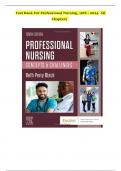
Test Bank For Professional Nursing, 10th - 2024 All
Chapters
,TEST BANK FOR
Professional Nursing: Concepts & Challenges, 10th Edition
By: Beth Black PhD, RN, FAAN (Author)
Chapter 1.Nursing in Today’s Evolving Health Care
Environment
Chapter 2.The History and Social Context of Nursing
Chapter 3.Nursing’s Pathway to Professionalism
Chapter 4.Nursing Education in an Evolving Health Care
Environment
Chapter 5.Becoming a Professional Nurse: Defining Nursing
and Socialization into Practice
Chapter 6.Nursing as a Regulated Practice: Legal Issues
Chapter 7.Ethics: Basic Concepts for Professional Nursing
Practice
Chapter 8.Conceptual and Philosophical Foundations of
Professional Nursing Practice
Chapter 9.Nursing Theory: The Basis for Professional Nursing
Chapter 10.The Science of Nursing and Evidence-Based
Practice
Chapter 11.Developing Nursing Judgment Through Critical Thinking
Chapter 12.Communication and Collaboration in Professional Nursing
Chapter 13.Nurses, Patients, and Families: Caring at the Intersection of Health, Illness, and
Culture
Chapter 14.Health Care in the United States
Chapter 15.Political Activism in Nursing: Communities, Organizations, Government
Chapter 16.Nursing Challenge: To Continue to Evolve
Chapter 1.Nursing in Today’s Evolving Health Care Environment
MULTIPLE CHOICE
1. Which of the following could eventually change the historical status of nursing as a
female- dominated profession?
a. More men graduating from baccalaureate and higher degree programs
b. The proportion of men in nursing beginning to increase
c. More male graduates of basic nursing programs entering the workplace
d. Salary compensation increasing to attract more men
ANS: C
Feedback
A More men graduating from baccalaureate and higher degree programs is not the best
answer because associate degree programs produce the most new graduates.
B The percentage of men in nursing has increased 50% since 2000.
C The more men who enter the workplace as nurses, the less nursing will be seen as a
female-dominated profession.
,D Salary rates do not appear to relate to the recruitment of men into nursing.
DIF: Cognitive Level: Comprehension REF: MCS: 2
2. The racial and ethnic composition of the nursing profession will change to more
accurately reflect the population as a whole when
a. the increased numbers of racial and ethnic minorities enrolled in educational programs
graduate and begin to practice.
b. the number of Asians or Native Hawaiian-Pacific Islanders begins to increase.
c. the percentage of African-American and Hispanic nurses decreases more than the
percentage of white nurses.
d. the nonwhite portion of the general population decreases.
ANS: A
Feedback
A A larger percentage of minorities are enrolled in nursing educational programs than
previously.
B Asians and Native Hawaiian-Pacific Islanders are over represented in nursing compared
to their percentage of the general population.
C Not only would the percentage of African-American and Hispanic nurses need to
increase, the percentage of white nurses would have to decrease in order to more
accurately reflect the population as a whole.
D The nonwhite portion of the general population is not likely to decrease.
DIF: Cognitive Level: Comprehension REF: MCS: 3
3. Which of the following is a correct statement about the registered nurse (RN) population?
a. The racial/ethnic composition of RNs closely resembles that of the general population.
b. The number of men entering nursing has decreased steadily over the last decade.
c. The rate of aging of RNs has slowed for the first time in the past 30 years.
d. The majority of employed RNs working full time must work a second position.
ANS: C
Feedback
A The racial/ethnic composition of RNs is increasing, but does not approximate their
percentage of the overall population.
B The number of men entering nursing is increasing.
C The average age of RNs in both 2004 and 2008 was 46. This is a result of the numbers of
RNs under 30 in the workforce.
D According to 2008 data, only 12% of nurses working full time hold second positions.
DIF: Cognitive Level: Knowledge REF: MCS: 3
4. Despite the variety of work settings available to the RN, data from 2008 indicate that the
primary work site for RNs is
a. ambulatory care settings.
b. community health settings.
c. long-term care facilities.
d. acute care hospitals.
ANS: D
Feedback
A Ambulatory care settings account for about 10.5% of RNs places of employment. B Public
health and community health settings account for 7.8% of employed RNs. C Long-term care
facilities account for 5.3% of RNs places of employment.
D Statistics show that 62.2% of RNs work in acute care hospitals.
, DIF: bCognitive bLevel: bKnowledge bREF: bMCS: b5
5. Which bof bthe bfollowing bbest bdescribes btrends bin bnursing beducation?
a. Numbers bof bRNs bwith bbachelors band bhigher bdegrees bare bincreasing.
b. Numbers bof bRNs bwith bassociate bdegrees bare bdecreasing.
c. Foreign-born bnurses bpracticing bin bthe bUnited bStates bare bseen bas bless
bknowledgeable bbecause bof btheir blesser beducational bpreparation.
d. Numbers bof bRNs bwith bdiploma beducations bare bincreasing.
ANS: bA
Feedback
A Slightly bover b50% bof bRNs beventually bobtain btheir bbachelors bof bscience bin bnursing
b(BSN) bor ba bhigher bnursing bdegree.
B The bmajority bof bnurses bin bthis bcountry bget btheir binitial bnursing beducation bin
bassociate bdegree bin bnursing b(ADN) bprograms.
C Foreign-born bnurses bpracticing bin bthe bUnited bStates bmay bbe bviewed bas bless
bknowledgeable bby btheir bpeers bbecause bof blanguage band bcultural bdifferences.
D The bnumbers bof bdiploma-educated bnurses bare bdeclining.
bDIF: bCognitive bLevel: bKnowledge bREF: bMCS: b4
6. One bimportant badvantage bof bclinical bladder bprograms bfor bhospital-based bRNs bis bthat bthey
a. allow bcareer badvancement bfor bnurses bwho bchoose bto bremain bat bthe bbedside.
b. encourage bnurses bto bmove binto bmanagement bpositions bin bwhich bthey bcan binfluence
bpatient bcare bon ba bbroader bscale.
c. encourage bRNs bto bbecome bpolitically bactive band bguide bthe bprofession bof bnursing.
d. provide btraining bto bstaff bnurses bso bthey bcan bmove bseamlessly bacross bdepartments.
ANS: bA
Feedback
A Clinical bladder bprograms ballow bnurses bto badvance bprofessionally bwhile bremaining bat
bthe bbedside.
B Clinical bladder bprograms bare bdesigned bto bkeep bproficient bnurses bat bthe bbedside.
C Encouraging bRNs bto bbecome bpolitically bactive band bguide bthe bprofession bof bnursing bis
bnot bthe bgoal bof bclinical bladder bprograms.
D Clinical bladder bprograms bare bnot bdesigned bto bfacilitate btransfer bbetween
bdepartments. bDIF: bCognitive bLevel: bComprehension bREF: bMCS: b7
7. Which bof bthe bfollowing bstatements bis bcorrect babout bcommunity bhealth bnursing b(CHN)?
a. Prevention band bcommunity beducation bare bthe bcornerstones bof bCHN.
b. Nursing bcare bis brapidly bmoving bfrom bthe bhome bsetting bto bthe binstitutional bsetting.
c. High-tech bcare bsuch bas bventilators band btotal bparenteral bnutrition bcannot bbe bhandled bin
bthe bhome.
d. Assessment bskills bare bless bimportant bin bCHN bbecause bpatients bare bnot bacutely bill.
ANS: bA


