
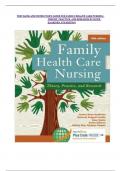
,Rowe Kaakinen, Family Health Care Nursing, 5e 1
Instructor's Guide
Introduction to the Instructor‘s Guide
Author: Deborah Padgett Coehlo, PhD, RN
Contributors: Diane Bauer, MS, RN; Kari Firestone, RN, MSN; Kathleen Bell, RN, MSN, CNM,
AHN-BC; Jane Palmieri, MSN, RN
This instructor‘s guide is designed to provide strategies for teaching family nursing to
undergraduate and graduate nursing students, and to already practicing professional nurses who
are learning to be more family focused in their nursing care. The editors of this textbook and
instructor‘s guide believe that the best nurses are those who expand their scientific knowledge
through creative and reflective thought, behavior, and experiences using evidence-based
practices. The authors of the Family Health Care Nursing: Theory, Practice and Research, fifth
edition, Instructor’s Guide utilize the University of British Columbia (UBC) model of teaching
(Thorne, Chillings, Ellis, & Perry, 1992), which incorporates activities for understanding,
reflection, behavioral experiences, and growth throughout this manual. This UBC model,
originally designed for nursing care of individuals, has been adapted for the instructor‘s guide to
be applied to families, recognizing the uniqueness of each individual family and the nursing role
in providing care during critical periods in the family life cycle. Family nurses‘ many roles assist
families in strengthening their abilities, enhancing protective strategies, sustaining strengths, and
developing positive coping strategies through therapeutic communication and holistic care. By
helping nursing faculty teach and guide undergraduate and graduate nursing students, as well as
practicing professional nurses, to explore individual and family meanings attached to health
events, the fifth edition textbook and instructor‘s guide can help shape ideas, develop trust, and
nurture therapeutic relationships between the health care system and families.
Copyright © 2015. F.A. Davis Company
,Rowe NKaakinen, NFamily NHealth NCare NNursing, 2
N5e NInstructor's NGuide
Five primary theoretical approaches are introduced and used throughout Family Health
Care Nursing: Theory, Practice and Research, fifth edition: family systems theory, family life
cycle theory, family health and illness cycle model, bioecological theory, and family assessment
and intervention model. These five theoretical approaches are applied to several case studies
within the text, to help nursing faculty demonstrate clinical applicability of critical concepts.
The instructor‘s guide is written to be adaptable into a wide range of curricular
frameworks, which include family nursing, such as stand-alone family nursing courses, and
family nursing concepts and theory as integrated within other nursing courses. In the textbook
foreword, you will note that the fifth edition of this text can be used to teach several levels of
nursing students (undergraduate or graduate), as well as practicing or graduate nurses.
Each chapter in the instructor‘s guide is similarly organized according to the following
components:
Introductory paragraph summarizing the contents of the chapter
Critical Concepts
Review of Key Terms
Quiz and Exam Questions (most chapters)
Reflection Questions
Student Learning Activities
Case Study (or multiple case studies) and Discussion Questions (most chapters)
Additionally, there are a number of appendices for the instructor‘s convenience:
Appendix A in the textbook contains the complete Family Stressor-Strength
Inventory (FS3I) tool and directions for administration and scoring.
Copyright N© N2015. NF.A. NDavis
Company
, Rowe NKaakinen, NFamily NHealth NCare NNursing, 3
N5e NInstructor's NGuide
Appendix NB Nin Nthe Ntextbook Ncontains Nthe NFreidman NFamily NAssessment NModel
(short Nform)
N
Appendix NC Nincluded Nin Nthis Ninstructor‘s Nguide Ncontains Na Nversatile Nassignment
for Neach Nchapter Ndesigned Nas Na Nstudent Nlearning Nactivity Nthat Ncan Nbe Nused Nin
N
multiple Nsettings.
N
Appendix ND Nincluded Nin Nthis Ninstructor‘s Nguide Nis Na Nmedia Nresource Nappendix
N that Nincludes Nboth Nclassic Nand Ncurrent Nbook Nand Nmovie Ntitles Nthat Ninstructors
N can Nuse Ncreatively Nthroughout Nthe Ncourse Nto Nfacilitate Nlearning, Nas Nwell Nas
N useful Ninternet Nresources Nthat Ninstructors Ncan Nuse Nacross Nchapters Nor Nunits Nin
N the Ntext. NMost Nof Nthese Nsites Nadhere Nclosely Nto Nevidence-based Npractice, Nand
N the Neditors Nintend Ninclusion Nto Nhelp Nstudents Nand Nnurses Nunderstand Nthe
N difference Nbetween Ninformation Ngleaned Nfrom Npopular Nmedia Nand Nevidence-
based Nprofessional Ninformation Nto Nsupport Ntheir Npractice.
Instructors Nusing Nthis Nguide Nare Nencouraged Nto Nread Nthe Nchapters Nin Nthe Ntext Nof
Family NHealth NCare NNursing: NTheory, NPractice Nand NResearch, Nfifth Nedition, Nbefore Nusing
N
the Nteaching Nstrategies Ndescribed Nherein. NA Nskeleton NPowerPoint Npresentation Nhas Nbeen
N
created Nfor Neach Nchapter Nin Nthe Ntext Nand Ncan Nbe Nfound Non Nthe NF.A. NDavis NWeb Nsite
N
connected Nto Nthe Nfifth Nedition Ntextbook. NThe Neditors Nstrongly Nrecommend Nthat Nfaculty
N
modify Nand Npersonalize Nthe NPowerPoint Npresentations Nto Nflesh Nthem Nout Nand Nadapt Nthem Nto
N
fit Nboth Nyour Npersonal Nteaching Nstyles Nand Nyour Nstudents‘ Nneeds.
N
PowerPoints Nare Norganized Naccording Nto Nthe Nfollowing Ncomponents:
Introduction
Copyright N© N2015. NF.A. NDavis
Company


