
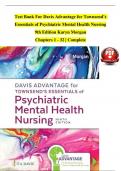
Test Bank For Davis Advantage for Townsend’s
Essentials of Psychiatric Mental Health Nursing
9th Edition Karyn Morgan
Chapters 1 - 32 | Complete
,TABLE OF CONTENTS
INTRODUCTION TO PSYCHIATRIC MENTAL HEALTH CONCEPTS
1. Mental Health and Mental Illness
2. Biological Implications
3. Ethical and Legal Issues
4. Psychopharmacology
II. PSYCHIATRIC MENTAL HEALTH NURSING INTERVENTIONS
5. Relationship Development and Therapeutic Communication
6. The Nursing Process in Psychiatric/Mental Health Nursing
7. Psychosocial Interventions and Spiritual Care
8. Intervention in Groups
9. Crisis Intervention
10. The Recovery Model
11. Suicide Prevention
III. CARE OF PATIENTS WITH PSYCHIATRIC DISORDERS
12. Caring for Patients with Mental Illness and Substance Use Disorders in General Practice Settings
13. Neurocognitive Disorders
14. Substance Use and Addiction Disorders
15. Schizophrenia Spectrum and Other Psychotic Disorders
16. Depressive Disorders
17. Bipolar and Related Disorders
18. Anxiety, Obsessive-Compulsive, and Related Disorders
19. Trauma- and Stressor-Related Disorders
20. Somatic Symptom and Dissociative Disorders
21. Eating Disorders
22. Personality Disorders
IV. PSYCHIATRIC MENTAL HEALTH NURSING OF SPECIAL POPULATIONS
23. Children and Adolescents
24. The Aging Individual
25. Survivors of Abuse or Neglect
26. Community Mental Health Nursing
27. The Bereaved Individual
28. Military Families
V. ONLINE CHAPTERS
29. Concepts of Personality Development
30. Complementary and Integrative Therapies
31. Cultural Concepts Relevant to Psychiatric Mental Health Nursing
32. Issues Related to Human Sexuality and Gender Dysphoria
,Chapter 1. Mental Health and Mental Illness
Multiple Choice
1. A nurse is assessing a client who is experiencing occasional feelings of sadness because of the
recent death of a beloved pet. The clients appetite, sleep patterns, and daily routine have not
changed. How should the nurse interpret the clients behaviors?
1. The clients behaviors demonstrate mental illness in the form of depression.
2. The clients behaviors are extensive, which indicates the presence of mental illness.
3. The clients behaviors are not congruent with cultural norms.
4. The clients behaviors demonstrate no functional impairment, indicating no mental illness.
ANSWER: 4
Rationale: The nurse should assess that the clients daily functioning is not impaired. The client
who experiences feelings of sadness after the loss of a pet is responding within normal
expectations. Without significant impairment, the clients distress does not indicate a mental
illness.
Cognitive Level: Analysis
Integrated Process: Assessment
2. At what point should the nurse determine that a client is at risk for developing a mental
illness?
1. When thoughts, feelings, and behaviors are not reflective of the DSM-5 criteria.
2. When maladaptive responses to stress are coupled with interference in daily functioning.
3. When a client communicates significant distress.
4. When a client uses defense mechanisms as ego protection.
ANSWER: 2
Rationale: The nurse should determine that the client is at risk for mental illness when responses
to stress are maladaptive and interfere with daily functioning. The DSM-5 indicates that in order
to be diagnosed with a mental illness, daily functioning must be significantly impaired. The
clients ability to communicate distress would be considered a positive attribute.
Cognitive Level: Application
Integrated Process: Assessment
3. A nurse is assessing a set of 15-year-old identical twins who respond very differently to stress.
One twin becomes anxious and irritable, and the other withdraws and cries. How should the
nurse explain these different stress responses to the parents?
1. Reactions to stress are relative rather than absolute; individual responses to stress vary.
2. It is abnormal for identical twins to react differently to similar stressors.
3. Identical twins should share the same temperament and respond similarly to stress.
4. Environmental influences to stress weigh more heavily than genetic influences.
, ANSWER: 1
Rationale: The nurse should explain to the parents that, although the twins have identical DNA,
there are several other factors that affect reactions to stress. Mental health is a state of being that
is relative to the individual client. Environmental influences and temperament can affect stress
reactions.
Cognitive Level: Application
Integrated Process: Implementation
4. Which client should the nurse anticipate to be most receptive to psychiatric treatment?
1. A Jewish, female social worker.
2. A Baptist, homeless male.
3. A Catholic, black male.
4. A Protestant, Swedish business executive.
ANSWER: 1
Rationale: The nurse should anticipate that the client of Jewish culture would place a high
importance on preventative health care and would consider mental health as equally important as
physical health. Women are also more likely to seek treatment for mental health problems than
men.
Cognitive Level: Application
Integrated Process: Planning
5. A psychiatric enurse eintern estates, eThis eclients euse eof edefense emechanisms eshould ebe
eeliminated.eWhich eis ea ecorrect e evaluation eof ethis enurses e statement?
1. Defense emechanisms ecan ebe eappropriate eresponses eto estress eand eneed enot ebe eeliminated.
2. Defense emechanisms eare ea emaladaptive eattempt eof ethe eego eto emanage eanxiety
eandshouldealways ebe e eliminated.
3. Defense emechanisms, eused eby eindividuals ewith eweak eego eintegrity, eshould ebe
ediscouragedandenot eeliminated.
4. Defense emechanisms ecause edisintegration eof ethe eego eand eshould ebe efostered eand eencouraged.
ANSWER: e1
Rationale: eThe enurse eshould edetermine ethat edefense emechanisms ecan ebe eappropriate eduring
etimeseof estress. eThe eclient ewith eno edefense emechanisms emay ehave ea elower etolerance efor
estress, ethus eleading eto eanxiety edisorders. eDefense emechanisms eshould ebe econfronted ewhen
ethey eimpede ethe eclient e from edeveloping e healthy ecoping eskills.
Cognitive eLevel: eApplication
eIntegrated eProcess:
eEvaluation
6. eDuring ean eintake eassessment, ea enurse easks eboth ephysiological eand epsychosocial
equestions. eTheeclient eangrily eresponds, eIm ehere efor emy eheart, enot emy ehead eproblems.
eWhich eis ethe enurses ebest eresponse?
1. Its ejust ea eroutine epart eof eour eassessment. eAll eclients eare easked ethese esame equestions.
2. Why eare eyou econcerned eabout ethese etypes eof equestions?
3. Psychological efactors, elike eexcessive estress, ehave ebeen efound eto eaffect emedical econditions.
4. We ecan eskip ethese equestions, eif eyou elike. eIt eisnt eimperative ethat ewe ecomplete ethis esection.
Essentials of Psychiatric Mental Health Nursing
9th Edition Karyn Morgan
Chapters 1 - 32 | Complete
,TABLE OF CONTENTS
INTRODUCTION TO PSYCHIATRIC MENTAL HEALTH CONCEPTS
1. Mental Health and Mental Illness
2. Biological Implications
3. Ethical and Legal Issues
4. Psychopharmacology
II. PSYCHIATRIC MENTAL HEALTH NURSING INTERVENTIONS
5. Relationship Development and Therapeutic Communication
6. The Nursing Process in Psychiatric/Mental Health Nursing
7. Psychosocial Interventions and Spiritual Care
8. Intervention in Groups
9. Crisis Intervention
10. The Recovery Model
11. Suicide Prevention
III. CARE OF PATIENTS WITH PSYCHIATRIC DISORDERS
12. Caring for Patients with Mental Illness and Substance Use Disorders in General Practice Settings
13. Neurocognitive Disorders
14. Substance Use and Addiction Disorders
15. Schizophrenia Spectrum and Other Psychotic Disorders
16. Depressive Disorders
17. Bipolar and Related Disorders
18. Anxiety, Obsessive-Compulsive, and Related Disorders
19. Trauma- and Stressor-Related Disorders
20. Somatic Symptom and Dissociative Disorders
21. Eating Disorders
22. Personality Disorders
IV. PSYCHIATRIC MENTAL HEALTH NURSING OF SPECIAL POPULATIONS
23. Children and Adolescents
24. The Aging Individual
25. Survivors of Abuse or Neglect
26. Community Mental Health Nursing
27. The Bereaved Individual
28. Military Families
V. ONLINE CHAPTERS
29. Concepts of Personality Development
30. Complementary and Integrative Therapies
31. Cultural Concepts Relevant to Psychiatric Mental Health Nursing
32. Issues Related to Human Sexuality and Gender Dysphoria
,Chapter 1. Mental Health and Mental Illness
Multiple Choice
1. A nurse is assessing a client who is experiencing occasional feelings of sadness because of the
recent death of a beloved pet. The clients appetite, sleep patterns, and daily routine have not
changed. How should the nurse interpret the clients behaviors?
1. The clients behaviors demonstrate mental illness in the form of depression.
2. The clients behaviors are extensive, which indicates the presence of mental illness.
3. The clients behaviors are not congruent with cultural norms.
4. The clients behaviors demonstrate no functional impairment, indicating no mental illness.
ANSWER: 4
Rationale: The nurse should assess that the clients daily functioning is not impaired. The client
who experiences feelings of sadness after the loss of a pet is responding within normal
expectations. Without significant impairment, the clients distress does not indicate a mental
illness.
Cognitive Level: Analysis
Integrated Process: Assessment
2. At what point should the nurse determine that a client is at risk for developing a mental
illness?
1. When thoughts, feelings, and behaviors are not reflective of the DSM-5 criteria.
2. When maladaptive responses to stress are coupled with interference in daily functioning.
3. When a client communicates significant distress.
4. When a client uses defense mechanisms as ego protection.
ANSWER: 2
Rationale: The nurse should determine that the client is at risk for mental illness when responses
to stress are maladaptive and interfere with daily functioning. The DSM-5 indicates that in order
to be diagnosed with a mental illness, daily functioning must be significantly impaired. The
clients ability to communicate distress would be considered a positive attribute.
Cognitive Level: Application
Integrated Process: Assessment
3. A nurse is assessing a set of 15-year-old identical twins who respond very differently to stress.
One twin becomes anxious and irritable, and the other withdraws and cries. How should the
nurse explain these different stress responses to the parents?
1. Reactions to stress are relative rather than absolute; individual responses to stress vary.
2. It is abnormal for identical twins to react differently to similar stressors.
3. Identical twins should share the same temperament and respond similarly to stress.
4. Environmental influences to stress weigh more heavily than genetic influences.
, ANSWER: 1
Rationale: The nurse should explain to the parents that, although the twins have identical DNA,
there are several other factors that affect reactions to stress. Mental health is a state of being that
is relative to the individual client. Environmental influences and temperament can affect stress
reactions.
Cognitive Level: Application
Integrated Process: Implementation
4. Which client should the nurse anticipate to be most receptive to psychiatric treatment?
1. A Jewish, female social worker.
2. A Baptist, homeless male.
3. A Catholic, black male.
4. A Protestant, Swedish business executive.
ANSWER: 1
Rationale: The nurse should anticipate that the client of Jewish culture would place a high
importance on preventative health care and would consider mental health as equally important as
physical health. Women are also more likely to seek treatment for mental health problems than
men.
Cognitive Level: Application
Integrated Process: Planning
5. A psychiatric enurse eintern estates, eThis eclients euse eof edefense emechanisms eshould ebe
eeliminated.eWhich eis ea ecorrect e evaluation eof ethis enurses e statement?
1. Defense emechanisms ecan ebe eappropriate eresponses eto estress eand eneed enot ebe eeliminated.
2. Defense emechanisms eare ea emaladaptive eattempt eof ethe eego eto emanage eanxiety
eandshouldealways ebe e eliminated.
3. Defense emechanisms, eused eby eindividuals ewith eweak eego eintegrity, eshould ebe
ediscouragedandenot eeliminated.
4. Defense emechanisms ecause edisintegration eof ethe eego eand eshould ebe efostered eand eencouraged.
ANSWER: e1
Rationale: eThe enurse eshould edetermine ethat edefense emechanisms ecan ebe eappropriate eduring
etimeseof estress. eThe eclient ewith eno edefense emechanisms emay ehave ea elower etolerance efor
estress, ethus eleading eto eanxiety edisorders. eDefense emechanisms eshould ebe econfronted ewhen
ethey eimpede ethe eclient e from edeveloping e healthy ecoping eskills.
Cognitive eLevel: eApplication
eIntegrated eProcess:
eEvaluation
6. eDuring ean eintake eassessment, ea enurse easks eboth ephysiological eand epsychosocial
equestions. eTheeclient eangrily eresponds, eIm ehere efor emy eheart, enot emy ehead eproblems.
eWhich eis ethe enurses ebest eresponse?
1. Its ejust ea eroutine epart eof eour eassessment. eAll eclients eare easked ethese esame equestions.
2. Why eare eyou econcerned eabout ethese etypes eof equestions?
3. Psychological efactors, elike eexcessive estress, ehave ebeen efound eto eaffect emedical econditions.
4. We ecan eskip ethese equestions, eif eyou elike. eIt eisnt eimperative ethat ewe ecomplete ethis esection.



