
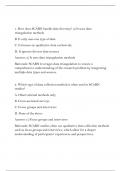
1. How does SCARN handle data diversity? a) It uses data
triangulation methods
B. It only uses one type of data
C. It focuses on qualitative data exclusively
D. It ignores diverse data sources
Answer: a) It uses data triangulation methods
Rationale: SCARN leverages data triangulation to ensure a
comprehensive understanding of the research problem by integrating
multiple data types and sources.
2. Which type of data collection method is often used in SCARN
studies?
A. Observational methods only
B. Cross-sectional surveys
C. Focus groups and interviews
D. None of the above
Answer: c) Focus groups and interviews
Rationale: SCARN studies often use qualitative data collection methods
such as focus groups and interviews, which allow for a deeper
understanding of participants' experiences and perspectives.
,3. What does the acronym SCARN stand for? a) Systematic
Collaboration in Academic Research Network
B. Structured Communication and Analytical Research Network
C. Statistical Content and Analysis Research Network
D. There is no standardized full form
Answer: d) There is no standardized full form
Rationale: SCARN does not have a universally accepted expansion but
is recognized as a methodology for research studies.
4. How is the SCARN methodology structured in terms of its stages? a)
Linear approach
B. Circular approach
C. Modular approach
D. Random approach
Answer: a) Linear approach
Rationale: SCARN follows a linear sequence of stages, starting with a
literature review and ending with conclusions and recommendations,
ensuring clarity and logical progression.
5. What kind of research design is favored in SCARN? a) Non-
experimental designs
B. Experimental designs only
C. Qualitative designs only
, D. Mixed-methods designs
Answer: d) Mixed-methods designs
Rationale: SCARN favors mixed-methods designs as they combine both
qualitative and quantitative approaches, leading to more comprehensive
research outcomes.
6. In SCARN, what does the term 'data triangulation' refer to?
A. Using a single data source to validate results
B. Analyzing data using three distinct methods or sources
C. Testing multiple hypotheses simultaneously
D. Focusing on qualitative data alone
Answer: b) Analyzing data using three distinct methods or sources
Rationale: Data triangulation involves integrating multiple data
sources or methods to provide a more comprehensive and valid
analysis.
7. Which of the following best describes a key feature of SCARN
research? a) It only focuses on qualitative data
B. It is entirely based on secondary data
C. It emphasizes structured analysis of both qualitative and quantitative
data
D. It avoids hypothesis formulation


