

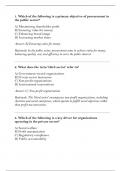
1. Which of the following is a primary objective of procurement in
the public sector?
A) Maximizing shareholder profit
B) Ensuring value for money
C) Enhancing brand image
D) Increasing market share
Answer: B) Ensuring value for money
Rationale: In the public sector, procurement aims to achieve value for money,
balancing quality, cost, and efficiency to serve the public interest.
2. What does the term 'third sector' refer to?
A) Government-owned organizations
B) Private sector businesses
C) Non-profit organizations
D) International corporations
Answer: C) Non-profit organizations
Rationale: The 'third sector' encompasses non-profit organizations, including
charities and social enterprises, which operate to fulfill social objectives rather
than profit maximization.
3. Which of the following is a key driver for organizations
operating in the private sector?
A) Social welfare
B) Profit maximization
C) Regulatory compliance
D) Public accountability
,Answer: B) Profit maximization
Rationale: Private sector organizations primarily focus on profit
maximization to ensure business sustainability and growth.
4. What is the main purpose of an Inventory Management System
(IMS)?
A) To track employee performance
B) To manage financial transactions
C) To oversee and optimize inventory levels
D) To schedule production processes
Answer: C) To oversee and optimize inventory levels
Rationale: An IMS helps organizations maintain accurate stock levels,
ensuring efficient order fulfillment and minimizing excess inventory.
5. Which of the following is a disadvantage of implementing an
Enterprise Resource Planning (ERP) system?
A) Improved data integration
B) High initial implementation costs
C) Enhanced operational efficiency
D) Streamlined business processes
Answer: B) High initial implementation costs
Rationale: While ERP systems offer numerous benefits, they often require
significant investment in software, training, and customization.
, 6. What is the primary function of Material Requirements
Planning (MRP) systems?
A) To manage financial accounting
B) To plan and control manufacturing processes
C) To oversee human resource management
D) To handle customer relationship management
Answer: B) To plan and control manufacturing processes
Rationale: MRP systems focus on ensuring that materials and components are
available for production, optimizing inventory levels, and scheduling
manufacturing activities.
7. Which of the following is a characteristic of the public sector
procurement process?
A) Profit-driven decision-making
B) Competitive tendering
C) Limited transparency
D) Minimal regulatory oversight
Answer: B) Competitive tendering
Rationale: Public sector procurement often involves competitive tendering to
ensure transparency and fairness in awarding contracts.
8. What does the term 'whole life costing' refer to in
procurement?
A) The total cost of ownership over the asset's lifespan
B) The initial purchase price of an asset
C) The cost of raw materials used in production
D) The cost of labor during the manufacturing process
the public sector?
A) Maximizing shareholder profit
B) Ensuring value for money
C) Enhancing brand image
D) Increasing market share
Answer: B) Ensuring value for money
Rationale: In the public sector, procurement aims to achieve value for money,
balancing quality, cost, and efficiency to serve the public interest.
2. What does the term 'third sector' refer to?
A) Government-owned organizations
B) Private sector businesses
C) Non-profit organizations
D) International corporations
Answer: C) Non-profit organizations
Rationale: The 'third sector' encompasses non-profit organizations, including
charities and social enterprises, which operate to fulfill social objectives rather
than profit maximization.
3. Which of the following is a key driver for organizations
operating in the private sector?
A) Social welfare
B) Profit maximization
C) Regulatory compliance
D) Public accountability
,Answer: B) Profit maximization
Rationale: Private sector organizations primarily focus on profit
maximization to ensure business sustainability and growth.
4. What is the main purpose of an Inventory Management System
(IMS)?
A) To track employee performance
B) To manage financial transactions
C) To oversee and optimize inventory levels
D) To schedule production processes
Answer: C) To oversee and optimize inventory levels
Rationale: An IMS helps organizations maintain accurate stock levels,
ensuring efficient order fulfillment and minimizing excess inventory.
5. Which of the following is a disadvantage of implementing an
Enterprise Resource Planning (ERP) system?
A) Improved data integration
B) High initial implementation costs
C) Enhanced operational efficiency
D) Streamlined business processes
Answer: B) High initial implementation costs
Rationale: While ERP systems offer numerous benefits, they often require
significant investment in software, training, and customization.
, 6. What is the primary function of Material Requirements
Planning (MRP) systems?
A) To manage financial accounting
B) To plan and control manufacturing processes
C) To oversee human resource management
D) To handle customer relationship management
Answer: B) To plan and control manufacturing processes
Rationale: MRP systems focus on ensuring that materials and components are
available for production, optimizing inventory levels, and scheduling
manufacturing activities.
7. Which of the following is a characteristic of the public sector
procurement process?
A) Profit-driven decision-making
B) Competitive tendering
C) Limited transparency
D) Minimal regulatory oversight
Answer: B) Competitive tendering
Rationale: Public sector procurement often involves competitive tendering to
ensure transparency and fairness in awarding contracts.
8. What does the term 'whole life costing' refer to in
procurement?
A) The total cost of ownership over the asset's lifespan
B) The initial purchase price of an asset
C) The cost of raw materials used in production
D) The cost of labor during the manufacturing process


