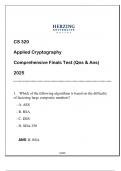
CS 320
Applied Cryptography
Comprehensive Finals Test (Qns & Ans)
2025
1. Which of the following algorithms is based on the difficulty
of factoring large composite numbers?
- A. AES
- B. RSA
- C. DES
- D. SHA-256
ANS: B. RSA
©/2025
, Rationale: RSA (Rivest–Shamir–Adleman) is a public-key
cryptosystem based on the difficulty of factoring large composite
numbers, making it secure for encryption and digital signatures.
2. What is the primary purpose of a hash function in
cryptography?
- A. Encrypting data
- B. Generating random numbers
- C. Ensuring data integrity
- D. Performing key exchange
ANS: C. Ensuring data integrity
Rationale: Hash functions are used to ensure data integrity by
producing a fixed-size hash value (digest) from input data, which
can be used to verify that the data has not been altered.
Fill-in-the-Blank Questions
3. The process of converting plaintext into ciphertext using a
cryptographic algorithm is known as __________.
ANS: encryption
©/2025
, Rationale: Encryption is the process of converting plaintext
into ciphertext using a cryptographic algorithm, making the data
unreadable to unauthorized users.
4. In symmetric-key cryptography, the same __________ is used
for both encryption and decryption.
ANS: key
Rationale: In symmetric-key cryptography, the same key is
used for both encryption and decryption, ensuring that both
parties must have the key to read the data.
True/False Questions
5. True or False: In asymmetric-key cryptography, the public
key is kept secret while the private key is shared with others.
ANS: False
Rationale: In asymmetric-key cryptography, the public key is
shared with others while the private key is kept secret to ensure
secure communication.
6. True or False: AES (Advanced Encryption Standard) is a
block cipher that uses key sizes of 128, 192, or 256 bits.
©/2025
, ANS: True
Rationale: AES is a symmetric block cipher that supports key
sizes of 128, 192, and 256 bits, providing a high level of security.
Multiple Response Questions
7. Which of the following are common uses of digital
signatures? (Select all that apply)
- A. Authenticating messages
- B. Encrypting data
- C. Ensuring non-repudiation
- D. Key exchange
ANSs: A, C
Rationale: Digital signatures are used to authenticate
messages and ensure non-repudiation, meaning the sender cannot
deny sending the message. They are not used for encrypting data
or key exchange.
8. Which of the following algorithms are examples of
symmetric-key encryption? (Select all that apply)
- A. AES
- B. DES
©/2025
Applied Cryptography
Comprehensive Finals Test (Qns & Ans)
2025
1. Which of the following algorithms is based on the difficulty
of factoring large composite numbers?
- A. AES
- B. RSA
- C. DES
- D. SHA-256
ANS: B. RSA
©/2025
, Rationale: RSA (Rivest–Shamir–Adleman) is a public-key
cryptosystem based on the difficulty of factoring large composite
numbers, making it secure for encryption and digital signatures.
2. What is the primary purpose of a hash function in
cryptography?
- A. Encrypting data
- B. Generating random numbers
- C. Ensuring data integrity
- D. Performing key exchange
ANS: C. Ensuring data integrity
Rationale: Hash functions are used to ensure data integrity by
producing a fixed-size hash value (digest) from input data, which
can be used to verify that the data has not been altered.
Fill-in-the-Blank Questions
3. The process of converting plaintext into ciphertext using a
cryptographic algorithm is known as __________.
ANS: encryption
©/2025
, Rationale: Encryption is the process of converting plaintext
into ciphertext using a cryptographic algorithm, making the data
unreadable to unauthorized users.
4. In symmetric-key cryptography, the same __________ is used
for both encryption and decryption.
ANS: key
Rationale: In symmetric-key cryptography, the same key is
used for both encryption and decryption, ensuring that both
parties must have the key to read the data.
True/False Questions
5. True or False: In asymmetric-key cryptography, the public
key is kept secret while the private key is shared with others.
ANS: False
Rationale: In asymmetric-key cryptography, the public key is
shared with others while the private key is kept secret to ensure
secure communication.
6. True or False: AES (Advanced Encryption Standard) is a
block cipher that uses key sizes of 128, 192, or 256 bits.
©/2025
, ANS: True
Rationale: AES is a symmetric block cipher that supports key
sizes of 128, 192, and 256 bits, providing a high level of security.
Multiple Response Questions
7. Which of the following are common uses of digital
signatures? (Select all that apply)
- A. Authenticating messages
- B. Encrypting data
- C. Ensuring non-repudiation
- D. Key exchange
ANSs: A, C
Rationale: Digital signatures are used to authenticate
messages and ensure non-repudiation, meaning the sender cannot
deny sending the message. They are not used for encrypting data
or key exchange.
8. Which of the following algorithms are examples of
symmetric-key encryption? (Select all that apply)
- A. AES
- B. DES
©/2025