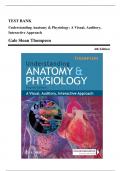
TEST BANK
Understanding Anatomy & Physiology: A Visual, Auditory,
Interactive Approach
Gale Sloan Thompson
4th Edition
,Table of Contents
Chapter 01 Orientation to the Human Body 1
Chapter 02 Chemistry of Life 8
Chapter 03 Cells 22
Chapter 04 Human Microbiome 30
Chapter 05 Tissues 38
Chapter 06 Integumentary System 51
Chapter 07 Bones & Bone Tissue 61
Chapter 08 Skeletal System 70
Chapter 09 Joints 81
Chapter 10 Muscular System 87
Chapter 11 Nervous System 97
Chapter 12 Sense Organs 114
Chapter 13 Endocrine System 122
Chapter 14 Blood 133
Chapter 15 Heart 142
Chapter 16 Vascular System 157
Chapter 17 Lymphatic & Immune Systems 176
Chapter 18 Respiratory System 188
Chapter 19 Urinary System 198
Chapter 20 Fluid, Electrolyte & Acid-Base Balance 207
Chapter 21 Digestive System 215
Chapter 22 Nutrition & Metabolism 225
Chapter 23 Reproductive Systems 237
Chapter 24 Pregnancy & Human Development 246
Chapter 25 Heredity 255
,______________________________________________________________________________________________
Test Bank - Understanding Anatomy and Physiology, 4th Edition (Thompson, 2025)
Chapter 1: Orientation to the Human Body
MATCHING
Match the name of each organ system to its key components.
a. integumentary system
b. skeletal system
c. muscular system
d. lymphatic system
e. respiratory system
f. urinary system
g. nervous system
h. endocrine system
i. circulatory system
j. digestive system
k. male reproductive system
l. female reproductive system
1. Consists of stomach, small and large intestines, liver, and pancreas
2. Consists of skin, hair, and nails
3. Consists of kidneys, ureters, urinary bladder, and urethra
4. Consists primarily of skeletal muscles
5. Consists of heart, arteries, veins, and capillaries
6. Consists of brain, spinal cord, nerves, and sense organs
7. Consists of ovaries, fallopian tubes, uterus, vagina, and breasts
8. Consists of pituitary gland, adrenals, pancreas, and thyroid
9. Consists of lymph nodes, lymphatic vessels, lymph, thymus, and spleen
10. Consists of the nose, pharynx, larynx, trachea, bronchi, and lungs
1. ANS: J PTS: 1 DIF: E KEY: REMEMBERING
2. ANS: A PTS: 1 DIF: E KEY: REMEMBERING
3. ANS: F PTS: 1 DIF: E KEY: REMEMBERING
4. ANS: C PTS: 1 DIF: E KEY: REMEMBERING
5. ANS: I PTS: 1 DIF: E KEY: REMEMBERING
6. ANS: G PTS: 1 DIF: E KEY: REMEMBERING
7. ANS: L PTS: 1 DIF: E KEY: REMEMBERING
8. ANS: H PTS: 1 DIF: E KEY: REMEMBERING
9. ANS: D PTS: 1 DIF: E KEY: REMEMBERING
10. ANS: E PTS: 1 DIF: E KEY: REMEMBERING
Match each term to its definition.
a. Distal
b. Proximal
c. Medial
d. Lateral
e. Superior
f. Inferior
g. Anterior
______________________________________________________________________________________________
1|Page
,______________________________________________________________________________________________
Test Bank - Understanding Anatomy and Physiology, 4th Edition (Thompson, 2025)
h. Posterior
i. Superficial
j. Deep
11. Toward the back of the body
12. Farthest from the point of origin
13. Above
14. At or near the body’s surface
15. Toward the body’s midline
16. Closest to the point of origin
17. Toward the front of the body
18. Below
11. ANS: H PTS: 1 DIF: E KEY: REMEMBERING
12. ANS: A PTS: 1 DIF: E KEY: REMEMBERING
13. ANS: E PTS: 1 DIF: E KEY: REMEMBERING
14. ANS: I PTS: 1 DIF: E KEY: REMEMBERING
15. ANS: C PTS: 1 DIF: E KEY: REMEMBERING
16. ANS: B PTS: 1 DIF: E KEY: REMEMBERING
17. ANS: G PTS: 1 DIF: E KEY: REMEMBERING
18. ANS: F PTS: 1 DIF: E KEY: REMEMBERING
Match each term to its location on the body.
a. Frontal
b. Deltoid
c. Brachial
d. Inguinal
e. Pectoral
f. Sternal
g. Digital
h. Antecubital
i. Buccal
j. Cephalic
k. Lumbar
l. Calcaneal
m. Plantar
n. Pedal
o. Tarsal
p. Axillary
19. Arm
20. Lower back
21. Armpit
22. Heel
23. Fingers
24. Shoulder
25. Sole of the foot
26. Forehead
27. Chest
______________________________________________________________________________________________
2|Page
,______________________________________________________________________________________________
Test Bank - Understanding Anatomy and Physiology, 4th Edition (Thompson, 2025)
28. Front of elbow
29. Foot
30. Cheek
31. Groin
32. Ankle
19. ANS: C PTS: 1 DIF: M KEY: REMEMBERING
20. ANS: K PTS: 1 DIF: M KEY: REMEMBERING
21. ANS: P PTS: 1 DIF: M KEY: REMEMBERING
22. ANS: L PTS: 1 DIF: M KEY: REMEMBERING
23. ANS: G PTS: 1 DIF: M KEY: REMEMBERING
24. ANS: B PTS: 1 DIF: M KEY: REMEMBERING
25. ANS: M PTS: 1 DIF: M KEY: REMEMBERING
26. ANS: A PTS: 1 DIF: M KEY: REMEMBERING
27. ANS: E PTS: 1 DIF: M KEY: REMEMBERING
28. ANS: H PTS: 1 DIF: M KEY: REMEMBERING
29. ANS: N PTS: 1 DIF: M KEY: REMEMBERING
30. ANS: I PTS: 1 DIF: M KEY: REMEMBERING
31. ANS: D PTS: 1 DIF: M KEY: REMEMBERING
32. ANS: O PTS: 1 DIF: M KEY: REMEMBERING
MULTIPLE CHOICE
33. Which organ system produces immune cells and has a role in fluid balance?
a. Integumentary system
b. Circulatory system
c. Endocrine system
d. Lymphatic system
ANS: D
The lymphatic system produces immune cells and has a role in fluid balance. The
integumentary system has a role in protection, temperature regulation, water retention, and
sensation. The circulatory system distributes oxygen, nutrients, water, hormones, and other
electrolytes; it also has a role in fluid and electrolyte balance. The endocrine system produces
hormones and regulates other systems.
PTS: 1 DIF: E KEY: REMEMBERING
34. Which organ system protects organs, allows for support and movement, and also plays a key
role in blood formation?
a. Circulatory system
b. Muscular system
c. Skeletal system
d. Nervous system
ANS: C
______________________________________________________________________________________________
3|Page
,______________________________________________________________________________________________
Test Bank - Understanding Anatomy and Physiology, 4th Edition (Thompson, 2025)
The skeletal system protects organs, gives the body support and allows it to move, and also
plays a role in the formation of blood cells. The circulatory system distributes oxygen,
nutrients, water, hormones, and other electrolytes; it also has a role in fluid and electrolyte
balance. The muscular system allows the body to move and produces heat. The nervous
system regulates and coordinates other systems, and also has a role in sensation and memory.
PTS: 1 DIF: E KEY: REMEMBERING
35. Which type of tissue covers the body’s surface?
a. Epithelial
b. Connective
c. Muscle
d. Nerve
ANS: A
Epithelial tissue covers the body surfaces. Connective tissue connects and supports parts of
the body. Muscle contracts to produce movement. Nerve tissue generates and transmits
impulses to regulate body function.
PTS: 1 DIF: E KEY: REMEMBERING
36. Bone, cartilage, and adipose tissue are all types of
a. epithelial tissue.
b. connective tissue.
c. muscle.
d. nerve tissue.
ANS: B
Bone, cartilage, and adipose tissue are all types of connective tissue.
PTS: 1 DIF: M KEY: UNDERSTANDING
37. The type of plane that divides the body horizontally into upper and lower portions is called a
a. sagittal plane.
b. frontal plane.
c. transverse plane.
d. coronal plane.
ANS: C
A transverse plane divides the body horizontally into upper and lower portions. A sagittal
plane divides the body lengthwise into right and left sides. A frontal plane divides the body
lengthwise into anterior and posterior positions. A coronal plane is another name for a frontal
plane.
PTS: 1 DIF: E KEY: REMEMBERING
38. Most illustrations that show the contents of the abdominal cavity use what type of plane?
a. Sagittal
b. Transverse
c. Horizontal
d. Frontal
______________________________________________________________________________________________
4|Page
,______________________________________________________________________________________________
Test Bank - Understanding Anatomy and Physiology, 4th Edition (Thompson, 2025)
ANS: D
Most illustrations that show the contents of the abdominal cavity use a frontal plane. A
sagittal plane is used to illustrate the organs of the head or pelvic cavity. A horizontal plane is
another name for a transverse plane. A transverse plane is used by computed tomography
scanners.
PTS: 1 DIF: M KEY: APPLYING
39. Which of the following correctly describes the anatomical position?
a. Standing erect, facing forward, with arms outstretched
b. Standing erect with arms at sides, palms facing backward, face and feet facing
forward
c. Standing erect with arms overhead, face and feet facing forward
d. Standing erect with arms at sides and with palms, face, and feet facing forward
ANS: D
The anatomical position involves standing erect with arms at the sides and with face, palms,
and feet facing forward.
PTS: 1 DIF: E KEY: REMEMBERING
40. The dorsal cavity contains the
a. thoracic and abdominopelvic cavities.
b. cranial and spinal cavities.
c. mediastinum and pleural cavities.
d. abdominal and pelvic cavities.
ANS: B
The dorsal cavity contains the cranial and spinal cavities. The other cavities are all contained
in the ventral cavity.
PTS: 1 DIF: M KEY: REMEMBERING
41. The heart is located in the mediastinum, which is part of what cavity?
a. Thoracic cavity
b. Dorsal cavity
c. Spinal cavity
d. Cranial cavity
ANS: A
The mediastinum is part of the thoracic cavity. The dorsal cavity is located at the back of the
body. The spinal and cranial cavities are part of the dorsal cavity.
PTS: 1 DIF: E KEY: REMEMBERING
42. A patient comes to the hospital for treatment of pain in the right hypochondriac region. Based
on the organs located in that region, which organ might be causing the pain?
a. Stomach
b. Small intestines
c. Gallbladder
______________________________________________________________________________________________
5|Page
,______________________________________________________________________________________________
Test Bank - Understanding Anatomy and Physiology, 4th Edition (Thompson, 2025)
d. Appendix
ANS: C
The gallbladder is located in the right hypochondriac region. The stomach is found in the
epigastric region. The small intestines are in the right and left lumbar regions, right and left
iliac regions, and hypogastric region. The appendix is in the right iliac region.
PTS: 1 DIF: D KEY: ANALYZING
COMPLETION
43. The structure of the body is called ________________; how it functions is called
______________.
ANS: anatomy, physiology
PTS: 1 DIF: E KEY: REMEMBERING
44. The human body is organized from the very ________________ to the very
________________.
ANS: simple, complex
PTS: 1 DIF: E KEY: REMEMBERING
45. The region proximal to the patellar region and distal to the inguinal region is the
________________ region.
ANS: femoral
PTS: 1 DIF: D KEY: APPLYING
46. The region superior to the pubic region and inferior to the abdominal region is the
________________ region.
ANS: pelvic
PTS: 1 DIF: D KEY: APPLYING
47. The two major body cavities are the ________________ and ________________ cavities.
ANS: dorsal, ventral ventral, dorsal
PTS: 1 DIF: E KEY: REMEMBERING
48. The constancy of the body’s internal environment is called ________________.
ANS: homeostasis
PTS: 1 DIF: E KEY: REMEMBERING
______________________________________________________________________________________________
6|Page
,______________________________________________________________________________________________
Test Bank - Understanding Anatomy and Physiology, 4th Edition (Thompson, 2025)
49. ________________ feedback is when an effector opposes the stimulus and reverses the
direction of change.
ANS: Negative
PTS: 1 DIF: M KEY: REMEMBERING
50. During childbirth, the hormone oxytocin is released, which causes even greater contractions
and an even greater release of oxytocin. This is an example of ________________ feedback.
ANS: positive
PTS: 1 DIF: M KEY: APPLYING
______________________________________________________________________________________________
7|Page
, ______________________________________________________________________________________________
Test Bank - Understanding Anatomy and Physiology, 4th Edition (Thompson, 2025)
Chapter 2: Chemistry of Life
MATCHING
Match each term to its definition or characteristic.
a. galactose
b. electron
c. radioactivity
d. proton
e. amino group
f. glucose
g. compounds
h. carboxyl group
i. cation
j. glycogen
k. catalyst
l. polar
m. buffer
n. anion
o. enzymes
p. matter
q. neutron
r. atomic weight
s. fructose
1. Positively charged atomic particle
2. Stored form of sugar in the human body
3. Having oppositely charged ends
4. COOH molecule
5. Atom with a positive charge
6. Substances that donate or remove H+ ions
7. Atom with a negative charge
8. Primary source of energy used by most of the body’s cells
9. Substance that enhances the rate of a chemical reaction
10. NH3 molecule
1. ANS: D PTS: 1 DIF: E KEY: REMEMBERING
2. ANS: J PTS: 1 DIF: E KEY: REMEMBERING
3. ANS: L PTS: 1 DIF: E KEY: REMEMBERING
4. ANS: H PTS: 1 DIF: E KEY: REMEMBERING
5. ANS: I PTS: 1 DIF: E KEY: REMEMBERING
6. ANS: M PTS: 1 DIF: E KEY: REMEMBERING
7. ANS: N PTS: 1 DIF: E KEY: REMEMBERING
8. ANS: F PTS: 1 DIF: E KEY: REMEMBERING
9. ANS: K PTS: 1 DIF: E KEY: REMEMBERING
10. ANS: E PTS: 1 DIF: E KEY: REMEMBERING
______________________________________________________________________________________________
8|Page
Understanding Anatomy & Physiology: A Visual, Auditory,
Interactive Approach
Gale Sloan Thompson
4th Edition
,Table of Contents
Chapter 01 Orientation to the Human Body 1
Chapter 02 Chemistry of Life 8
Chapter 03 Cells 22
Chapter 04 Human Microbiome 30
Chapter 05 Tissues 38
Chapter 06 Integumentary System 51
Chapter 07 Bones & Bone Tissue 61
Chapter 08 Skeletal System 70
Chapter 09 Joints 81
Chapter 10 Muscular System 87
Chapter 11 Nervous System 97
Chapter 12 Sense Organs 114
Chapter 13 Endocrine System 122
Chapter 14 Blood 133
Chapter 15 Heart 142
Chapter 16 Vascular System 157
Chapter 17 Lymphatic & Immune Systems 176
Chapter 18 Respiratory System 188
Chapter 19 Urinary System 198
Chapter 20 Fluid, Electrolyte & Acid-Base Balance 207
Chapter 21 Digestive System 215
Chapter 22 Nutrition & Metabolism 225
Chapter 23 Reproductive Systems 237
Chapter 24 Pregnancy & Human Development 246
Chapter 25 Heredity 255
,______________________________________________________________________________________________
Test Bank - Understanding Anatomy and Physiology, 4th Edition (Thompson, 2025)
Chapter 1: Orientation to the Human Body
MATCHING
Match the name of each organ system to its key components.
a. integumentary system
b. skeletal system
c. muscular system
d. lymphatic system
e. respiratory system
f. urinary system
g. nervous system
h. endocrine system
i. circulatory system
j. digestive system
k. male reproductive system
l. female reproductive system
1. Consists of stomach, small and large intestines, liver, and pancreas
2. Consists of skin, hair, and nails
3. Consists of kidneys, ureters, urinary bladder, and urethra
4. Consists primarily of skeletal muscles
5. Consists of heart, arteries, veins, and capillaries
6. Consists of brain, spinal cord, nerves, and sense organs
7. Consists of ovaries, fallopian tubes, uterus, vagina, and breasts
8. Consists of pituitary gland, adrenals, pancreas, and thyroid
9. Consists of lymph nodes, lymphatic vessels, lymph, thymus, and spleen
10. Consists of the nose, pharynx, larynx, trachea, bronchi, and lungs
1. ANS: J PTS: 1 DIF: E KEY: REMEMBERING
2. ANS: A PTS: 1 DIF: E KEY: REMEMBERING
3. ANS: F PTS: 1 DIF: E KEY: REMEMBERING
4. ANS: C PTS: 1 DIF: E KEY: REMEMBERING
5. ANS: I PTS: 1 DIF: E KEY: REMEMBERING
6. ANS: G PTS: 1 DIF: E KEY: REMEMBERING
7. ANS: L PTS: 1 DIF: E KEY: REMEMBERING
8. ANS: H PTS: 1 DIF: E KEY: REMEMBERING
9. ANS: D PTS: 1 DIF: E KEY: REMEMBERING
10. ANS: E PTS: 1 DIF: E KEY: REMEMBERING
Match each term to its definition.
a. Distal
b. Proximal
c. Medial
d. Lateral
e. Superior
f. Inferior
g. Anterior
______________________________________________________________________________________________
1|Page
,______________________________________________________________________________________________
Test Bank - Understanding Anatomy and Physiology, 4th Edition (Thompson, 2025)
h. Posterior
i. Superficial
j. Deep
11. Toward the back of the body
12. Farthest from the point of origin
13. Above
14. At or near the body’s surface
15. Toward the body’s midline
16. Closest to the point of origin
17. Toward the front of the body
18. Below
11. ANS: H PTS: 1 DIF: E KEY: REMEMBERING
12. ANS: A PTS: 1 DIF: E KEY: REMEMBERING
13. ANS: E PTS: 1 DIF: E KEY: REMEMBERING
14. ANS: I PTS: 1 DIF: E KEY: REMEMBERING
15. ANS: C PTS: 1 DIF: E KEY: REMEMBERING
16. ANS: B PTS: 1 DIF: E KEY: REMEMBERING
17. ANS: G PTS: 1 DIF: E KEY: REMEMBERING
18. ANS: F PTS: 1 DIF: E KEY: REMEMBERING
Match each term to its location on the body.
a. Frontal
b. Deltoid
c. Brachial
d. Inguinal
e. Pectoral
f. Sternal
g. Digital
h. Antecubital
i. Buccal
j. Cephalic
k. Lumbar
l. Calcaneal
m. Plantar
n. Pedal
o. Tarsal
p. Axillary
19. Arm
20. Lower back
21. Armpit
22. Heel
23. Fingers
24. Shoulder
25. Sole of the foot
26. Forehead
27. Chest
______________________________________________________________________________________________
2|Page
,______________________________________________________________________________________________
Test Bank - Understanding Anatomy and Physiology, 4th Edition (Thompson, 2025)
28. Front of elbow
29. Foot
30. Cheek
31. Groin
32. Ankle
19. ANS: C PTS: 1 DIF: M KEY: REMEMBERING
20. ANS: K PTS: 1 DIF: M KEY: REMEMBERING
21. ANS: P PTS: 1 DIF: M KEY: REMEMBERING
22. ANS: L PTS: 1 DIF: M KEY: REMEMBERING
23. ANS: G PTS: 1 DIF: M KEY: REMEMBERING
24. ANS: B PTS: 1 DIF: M KEY: REMEMBERING
25. ANS: M PTS: 1 DIF: M KEY: REMEMBERING
26. ANS: A PTS: 1 DIF: M KEY: REMEMBERING
27. ANS: E PTS: 1 DIF: M KEY: REMEMBERING
28. ANS: H PTS: 1 DIF: M KEY: REMEMBERING
29. ANS: N PTS: 1 DIF: M KEY: REMEMBERING
30. ANS: I PTS: 1 DIF: M KEY: REMEMBERING
31. ANS: D PTS: 1 DIF: M KEY: REMEMBERING
32. ANS: O PTS: 1 DIF: M KEY: REMEMBERING
MULTIPLE CHOICE
33. Which organ system produces immune cells and has a role in fluid balance?
a. Integumentary system
b. Circulatory system
c. Endocrine system
d. Lymphatic system
ANS: D
The lymphatic system produces immune cells and has a role in fluid balance. The
integumentary system has a role in protection, temperature regulation, water retention, and
sensation. The circulatory system distributes oxygen, nutrients, water, hormones, and other
electrolytes; it also has a role in fluid and electrolyte balance. The endocrine system produces
hormones and regulates other systems.
PTS: 1 DIF: E KEY: REMEMBERING
34. Which organ system protects organs, allows for support and movement, and also plays a key
role in blood formation?
a. Circulatory system
b. Muscular system
c. Skeletal system
d. Nervous system
ANS: C
______________________________________________________________________________________________
3|Page
,______________________________________________________________________________________________
Test Bank - Understanding Anatomy and Physiology, 4th Edition (Thompson, 2025)
The skeletal system protects organs, gives the body support and allows it to move, and also
plays a role in the formation of blood cells. The circulatory system distributes oxygen,
nutrients, water, hormones, and other electrolytes; it also has a role in fluid and electrolyte
balance. The muscular system allows the body to move and produces heat. The nervous
system regulates and coordinates other systems, and also has a role in sensation and memory.
PTS: 1 DIF: E KEY: REMEMBERING
35. Which type of tissue covers the body’s surface?
a. Epithelial
b. Connective
c. Muscle
d. Nerve
ANS: A
Epithelial tissue covers the body surfaces. Connective tissue connects and supports parts of
the body. Muscle contracts to produce movement. Nerve tissue generates and transmits
impulses to regulate body function.
PTS: 1 DIF: E KEY: REMEMBERING
36. Bone, cartilage, and adipose tissue are all types of
a. epithelial tissue.
b. connective tissue.
c. muscle.
d. nerve tissue.
ANS: B
Bone, cartilage, and adipose tissue are all types of connective tissue.
PTS: 1 DIF: M KEY: UNDERSTANDING
37. The type of plane that divides the body horizontally into upper and lower portions is called a
a. sagittal plane.
b. frontal plane.
c. transverse plane.
d. coronal plane.
ANS: C
A transverse plane divides the body horizontally into upper and lower portions. A sagittal
plane divides the body lengthwise into right and left sides. A frontal plane divides the body
lengthwise into anterior and posterior positions. A coronal plane is another name for a frontal
plane.
PTS: 1 DIF: E KEY: REMEMBERING
38. Most illustrations that show the contents of the abdominal cavity use what type of plane?
a. Sagittal
b. Transverse
c. Horizontal
d. Frontal
______________________________________________________________________________________________
4|Page
,______________________________________________________________________________________________
Test Bank - Understanding Anatomy and Physiology, 4th Edition (Thompson, 2025)
ANS: D
Most illustrations that show the contents of the abdominal cavity use a frontal plane. A
sagittal plane is used to illustrate the organs of the head or pelvic cavity. A horizontal plane is
another name for a transverse plane. A transverse plane is used by computed tomography
scanners.
PTS: 1 DIF: M KEY: APPLYING
39. Which of the following correctly describes the anatomical position?
a. Standing erect, facing forward, with arms outstretched
b. Standing erect with arms at sides, palms facing backward, face and feet facing
forward
c. Standing erect with arms overhead, face and feet facing forward
d. Standing erect with arms at sides and with palms, face, and feet facing forward
ANS: D
The anatomical position involves standing erect with arms at the sides and with face, palms,
and feet facing forward.
PTS: 1 DIF: E KEY: REMEMBERING
40. The dorsal cavity contains the
a. thoracic and abdominopelvic cavities.
b. cranial and spinal cavities.
c. mediastinum and pleural cavities.
d. abdominal and pelvic cavities.
ANS: B
The dorsal cavity contains the cranial and spinal cavities. The other cavities are all contained
in the ventral cavity.
PTS: 1 DIF: M KEY: REMEMBERING
41. The heart is located in the mediastinum, which is part of what cavity?
a. Thoracic cavity
b. Dorsal cavity
c. Spinal cavity
d. Cranial cavity
ANS: A
The mediastinum is part of the thoracic cavity. The dorsal cavity is located at the back of the
body. The spinal and cranial cavities are part of the dorsal cavity.
PTS: 1 DIF: E KEY: REMEMBERING
42. A patient comes to the hospital for treatment of pain in the right hypochondriac region. Based
on the organs located in that region, which organ might be causing the pain?
a. Stomach
b. Small intestines
c. Gallbladder
______________________________________________________________________________________________
5|Page
,______________________________________________________________________________________________
Test Bank - Understanding Anatomy and Physiology, 4th Edition (Thompson, 2025)
d. Appendix
ANS: C
The gallbladder is located in the right hypochondriac region. The stomach is found in the
epigastric region. The small intestines are in the right and left lumbar regions, right and left
iliac regions, and hypogastric region. The appendix is in the right iliac region.
PTS: 1 DIF: D KEY: ANALYZING
COMPLETION
43. The structure of the body is called ________________; how it functions is called
______________.
ANS: anatomy, physiology
PTS: 1 DIF: E KEY: REMEMBERING
44. The human body is organized from the very ________________ to the very
________________.
ANS: simple, complex
PTS: 1 DIF: E KEY: REMEMBERING
45. The region proximal to the patellar region and distal to the inguinal region is the
________________ region.
ANS: femoral
PTS: 1 DIF: D KEY: APPLYING
46. The region superior to the pubic region and inferior to the abdominal region is the
________________ region.
ANS: pelvic
PTS: 1 DIF: D KEY: APPLYING
47. The two major body cavities are the ________________ and ________________ cavities.
ANS: dorsal, ventral ventral, dorsal
PTS: 1 DIF: E KEY: REMEMBERING
48. The constancy of the body’s internal environment is called ________________.
ANS: homeostasis
PTS: 1 DIF: E KEY: REMEMBERING
______________________________________________________________________________________________
6|Page
,______________________________________________________________________________________________
Test Bank - Understanding Anatomy and Physiology, 4th Edition (Thompson, 2025)
49. ________________ feedback is when an effector opposes the stimulus and reverses the
direction of change.
ANS: Negative
PTS: 1 DIF: M KEY: REMEMBERING
50. During childbirth, the hormone oxytocin is released, which causes even greater contractions
and an even greater release of oxytocin. This is an example of ________________ feedback.
ANS: positive
PTS: 1 DIF: M KEY: APPLYING
______________________________________________________________________________________________
7|Page
, ______________________________________________________________________________________________
Test Bank - Understanding Anatomy and Physiology, 4th Edition (Thompson, 2025)
Chapter 2: Chemistry of Life
MATCHING
Match each term to its definition or characteristic.
a. galactose
b. electron
c. radioactivity
d. proton
e. amino group
f. glucose
g. compounds
h. carboxyl group
i. cation
j. glycogen
k. catalyst
l. polar
m. buffer
n. anion
o. enzymes
p. matter
q. neutron
r. atomic weight
s. fructose
1. Positively charged atomic particle
2. Stored form of sugar in the human body
3. Having oppositely charged ends
4. COOH molecule
5. Atom with a positive charge
6. Substances that donate or remove H+ ions
7. Atom with a negative charge
8. Primary source of energy used by most of the body’s cells
9. Substance that enhances the rate of a chemical reaction
10. NH3 molecule
1. ANS: D PTS: 1 DIF: E KEY: REMEMBERING
2. ANS: J PTS: 1 DIF: E KEY: REMEMBERING
3. ANS: L PTS: 1 DIF: E KEY: REMEMBERING
4. ANS: H PTS: 1 DIF: E KEY: REMEMBERING
5. ANS: I PTS: 1 DIF: E KEY: REMEMBERING
6. ANS: M PTS: 1 DIF: E KEY: REMEMBERING
7. ANS: N PTS: 1 DIF: E KEY: REMEMBERING
8. ANS: F PTS: 1 DIF: E KEY: REMEMBERING
9. ANS: K PTS: 1 DIF: E KEY: REMEMBERING
10. ANS: E PTS: 1 DIF: E KEY: REMEMBERING
______________________________________________________________________________________________
8|Page