
A1.2: NUCLEIC ACIDS
Gaia Theory: all the world works as an individual organism.
DNA & RNA: allow storage of genetic hereditary information.
DNA → tells amino acids how to make proteins. Blueprint for living things.
RNA → “copy” of DNA (1 column)
Nucleic acids and their structure
DNA as the genetic material of all living organisms
DNA → deoxyribonucleic acid
↪ polymer (combined monomers) that contains our genes, that will
code our characteristics
DNA = nucleic acid
Nucleic acids → chain of repeating monomers called nucleotides
Nucleotides join together by a condensation reaction called
polymerisation
Two types of nucleic acids in living organisms:
DNA RNA
Deoxyribonucleic acid Ribonucleic acid
- Double helix - Single-stranded
- CGTA - CGAU
- Deoxyribose (-1 oxygen) - Ribose (+1 oxygen)
, DNA = genetic material of all living organisms
Viruses → not considered living organisms, they need a host to replicate. Most use RNA
Components of a nucleotide
Structure of DNA and RNA is very similar → both made of nucleotide monomers
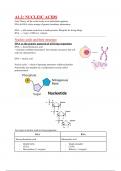
These nucleotides have 3 components:
● Pentose sugar = simple sugar made of 5 carbons
● Nitrogenous base = contains nitrogen and acts as a base
● Phosphate group = functional group made up of phosphorus and oxygen
Sugar-phosphate bonding
Nucleotide units are linked through covalent bonds to form a single strand of
DNA/RNA. Bonds form between:
● Phosphate group attached to the 5’C of one pentose sugar
● Hydroxyl group (-OH) attached to the 3’C of another sugar
↪ 1 H2O molecule is released
The linking of nucleotides creates a continuous chain of covalently bonded atoms
in each strand of DNA and RNA nucleotides, which forms a strong
sugar–phosphate backbone in the polymer of DNA and RNA.
Linking also creates two ends: 5’ end and 3’ end
Gaia Theory: all the world works as an individual organism.
DNA & RNA: allow storage of genetic hereditary information.
DNA → tells amino acids how to make proteins. Blueprint for living things.
RNA → “copy” of DNA (1 column)
Nucleic acids and their structure
DNA as the genetic material of all living organisms
DNA → deoxyribonucleic acid
↪ polymer (combined monomers) that contains our genes, that will
code our characteristics
DNA = nucleic acid
Nucleic acids → chain of repeating monomers called nucleotides
Nucleotides join together by a condensation reaction called
polymerisation
Two types of nucleic acids in living organisms:
DNA RNA
Deoxyribonucleic acid Ribonucleic acid
- Double helix - Single-stranded
- CGTA - CGAU
- Deoxyribose (-1 oxygen) - Ribose (+1 oxygen)
, DNA = genetic material of all living organisms
Viruses → not considered living organisms, they need a host to replicate. Most use RNA
Components of a nucleotide
Structure of DNA and RNA is very similar → both made of nucleotide monomers
These nucleotides have 3 components:
● Pentose sugar = simple sugar made of 5 carbons
● Nitrogenous base = contains nitrogen and acts as a base
● Phosphate group = functional group made up of phosphorus and oxygen
Sugar-phosphate bonding
Nucleotide units are linked through covalent bonds to form a single strand of
DNA/RNA. Bonds form between:
● Phosphate group attached to the 5’C of one pentose sugar
● Hydroxyl group (-OH) attached to the 3’C of another sugar
↪ 1 H2O molecule is released
The linking of nucleotides creates a continuous chain of covalently bonded atoms
in each strand of DNA and RNA nucleotides, which forms a strong
sugar–phosphate backbone in the polymer of DNA and RNA.
Linking also creates two ends: 5’ end and 3’ end


