
A1.1: WATER
Every aspect of our existence depends on water:
● Site for metabolism → it works as a solvent due to its polarity
● Inner material of cells
● Transport
● Chemical reactions
● Etc
Water = polar → can solve other polar molecules
H2O properties emerge from its structure:
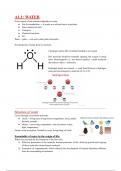
2 hydrogen atoms (H) covalently bonded to an oxygen
H2O molecule should be neutrally charged, but oxygen is much
more electronegative (e- not shared equally) = polar molecule
that attracts other e - molecules
Hydrogen bonds are created → weak bond between a hydrogen
atom and electronegative molecule (N, O or F)
Structure of water
Cycles through everywhere and links:
● biotic = living/once-living factors (organisms): moss, plants,
bacteria, animals…
● abiotic = non-living components of an ecosystem: water,
light, temperature…
Factors in an ecosystem. Needed by every living thing on Earth.
Essentiality of water in the origin of life:
Water was essential for the formation of the first cells
1) Effective interaction of the naturally formed molecules of life, allowing growth and copying
of these molecules (water-based reactions)
2) Formation of compartments, which allowed the development of internal chemistry different
from the surrounding environment
, Living things have never stopped needing water:
● Cell’s cytoplasm (water-based)
● Metabolism (cell-based chemical reactions) need water
● Plasma membrane only works in watery environments
Water was needed to origin life and remains essential as the medium where life processes take place,
due to water’s solvent properties. Also, deep water gave place to the first organisms to be created
away from the harming UV light from the Sun when there still wasn’t atmosphere.
Chemical structure of water:
1O + covalent bond + 2H = H2O
Pair of e- in each covalent bond → not shared equally (due to O’s electronegativity)
Polarity of H2O molecule
Electronegativity is influenced by:
● Number of protons in nucleus → p+ attract e-
● Number of orbitals in the atom → more orbital levels will decrease the pull on the shared e-
because they will be further away from the nucleus, and the e- in between will shield them
O = more electronegative → attracts shared electrons more strongly than H atoms
↪ O attracts more e-, so it has a partial negative
charge = polar covalent bond
Bonding between water molecules:
Positive H side of one water molecule → attracted
to negative O of other water
↪ hydrogen bond holds the 2 molecules together
H-bonds are weak, and reform rapidly with other
water molecules
Cohesion:
Cohesion → when “like” molecules are mutually attracted
Water → highly cohesive due to hydrogen bonding
Every aspect of our existence depends on water:
● Site for metabolism → it works as a solvent due to its polarity
● Inner material of cells
● Transport
● Chemical reactions
● Etc
Water = polar → can solve other polar molecules
H2O properties emerge from its structure:
2 hydrogen atoms (H) covalently bonded to an oxygen
H2O molecule should be neutrally charged, but oxygen is much
more electronegative (e- not shared equally) = polar molecule
that attracts other e - molecules
Hydrogen bonds are created → weak bond between a hydrogen
atom and electronegative molecule (N, O or F)
Structure of water
Cycles through everywhere and links:
● biotic = living/once-living factors (organisms): moss, plants,
bacteria, animals…
● abiotic = non-living components of an ecosystem: water,
light, temperature…
Factors in an ecosystem. Needed by every living thing on Earth.
Essentiality of water in the origin of life:
Water was essential for the formation of the first cells
1) Effective interaction of the naturally formed molecules of life, allowing growth and copying
of these molecules (water-based reactions)
2) Formation of compartments, which allowed the development of internal chemistry different
from the surrounding environment
, Living things have never stopped needing water:
● Cell’s cytoplasm (water-based)
● Metabolism (cell-based chemical reactions) need water
● Plasma membrane only works in watery environments
Water was needed to origin life and remains essential as the medium where life processes take place,
due to water’s solvent properties. Also, deep water gave place to the first organisms to be created
away from the harming UV light from the Sun when there still wasn’t atmosphere.
Chemical structure of water:
1O + covalent bond + 2H = H2O
Pair of e- in each covalent bond → not shared equally (due to O’s electronegativity)
Polarity of H2O molecule
Electronegativity is influenced by:
● Number of protons in nucleus → p+ attract e-
● Number of orbitals in the atom → more orbital levels will decrease the pull on the shared e-
because they will be further away from the nucleus, and the e- in between will shield them
O = more electronegative → attracts shared electrons more strongly than H atoms
↪ O attracts more e-, so it has a partial negative
charge = polar covalent bond
Bonding between water molecules:
Positive H side of one water molecule → attracted
to negative O of other water
↪ hydrogen bond holds the 2 molecules together
H-bonds are weak, and reform rapidly with other
water molecules
Cohesion:
Cohesion → when “like” molecules are mutually attracted
Water → highly cohesive due to hydrogen bonding


