4PAHPDFF Psychology and the Individual Week 3
BSc Psychology Year 1 Evaluating Theories of Personality
EVALUATING THEORIES OF
PERSONALITY
EXPLAIN THE KEY COMPONENTS OF THE EVALUATION
FRAMEWORK
THE EVALUATION FRAMEWORK
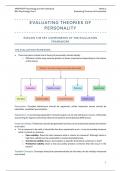
• There are basic criteria that a theory of personality should satisfy
o Different criteria may assume greater or lesser importance depending on the nature
of the theory
Description: Complex behaviours should be organised, whilst important issues should be
identified, simplified and clarified.
Explanation: A convincing explanation should be given as to why behaviour occurs, effectively
accounting for typical commonly observed instances and individual differences.
Empirical Validity: Predictions should be generated so they can be empirically tested and shown
to be valid.
• For a measure to be valid, it should be free from systematic error – it can accurately measure
what it intends to measure
o Face validity: Does the test measure what it claims to measure? Although tests in
high face validity can be vulnerable to social desirability bias
o Construct validity: Does a test capture a specific theoretical construct or trait?
o Predictive validity: Does a test accurately predict a criterion that will occur in the
future?
Testable Concepts: Concepts should be operationalised so that they can be reliably measured
and tested.
1
, 4PAHPDFF Psychology and the Individual Week 3
BSc Psychology Year 1 Evaluating Theories of Personality
• Reliability means free from unsystematic error – the degree to which a tool produces stable
and consistent results
o Test-retest reliability: Does the test give similar results at different times?
o Parallel forms: Do equivalent test forms yield the same answer?
o Split-half reliability: Considers all possible ways to divide the test into two halves
and computes the average inter-item correlation – Cronbach’s alpha
Comprehensiveness: A broad range of normal and abnormal behaviours should be considered,
while also setting boundaries and determining which behaviours are important to highlight.
Parsimony (Simplicity): All concepts should be shown to be necessary for explaining the relevant
phenomena, while also being sufficient to adequately explain the data. Being broad enough to
cover personality, while remaining simple enough to be useful.
Heuristic Value: The theory should stimulate interest, ideas and new research.
Applied Value: The practical usefulness of the theory should be judged, leading to beneficial
changes and application within a wider context.
Other Considerations
• The philosophical views of humans' inherent nature
o For example, a theory that conceptualises humans as inherently aggressive or
destructive will have different impacts than one that views humans as loving and kind
• The relevant influence of internal and external determinants of behaviour
o For example, framing determinants as unconscious, conscious, or external can lead
to different consequences, whether good or bad
• The theory's perspective on the influence of the past, present, and future on behaviour
o For example, a theory suggesting that working through past trauma can be beneficial
contrasts with another theory suggesting that this would be more disturbing
• How well the theory can account for both common behaviours and individual differences,
including how behaviour integrates and adapts to inconsistencies
o For example, why the same person may act confidently in one situation but anxiously
in another
Cultural Contexts
• While the same characteristics of personality are identifiable across cultures, the way they
are expressed as personality types can differ by culture
o For example, in Chinese, there is no exact word for what English describes as an
‘artistic individual’
• Culture can also influence which personality types are valued
o Western cultures tend to value ambitious and driven individuals, while in collectivist
societies, they tend to prioritise cooperativeness and harmony
• Theories and clinical treatments can be influenced by culture
o Individualistic cultures may tend to focus more on the individual and meeting that
individual’s needs with the self at the core, whilst collectivist cultures may aim to
emphasise family and social appropriateness
2
BSc Psychology Year 1 Evaluating Theories of Personality
EVALUATING THEORIES OF
PERSONALITY
EXPLAIN THE KEY COMPONENTS OF THE EVALUATION
FRAMEWORK
THE EVALUATION FRAMEWORK
• There are basic criteria that a theory of personality should satisfy
o Different criteria may assume greater or lesser importance depending on the nature
of the theory
Description: Complex behaviours should be organised, whilst important issues should be
identified, simplified and clarified.
Explanation: A convincing explanation should be given as to why behaviour occurs, effectively
accounting for typical commonly observed instances and individual differences.
Empirical Validity: Predictions should be generated so they can be empirically tested and shown
to be valid.
• For a measure to be valid, it should be free from systematic error – it can accurately measure
what it intends to measure
o Face validity: Does the test measure what it claims to measure? Although tests in
high face validity can be vulnerable to social desirability bias
o Construct validity: Does a test capture a specific theoretical construct or trait?
o Predictive validity: Does a test accurately predict a criterion that will occur in the
future?
Testable Concepts: Concepts should be operationalised so that they can be reliably measured
and tested.
1
, 4PAHPDFF Psychology and the Individual Week 3
BSc Psychology Year 1 Evaluating Theories of Personality
• Reliability means free from unsystematic error – the degree to which a tool produces stable
and consistent results
o Test-retest reliability: Does the test give similar results at different times?
o Parallel forms: Do equivalent test forms yield the same answer?
o Split-half reliability: Considers all possible ways to divide the test into two halves
and computes the average inter-item correlation – Cronbach’s alpha
Comprehensiveness: A broad range of normal and abnormal behaviours should be considered,
while also setting boundaries and determining which behaviours are important to highlight.
Parsimony (Simplicity): All concepts should be shown to be necessary for explaining the relevant
phenomena, while also being sufficient to adequately explain the data. Being broad enough to
cover personality, while remaining simple enough to be useful.
Heuristic Value: The theory should stimulate interest, ideas and new research.
Applied Value: The practical usefulness of the theory should be judged, leading to beneficial
changes and application within a wider context.
Other Considerations
• The philosophical views of humans' inherent nature
o For example, a theory that conceptualises humans as inherently aggressive or
destructive will have different impacts than one that views humans as loving and kind
• The relevant influence of internal and external determinants of behaviour
o For example, framing determinants as unconscious, conscious, or external can lead
to different consequences, whether good or bad
• The theory's perspective on the influence of the past, present, and future on behaviour
o For example, a theory suggesting that working through past trauma can be beneficial
contrasts with another theory suggesting that this would be more disturbing
• How well the theory can account for both common behaviours and individual differences,
including how behaviour integrates and adapts to inconsistencies
o For example, why the same person may act confidently in one situation but anxiously
in another
Cultural Contexts
• While the same characteristics of personality are identifiable across cultures, the way they
are expressed as personality types can differ by culture
o For example, in Chinese, there is no exact word for what English describes as an
‘artistic individual’
• Culture can also influence which personality types are valued
o Western cultures tend to value ambitious and driven individuals, while in collectivist
societies, they tend to prioritise cooperativeness and harmony
• Theories and clinical treatments can be influenced by culture
o Individualistic cultures may tend to focus more on the individual and meeting that
individual’s needs with the self at the core, whilst collectivist cultures may aim to
emphasise family and social appropriateness
2