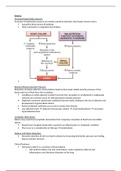
Edema
Increased hydrostatic pressure
Increases in hydrostatic pressure are mainly caused by disorders that impair venous return.
Caused by deep venous thrombosis
Most commonly in congestive heart failure
Reduced Plasma Osmotic Pressure
Reduction of plasma albumin concentrations leads to decreased colloid osmotic pressure of the
blood and loss of fluid from the circulation
Conditions in which albumin is either lost from the circulation or synthesized in inadequate
amounts are common cause of reduced plasma osmotic pressure
Nephrotic syndrome: glomerular capillaries become leaky, leading to the loss of albumin and
development of generalized edema
Reduced albumin synthesis occurs due to severe liver disease
Low albumin levels reduced intravascular volume renal hypoperfusion secondary
hyperaldosteronism
Lymphatic Obstruction
Edema may result from lymphatic obstruction that comprises resorption of fluid form interstitial
spaces.
Results from localized obstruction caused by an inflammatory or neoplastic condition
May occur as a complication of therapy lymphedema
Sodium and Water Retention
Excessive retention of salt can lead to edema by increasing hydrostatic pressure and reding
plasma osmotic pressure
Clinical Features
Pulmonary edema is a common clinical problem
o Left ventricle failure, but also renal failure, acute respiratory distress and
inflammatory and infections disorders of the lung
, o Can cause death by interfering with normal ventilatory function
Brain edema is life threating
o If the swelling is severe, the brain can herniate (extrude) through the foramen
magnum.
o Increased intracranial pressure, the brain stem vascular supply can be compressed,
leading to death due to injury to the medullary centers controlling respiratory and
other vital functions
Hemorrhage
Hemorrhage, defined as the extravasation of blood from vessels, is most often the result of damage
to blood vessels or defective clot formation.
Trauma, atherosclerosis or inflammatory of neo-plastic erosion of vessel wall also may lead
to hemorrhage, which may be extensive if the affected vessel is large vein or artery
Different appearances and clinical consequences
o Hematoma
Trivial to fatal
Large bleeding into body cavities are described variously according to
location
Can result in jaundice from massive breakdown of red cells and hemoglobin
o Petechiae (1-2 mm)
Skin, mucous membranes, or serosal surfaces
Causes low platelet count, defective platelet function and loss of vascular
wall support
o Purpura (3 to 5 mm)
Causes low platelet count, defective platelet function and loss of vascular
wall support
Also, by trauma, vascular inflammation and increased vascular fragility
o Ecchymoses (1 to 2 cm)
Subcutaneous hematomas
Extravasated red cells are phagocytosed and degraded by macrophages
Color changes of hemoglobin (red-blue color) to bilirubin (blue-green color)
and eventually hemosiderin (golden-brown)
Clinical significance depends on volume of blood that is lost and the rate of bleeding
o Greater losses can cause hemorrhagic (hypovolemic) shock
Location of bleeding is important for clinical significance
o Bleeding in the brain can cause death
Chronic or recurrent external blood loss culminates in iron deficiency as a consequence of a
loss of iron in hemoglobin
Hemostasis and Thrombosis
Normal Hemostasis
Hemostasis is a precisely orchestrated process involving platelets, clotting factors, and endothelium
that occurs at the site of vascular injury and culminates in the formation of a blood clot, which served
to prevent or limit the extent of bleeding.
Arteriolar vasoconstriction
o Reduced blood flow to the injured area
o Reflex neurogenic mechanisms and augmented by local secretion factors
o Effect is transient bleeding would resume activation of platelets and
coagulation factors
Primary hemostasis: the formation of the platelet plug
o vWF and collagen promotion of platelet adherence and activation
Increased hydrostatic pressure
Increases in hydrostatic pressure are mainly caused by disorders that impair venous return.
Caused by deep venous thrombosis
Most commonly in congestive heart failure
Reduced Plasma Osmotic Pressure
Reduction of plasma albumin concentrations leads to decreased colloid osmotic pressure of the
blood and loss of fluid from the circulation
Conditions in which albumin is either lost from the circulation or synthesized in inadequate
amounts are common cause of reduced plasma osmotic pressure
Nephrotic syndrome: glomerular capillaries become leaky, leading to the loss of albumin and
development of generalized edema
Reduced albumin synthesis occurs due to severe liver disease
Low albumin levels reduced intravascular volume renal hypoperfusion secondary
hyperaldosteronism
Lymphatic Obstruction
Edema may result from lymphatic obstruction that comprises resorption of fluid form interstitial
spaces.
Results from localized obstruction caused by an inflammatory or neoplastic condition
May occur as a complication of therapy lymphedema
Sodium and Water Retention
Excessive retention of salt can lead to edema by increasing hydrostatic pressure and reding
plasma osmotic pressure
Clinical Features
Pulmonary edema is a common clinical problem
o Left ventricle failure, but also renal failure, acute respiratory distress and
inflammatory and infections disorders of the lung
, o Can cause death by interfering with normal ventilatory function
Brain edema is life threating
o If the swelling is severe, the brain can herniate (extrude) through the foramen
magnum.
o Increased intracranial pressure, the brain stem vascular supply can be compressed,
leading to death due to injury to the medullary centers controlling respiratory and
other vital functions
Hemorrhage
Hemorrhage, defined as the extravasation of blood from vessels, is most often the result of damage
to blood vessels or defective clot formation.
Trauma, atherosclerosis or inflammatory of neo-plastic erosion of vessel wall also may lead
to hemorrhage, which may be extensive if the affected vessel is large vein or artery
Different appearances and clinical consequences
o Hematoma
Trivial to fatal
Large bleeding into body cavities are described variously according to
location
Can result in jaundice from massive breakdown of red cells and hemoglobin
o Petechiae (1-2 mm)
Skin, mucous membranes, or serosal surfaces
Causes low platelet count, defective platelet function and loss of vascular
wall support
o Purpura (3 to 5 mm)
Causes low platelet count, defective platelet function and loss of vascular
wall support
Also, by trauma, vascular inflammation and increased vascular fragility
o Ecchymoses (1 to 2 cm)
Subcutaneous hematomas
Extravasated red cells are phagocytosed and degraded by macrophages
Color changes of hemoglobin (red-blue color) to bilirubin (blue-green color)
and eventually hemosiderin (golden-brown)
Clinical significance depends on volume of blood that is lost and the rate of bleeding
o Greater losses can cause hemorrhagic (hypovolemic) shock
Location of bleeding is important for clinical significance
o Bleeding in the brain can cause death
Chronic or recurrent external blood loss culminates in iron deficiency as a consequence of a
loss of iron in hemoglobin
Hemostasis and Thrombosis
Normal Hemostasis
Hemostasis is a precisely orchestrated process involving platelets, clotting factors, and endothelium
that occurs at the site of vascular injury and culminates in the formation of a blood clot, which served
to prevent or limit the extent of bleeding.
Arteriolar vasoconstriction
o Reduced blood flow to the injured area
o Reflex neurogenic mechanisms and augmented by local secretion factors
o Effect is transient bleeding would resume activation of platelets and
coagulation factors
Primary hemostasis: the formation of the platelet plug
o vWF and collagen promotion of platelet adherence and activation