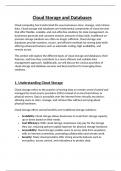
Cloud Storage and Databases
Cloud computing has transformed the way businesses store, manage, and retrieve
data. Cloud storage and databases are fundamental components of cloud services
that offer flexible, scalable, and cost-effective solutions for data management. As
businesses generate and consume massive amounts of data daily, traditional on-
premise storage solutions are often no longer sufficient. Cloud storage and
databases provide seamless, secure, and efficient methods for storing data while
offering enhanced features such as automatic scaling, high availability, and
remote access.
This section will explore the different types of cloud storage and databases, their
features, and how they contribute to a more efficient and scalable data
management approach. Additionally, we will discuss the various providers of
cloud storage and database services and best practices for leveraging these
solutions.
1. Understanding Cloud Storage
Cloud storage refers to the practice of storing data on remote servers hosted and
managed by cloud service providers (CSPs) instead of on local hard drives or
physical servers. Data is accessible over the internet from virtually any device,
allowing users to store, manage, and retrieve files without worrying about
physical hardware.
Cloud storage offers several benefits over traditional storage solutions:
Scalability: Cloud storage allows businesses to scale their storage capacity
up or down based on their needs.
Cost Efficiency: With cloud storage, businesses only pay for the storage
they use, reducing upfront capital expenses for physical storage hardware.
Accessibility: Cloud storage enables users to access data from anywhere
with an internet connection, promoting collaboration and remote work.
Security: Many cloud providers offer strong security features such as
encryption, access control, and redundancy to protect data.
, Types of Cloud Storage: Cloud storage solutions can be broadly categorized into
several types, each designed for specific use cases.
a) Object Storage: Object storage is designed to store large amounts of
unstructured data, such as media files, backups, and log files. In object storage,
data is stored as objects, each containing the data itself, metadata, and a unique
identifier. Object storage is highly scalable and suitable for storing massive
datasets with low-latency access.
Popular providers of object storage include:
Amazon S3 (Simple Storage Service): A widely used object storage service
offering high scalability, durability, and low-cost data storage.
Google Cloud Storage: A cloud-based storage service that supports a
variety of data types and offers performance optimizations.
Microsoft Azure Blob Storage: Object storage designed for storing massive
amounts of unstructured data, with support for high-performance
scenarios.
b) Block Storage: Block storage divides data into fixed-size blocks and stores them
separately, allowing for higher performance and lower-latency access. Block
storage is ideal for applications that require high input/output operations per
second (IOPS), such as databases and virtual machines (VMs). Unlike object
storage, block storage can be directly attached to a server or VM, allowing for
more flexibility in managing data.
Popular providers of block storage include:
Amazon EBS (Elastic Block Store): A scalable block storage service designed
for use with Amazon EC2 instances.
Google Persistent Disks: A high-performance block storage service
integrated with Google Cloud Compute Engine instances.
Azure Managed Disks: A cloud-based block storage service for virtual
machines in Microsoft Azure.
c) File Storage: File storage is used to store data in a hierarchical file system,
similar to traditional on-premise file systems. File storage is suitable for use cases
where users need to access files using standard file protocols like NFS or SMB.
Cloud computing has transformed the way businesses store, manage, and retrieve
data. Cloud storage and databases are fundamental components of cloud services
that offer flexible, scalable, and cost-effective solutions for data management. As
businesses generate and consume massive amounts of data daily, traditional on-
premise storage solutions are often no longer sufficient. Cloud storage and
databases provide seamless, secure, and efficient methods for storing data while
offering enhanced features such as automatic scaling, high availability, and
remote access.
This section will explore the different types of cloud storage and databases, their
features, and how they contribute to a more efficient and scalable data
management approach. Additionally, we will discuss the various providers of
cloud storage and database services and best practices for leveraging these
solutions.
1. Understanding Cloud Storage
Cloud storage refers to the practice of storing data on remote servers hosted and
managed by cloud service providers (CSPs) instead of on local hard drives or
physical servers. Data is accessible over the internet from virtually any device,
allowing users to store, manage, and retrieve files without worrying about
physical hardware.
Cloud storage offers several benefits over traditional storage solutions:
Scalability: Cloud storage allows businesses to scale their storage capacity
up or down based on their needs.
Cost Efficiency: With cloud storage, businesses only pay for the storage
they use, reducing upfront capital expenses for physical storage hardware.
Accessibility: Cloud storage enables users to access data from anywhere
with an internet connection, promoting collaboration and remote work.
Security: Many cloud providers offer strong security features such as
encryption, access control, and redundancy to protect data.
, Types of Cloud Storage: Cloud storage solutions can be broadly categorized into
several types, each designed for specific use cases.
a) Object Storage: Object storage is designed to store large amounts of
unstructured data, such as media files, backups, and log files. In object storage,
data is stored as objects, each containing the data itself, metadata, and a unique
identifier. Object storage is highly scalable and suitable for storing massive
datasets with low-latency access.
Popular providers of object storage include:
Amazon S3 (Simple Storage Service): A widely used object storage service
offering high scalability, durability, and low-cost data storage.
Google Cloud Storage: A cloud-based storage service that supports a
variety of data types and offers performance optimizations.
Microsoft Azure Blob Storage: Object storage designed for storing massive
amounts of unstructured data, with support for high-performance
scenarios.
b) Block Storage: Block storage divides data into fixed-size blocks and stores them
separately, allowing for higher performance and lower-latency access. Block
storage is ideal for applications that require high input/output operations per
second (IOPS), such as databases and virtual machines (VMs). Unlike object
storage, block storage can be directly attached to a server or VM, allowing for
more flexibility in managing data.
Popular providers of block storage include:
Amazon EBS (Elastic Block Store): A scalable block storage service designed
for use with Amazon EC2 instances.
Google Persistent Disks: A high-performance block storage service
integrated with Google Cloud Compute Engine instances.
Azure Managed Disks: A cloud-based block storage service for virtual
machines in Microsoft Azure.
c) File Storage: File storage is used to store data in a hierarchical file system,
similar to traditional on-premise file systems. File storage is suitable for use cases
where users need to access files using standard file protocols like NFS or SMB.