ATI TEAS 7 BIOLOGY REVIEW
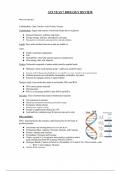
Macromolecules: Carbohydrate, Lipid, Nucleic Acid, Protein, Enzyme Carbohydrate: Sugars and starches which body breaks down to glucose ● Structural function: cellulose and chitin ● Energy storage: amylose, amylopectin, glycogen ● Recognition molecules: glycoproteins and glycolipids Lipids: Fatty acids and their derivatives that are soluble in water ● H and C and main components ● Fats ● Hydrophobic- thus help separate aqueous compartments ● Store energy (fats, oils, adipose) Protein: Molecules composed of amino acids joined by peptide bonds ● Monomer: amino acids (amino group + carboxylic acid)(20 types) ● Keratin and Collagen (hydrophobic)- not soluble in water, found in structural protein ● Globular proteins are hydrophilic (hemoglobin, antibodies, enzymes) ● Function as transport carries or signal transfer Nucleic Acids: Long molecules made of nucleotides; DNA and RNA ● DNA stores genetic material ● Chromosomes ● RNA is a messenger (mRNA) also rRNA and tRNA Enzymes: Class of protein that catalyze biochemical reactions ● Not consumed in reaction ● Speed up reaction by lowering activation energy ● Exergonic: release energy ● Endergonic: require energy ● Energy is supplied and released as ATP ● Lock and Key (substrate must fit into enzymes active site) DNA and RNA DNA: macromolecule that contains coded instructions for the body to produce proteins ● Nucleotide: the building block of DNA and RNA ● Nitrogenous Base: Adenine, Thymine, Guanine, and Cytosine ● Purines: Adenine and Guanine ● Pyrimidines: Thymine and Cytosine ● Codon: Agroup of 3 nitrogenous bases used to synthesize amino acids (Synthesized from RNA during TRANSLATION) ● Hydrogen Bonds: Connect a Purine to a Pyrimidine (A-T) and (C-G). Non-covalent, weak. o RNA: Uracil replaces Thymine ● Double Helix structure ● Coded or read 5'→3' ● Sugar(pentose)-Phosphate backbone (deoxyribose and phosphate group- bound to 4 oxygen atoms) DNA Replication DNA Helicase: Unzips and Unwinds DNA strand DNA Primase: Generates RNA Primer. Act as a template for starting point of DNA Replication DNA Polymerase: Synthesize new DNA molecules by adding nucleotides to leading and lagging DNA strands in 5'→3' direction Topoisomerase: Prevents supercoiling DNA Ligase: Joins DNA fragments together by forming phosphodiester bonds between nucleotides Okazaki Fragment: Short, newly synthesized DNA fragments that are formed on the lagging strand Single Strand Binding Protein: Stabilize structure during replication Leading Strand: Replicated continuously in the 3' to 5' direction Lagging Strand: Replicated discontinuously in short sections o Anaphase o Telophase o Cytokinesis ● Mitosis = “daughter cell” exact replica o Interphase (G1, S, G2) o Prophase o Metaphase Cell Cycle ● Meiosis = “daughter cells” different genetic coding o Only happens in gametes* o 1st phase ● chromosomes cross over ● genetic material exchanged ● tetrads of 4 chromatids formed □ Homologous pairs of chromatids are separated and go to different poles □2 cells go through 2nd cell division □ 4 daughter cells with different sets of chromosomes ● Haploid : contains half genetic material of parent cell ● Zygote- controls cell differentiation Tissues ¾ groups of cells ¾ Muscle, nerve, epithelial, connective 1. Epithelial: (joined together tightly) ex. Skin 2. Connective: (dense, loose, or fatty) ex. Bone tissue, cartilage, tendons, ligaments, fat, blood, lymph □Protects & binds body parts a. Cartilage: cushions & provides structural support i. Fibrous b. Blood: transports oxygen to cells & removes waste / ALSO carries hormones & defends against disease c. Bone: (hard) produces red blood cells 3. Muscle: Support & move body a. Smooth b. Cardiac c. Skeletal 4. Nervous: ex. Brain, spinal cord, & nerves a. Neurons- control responses to changes in environment Organs ¾ groups of tissues ex. Heart = muscle tissue in myocardium; connective tissue in blood; nervous tissue for heart rate; epithelial tissue in membranes Organ Systems ¾ groups of organs 1. Integumentary (Exocrine system) a. Skin i. Sebaceous glands sweat glands ii. Hair iii. Nails b. Protection i. Protects body from pathogens c. Secretion i. Secrete oil d. Communication i. Sensory receptors send info. about pain, touch, pressure, and temperature LAYERS OF THE SKIN 1. Epidermis a. Most superficial layer of skin b. Epithelial cells **Does not contain any blood vessels c. Stratum basale i. deepest portion ii. single layer of cells iii. keratinized 1. waxy protein waterproofs skin 2. Dermis a. Mostly connective tissue b. Blood vessels, sensory receptors, hair follicles, sebaceous glands, sweat glands 2 c. Elastin and collagen fibers 3. Subcutaneous layer/ Hypodermis a. Connective tissue i. Binds skin to muscle b. Fat deposits cushion and insulate TEMPERATURE HOMEOSTASIS ¾ skin is involved in temperature homeostasis through sweat glands a. Controlled by negative feedback system a. Receptor i. Sensory cells in dermis of skin b. Control center i. Hypothalamus c. Effector i. Sweat glands, blood vessels, and muscles (shivering) ii. Evaporation of sweat cools body iii. Vasodilation of blood vessels release heat into environment to lower body temperature SEBACEOUS VS SWEAT GLANDS a. Both exocrine glands a. Secrete substances into ducts i. Through ducts to the surface of the skin 1. Sebaceous glands a. Holocrine glands i. Secrete sebum 1. Oily mixture of lipids and proteins b. Connected to hair follicles and secrete sebum through hair pore 1. Sweat glands a. Eccrine or apocrine glands i. Eccrine glands: not connected to hair follicles 1. Secrete salty solution 2. Forehead, neck, back 3. Activated by elevated body temperature ii. Apocrine glands 1. Secrete oily solution 2. Armpits, groin, palms, soles of feet 3. Activated by stress or anxiety 2. Respiratory a. Structure i. UPPER: Nose, nasal cavity, mouth, pharynx (throat), larynx (voice box) ii. LOWER: trachea (windpipe), lungs, bronchial tree iii. Airway: lined with cilia that sweep debris back towards mouth iv. Lungs: (bronchi & bronchial network ---alveoli) v. RIGHT LUNG: 3 lobes vi. LEFT LUNG: 2 lobes vii. MUSCLES 1. Diaphragm a. Dome-shaped b. Separates thoracic & abdominal cavities 2. Intercostal muscles a. Between ribs b. Function i. Supply body w/ oxygen by alveoli ii. Filters air (warmed, moistened, & filtered before reaching lungs) iii. Speech (air moves through larynx □ produces sound □ trachea iv. Smell 1. Chemoreceptors (in nasal cavity) respond to chemicals v. BREATHING PROCESS (controlled by medulla oblongata) 1. Diaphragm & intercostal muscles expand □increase size of chest cavity 2. Volume chest cavity increases = pressure inside decreases 3. Outside air (high pressure); Air in lungs (low pressure) □ air goes in lungs 4. Muscles relax □ air leaves lungs 3. Cardiovascular ● BLOOD o Red blood cells ▪ Transport oxygen to cells ▪ Form in bone marrow o White blood cells ▪ Defend against infection ● Lymphocytes ● Neutrophils ● Monocytes ● Eosinophils ● Basophils o Platelets ▪ Blood clotting o Plasma ▪ half blood volume ▪ mostly water/ serves as a solvent ▪ contains plasma proteins, ions, glucose, amino acids, hormones, & dissolved gas ● BLOOD VESSELS ● HEART o 4 chambers ▪ each half = atrium & ventricle ● AV valve separates halves o between ventricle & artery leading away from heart ● keep blood moving in single direction o Cardiac cycle ▪ Atrial contraction = fills ventricles ▪ Ventricular contraction = empties ventricles ▪ 1st DIASTOLE PHASE ● Blood flows through superior & inferior venae cavae ● (heart relaxed) atrium □ tricuspid valve □ right ventricle ● SA node (pacemaker wall of right atrium) generates signals (carried by Purkinje fibers) to rest of atrium ● Contracts & fills right ventricle w/ blood ● Impulse from SA node transmitted to ventricle through AV node ● Signals the right ventricle to contract & initiate 1st systole phase ▪ 1st SYSTOLE PHASE ● Tricuspid valve closes□ Pulmonary semilunar valve opens ● Blood is pumped out the pulmonary arteries to lungs ▪ 2nd DIASTOLE PHASE ● Blood returning from lungs fills left atrium ● SA node triggers mitral valve to open □ Blood fills left ventricle ▪ 2nd SYSTOLE PHASE ● Mitral valve closes □ Aortic semilunar valve opens ● Left ventricle contracts □ blood is pumped out of aorta to rest of body o Types of Circulation ▪ Coronary: Flow of blood to heart ● Coronary arteries □ aorta (supplying major arteries) □ enter heart w/ oxygenated blood ● Deoxygenated blood returns to right atrium through cardiac veins (empty into the coronary sinus) ▪ Pulmonary: flow of blood between the heart & lungs ● Deoxygenated blood flows from right ventricle to the lungs through pulmonary arteries ● Oxygenated blood flows back to the left atrium through pulmonary veins ▪ Systemic: flow of blood to entire body ● blood exits left ventricle through aorta □ branches into the carotid arteries, subclavian arteries, common iliac arteries, & renal artery ● blood returns to heart through jugular veins, subclavian veins, common iliac veins, & renal veins □ empty into superior & inferior venaecavae o Portal circulation: flow of blood from digestive system to the liver & then back to the heart o Renal circulation: flow of blood between the heart & kidneys o Blood Pressure ¾fluid pressure generated by the cardiac cycle ▪ Functions by transporting oxygen-poor blood into the lungs & oxygen-rich blood to body tissues ▪ Arteries branch into smaller arterioles which contract & expand based on body signals ▪ Arterioles are where adjustments are made in blood delivery to specific areas based on complex communication from body systems ● Capillary beds: diffusion sites for exchanged between blood and interstitial fluid o has the thinnest wall of any blood vessel (single layer endothelial cells) 4. Endocrine ¾secrete hormones that help regulate body a. Endocrine system and nervous system work closely together i. Hypothalamus + pituitary gland = neuroendocrine control center ii. MAJOR ENDOCRINE GLANDS 1. Adrenal cortex a. Monitors blood sugar level b. Helps in protein & lipid metabolism 2. Adrenal medulla a. Controls cardiac function b. Raises blood sugar c. Controls size of blood vessels 3. Thyroid gland a. Regulate metabolism b. Functions in growth/development 4. Parathyroid a. Regulates calcium levels in blood 5. Pancreas islets a. Raises and lowers blood sugar b. Active in carbohydrate metabolism 6. Thymus gland a. Role in immune responses 7. Pineal gland a. Influence on daily biorhythms and sexual activity 8. Pituitary gland a. Growth and development ENDOCRINE FUNCTIONS OF PANCREAS a. Islets of Langerhans i. groups of endocrine cells ii. insulin-producing beta cells and glucagon-releasing alpha cells b. Hormones (pancreas) i. Insulin 1. Control carbohydrate metabolism a. Lowering blood sugar 2. Affects fat metabolism ii. Glucagon 1. Control carbohydrate metabolism a. Increase blood sugar THYROID & PARATHYROID GLANDS a. Parathyroid glands i. 4 small glands ii. secrete parathyroid hormone 1. increase blood calcium b. Thyroid gland i. regulate metabolism ii. secretes 1. Thyroxine a. Increase metabolism 2. Triiodothyronine a. Increase metabolism 3. Calcitonin a. Decreases blood calcium c. Hypothalamus i. directs pituitary gland to secrete TSH 1. stimulates the thyroid gland to release these hormones as needed
Document information
- Uploaded on
- February 6, 2025
- Number of pages
- 55
- Written in
- 2024/2025
- Type
- Exam (elaborations)
- Contains
- Questions & answers