
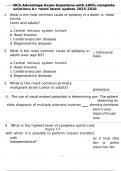
NCS Advantage Exam Questions with 100% complete
solutions A+ rated latest update 2025-2026
1. What is the most common cause of epilepsy in a doles- b. Head
trauma
cents and adults?
a. Central nervous system tumors
b. Head trauma
c. Cerebrovascular disease
d. Degenerative disease
2. What is the most common cause of epilepsy in c. Cerebrovascular
adults over age 65? disease
a. Central nervous system tumors
b. Head trauma
c. Cerebrovascular disease
d. Degenerative disease
3. What is the most common primary
malignant brain tumor in adults?
glioblastoma
4. The use of visual evoked potentials in determining pos- The patient
observing an
sible diagnosis of multiple sclerosis involves . alternating checkerboard
pattern to assess
integrity of the optic
nerve
5. What is the highest level of complete spinal cord
injury C7
with which it is possible to perform uneven transfers
with use of triceps allows
independence? them to perform
uneven trans- fers
, NCS Advantage Exam Questions with 100% complete
solutions A+ rated latest update 2025-2026
6. Which type of hematoma requires the most immediate epidrual
medical interventions?
occurs between dura
, NCS Advantage Exam Questions with 100% complete
solutions A+ rated latest update 2025-2026
mater and skull - can
lead to increased ICP
and com- press brain
tissue
7. All of the following are causes of knee hyperextension c. Dorsiflexor
weakness
at mid and terminal stance except:
a. Hip extensor weakness The ankle dorsiflexors
b. Impaired proprioception are inactive during
c. Dorsiflexor weakness mid and terminal
d. Quadriceps weakness stance. During these
phases of gait, the
ankle plantarflexors
are active to stabilize
the knee. Therefore,
ankle dorsiflex- or
weakness will not di-
rectly impact knee
8. A 46-year-old male with left hemiparesis position during mid
due to a and terminal stance.
The patient has < 3+/5
stroke six months ago presents to an outpatient phys- quadriceps
strength which
ical therapy clinic. The patient is currently a. KAFO
using a wheelchair for all mobility. b. Rigid AFO
Examination findings on the left lower c. Articulatin
extremity include: grossly 3/5 strength, g AFO
diminished proprioception at the ankle, and with
range of motion within functional limits. Which dorsiflexio
n assist
orthosis would be best for this patient?
d. Articulatin
g AFO
, NCS Advantage Exam Questions with 100% complete
solutions A+ rated latest update 2025-2026
with plantarflexion stop suggests the need for
a KAFO as determined
9.
by the Rancho
R.O.A.D.M.A.P.
KAFO - given more in-
formation about
strength on opposite
side, etc the rigid AFO
may have been a
choice...
solutions A+ rated latest update 2025-2026
1. What is the most common cause of epilepsy in a doles- b. Head
trauma
cents and adults?
a. Central nervous system tumors
b. Head trauma
c. Cerebrovascular disease
d. Degenerative disease
2. What is the most common cause of epilepsy in c. Cerebrovascular
adults over age 65? disease
a. Central nervous system tumors
b. Head trauma
c. Cerebrovascular disease
d. Degenerative disease
3. What is the most common primary
malignant brain tumor in adults?
glioblastoma
4. The use of visual evoked potentials in determining pos- The patient
observing an
sible diagnosis of multiple sclerosis involves . alternating checkerboard
pattern to assess
integrity of the optic
nerve
5. What is the highest level of complete spinal cord
injury C7
with which it is possible to perform uneven transfers
with use of triceps allows
independence? them to perform
uneven trans- fers
, NCS Advantage Exam Questions with 100% complete
solutions A+ rated latest update 2025-2026
6. Which type of hematoma requires the most immediate epidrual
medical interventions?
occurs between dura
, NCS Advantage Exam Questions with 100% complete
solutions A+ rated latest update 2025-2026
mater and skull - can
lead to increased ICP
and com- press brain
tissue
7. All of the following are causes of knee hyperextension c. Dorsiflexor
weakness
at mid and terminal stance except:
a. Hip extensor weakness The ankle dorsiflexors
b. Impaired proprioception are inactive during
c. Dorsiflexor weakness mid and terminal
d. Quadriceps weakness stance. During these
phases of gait, the
ankle plantarflexors
are active to stabilize
the knee. Therefore,
ankle dorsiflex- or
weakness will not di-
rectly impact knee
8. A 46-year-old male with left hemiparesis position during mid
due to a and terminal stance.
The patient has < 3+/5
stroke six months ago presents to an outpatient phys- quadriceps
strength which
ical therapy clinic. The patient is currently a. KAFO
using a wheelchair for all mobility. b. Rigid AFO
Examination findings on the left lower c. Articulatin
extremity include: grossly 3/5 strength, g AFO
diminished proprioception at the ankle, and with
range of motion within functional limits. Which dorsiflexio
n assist
orthosis would be best for this patient?
d. Articulatin
g AFO
, NCS Advantage Exam Questions with 100% complete
solutions A+ rated latest update 2025-2026
with plantarflexion stop suggests the need for
a KAFO as determined
9.
by the Rancho
R.O.A.D.M.A.P.
KAFO - given more in-
formation about
strength on opposite
side, etc the rigid AFO
may have been a
choice...


