

NR 509 Final Exam
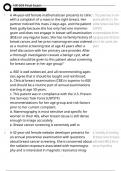
1. A 44-year-old female mathematician presents to clinic c. This patient was in com-
with a complaint of a mass in the right breast. Her pliance with the U.S. Pre-
partner noticed this mass 2 days ago, and the patient ventive Services Task Force
feels guilty because she has only had one mammo- (USPSTF)
gram and does not engage in breast self-examination recommendations for her
(BSE) on any regular basis. She has no family history of age group and risk factors
breast cancer, and her prior mammogram was ordered prior to her current com-
as a routine screening test at age 43 years after a plaint.
brief discussion with her primary care provider. After
a thorough investigation reveals a benign cyst, what
advice should be given to this patient about screening
for breast cancer in her age group?
a. BSE is well evidenced, and all recommending agen-
cies agree that it should be taught and reinforced.
b. Clinical breast examination (CBE) is superior to BSE
and should be a routine part of annual examinations
starting at age 30 years.
c. This patient was in compliance with the U.S. Preven-
tive Services Task Force (USPSTF)
recommendations for her age group and risk factors
prior to her current complaint.
d. Mammography is most sensitive and specific for
women in their 40s, when breast tissue is still dense
enough to image accurately.
e. Breast cancer screening is extremely well st
2. A 42-year-old female website developer presents for b. Sensitivity of screening
an annual preventive examination with questions for breast cancer increases
about breast cancer screening. She is concerned about with breast MRI at the ex-
the radiation exposure associated with mammogra- pense of specificity.
phy and is interested in magnetic resonance imag-
, NR 509 Final Exam
ing (MRI) as a possible alternative for routine screen-
ing. She is otherwise healthy with no family history of
breast, ovarian, or colon cancer. Which of the following
is true about MRI as a screening modality for breast
cancer in the general population?
a. Breast cancer screening by MRI has been well stud-
ied in the general population.
b. Sensitivity of screening for breast cancer increases
with breast MRI at the expense of specificity.
c. This patient is an ideal candidate for screening via
breast MRI based on current evidence
d. Women at low lifetime risk of breast cancer (<20%)
are recommended to undergo screening MRI.
e. Known BRCA1 or BRCA2 mutation is insufficient cri-
teria to justify screening with breast MRI.
3. A 35-year-old G0P0 woman presents to clinic with a e. Prolactinoma
complaint of bilateral nipple discharge. This discharge
started several weeks ago and has occurred at irregu-
lar intervals since that time. She does not complain of
local tenderness, redness, fever, or any other systemic
symptoms aside from slightly irregular periods over
the last few months. On examination, she is able to
express a small amount of discharge, which is sent to
the laboratory and found to be consistent with breast
milk but without any signs of blood or pus. Screening
laboratories are also sent, which reveal a normal blood
count, metabolic panel, thyroid-stimulating hormone,
and human chorionic gonadotropin (HCG) level. Fur-
ther laboratories are still pending. Which of the follow-
ing is the most likely diagnosis?
, NR 509 Final Exam
a. Mastitis
b. Ductal carcinoma in situ
c. Paget disease of the breast
d. Occult pregnancy
e. Prolactinoma
4. A 22-year-old G0P0 undergraduate student presents b. This patient is more like-
to clinic after finding a breast mass on breast self-ex- ly to find a fibroadenoma
amination (BSE) at home. The mass is nontender with- than a cancer on self-ex-
out skin changes, erythema, or overlying swelling. She amination.
has heard that most breast cancers are found by pa-
tients themselves, and she is very concerned that she
may have breast cancer. Which of the following is true
about BSE and self-detection of breast cancer?
a. Most masses that women find at home and bring to
a provider's attention turn out to be malignant.
b. This patient is more likely to find a fibroadenoma
than a cancer on self-examination.
c. The most likely breast mass this patient is likely to
find in herself is an abscess complicating underlying
mastitis.
d. Because of this patient's age, breast masses should
not be pursued with imaging and diagnosis because
the risk of cancer is so low.
e. BSE is universally recommended because of very
high sensitivity and specificity for finding cancerous
lesions.
5. A 48-year-old female psychologist presents to clinic
with concerns about her breast cancer risk after an
, NR 509 Final Exam
age-matched cousin was recently diagnosed with this d. This patient carries sev-
disease. This cousin is the third family member on her eral risk factors that to-
father's side in as many years to be diagnosed with gether justify BRCA testing.
breast cancer, including the patient's own father, who
had surgery and subsequent treatment 3 years ago for
breast cancer. The patient has little other knowledge
of her family history, only that her grandparents inde-
pendently arrived from Eastern Europe near the end
of World War II and were among very few members of
their family that survived the war. The patient has read
about testing for the breast cancer genes (BRCA1 and
BRCA2) and desires further information about whether
this would be appropriate for her. Which of the fol-
lowing is true about this patient's indications for BRCA
testing?
a. Her familial lineage is irrelevant to her risk of BRCA
genes and should be discounted in assessing her risk
for these genes.
b. Breast cancer in a male relative does not add signifi-
cant weight to the decision to test for the BRCA genes
in this patient.
c. The BRCAPRO calculator does not add any further
clinical information to this patient
6. A 68-year-old former paleontologist presents to clinic c. Regardless of rec-
with concerns about her breast cancer risk. Her moth- ommendations, the high
er developed the disease in her 50s and died from it in sensitivity of breast MRI
her 60s. A younger cousin developed the disease a few comes at the expense of
years ago before the age of 50 years, but this individual markedlydecreased speci-
was not tested for the BRCA1 and ficity (i.e., the ability to
BRCA2 genes. In addition, the patient suffered from
1. A 44-year-old female mathematician presents to clinic c. This patient was in com-
with a complaint of a mass in the right breast. Her pliance with the U.S. Pre-
partner noticed this mass 2 days ago, and the patient ventive Services Task Force
feels guilty because she has only had one mammo- (USPSTF)
gram and does not engage in breast self-examination recommendations for her
(BSE) on any regular basis. She has no family history of age group and risk factors
breast cancer, and her prior mammogram was ordered prior to her current com-
as a routine screening test at age 43 years after a plaint.
brief discussion with her primary care provider. After
a thorough investigation reveals a benign cyst, what
advice should be given to this patient about screening
for breast cancer in her age group?
a. BSE is well evidenced, and all recommending agen-
cies agree that it should be taught and reinforced.
b. Clinical breast examination (CBE) is superior to BSE
and should be a routine part of annual examinations
starting at age 30 years.
c. This patient was in compliance with the U.S. Preven-
tive Services Task Force (USPSTF)
recommendations for her age group and risk factors
prior to her current complaint.
d. Mammography is most sensitive and specific for
women in their 40s, when breast tissue is still dense
enough to image accurately.
e. Breast cancer screening is extremely well st
2. A 42-year-old female website developer presents for b. Sensitivity of screening
an annual preventive examination with questions for breast cancer increases
about breast cancer screening. She is concerned about with breast MRI at the ex-
the radiation exposure associated with mammogra- pense of specificity.
phy and is interested in magnetic resonance imag-
, NR 509 Final Exam
ing (MRI) as a possible alternative for routine screen-
ing. She is otherwise healthy with no family history of
breast, ovarian, or colon cancer. Which of the following
is true about MRI as a screening modality for breast
cancer in the general population?
a. Breast cancer screening by MRI has been well stud-
ied in the general population.
b. Sensitivity of screening for breast cancer increases
with breast MRI at the expense of specificity.
c. This patient is an ideal candidate for screening via
breast MRI based on current evidence
d. Women at low lifetime risk of breast cancer (<20%)
are recommended to undergo screening MRI.
e. Known BRCA1 or BRCA2 mutation is insufficient cri-
teria to justify screening with breast MRI.
3. A 35-year-old G0P0 woman presents to clinic with a e. Prolactinoma
complaint of bilateral nipple discharge. This discharge
started several weeks ago and has occurred at irregu-
lar intervals since that time. She does not complain of
local tenderness, redness, fever, or any other systemic
symptoms aside from slightly irregular periods over
the last few months. On examination, she is able to
express a small amount of discharge, which is sent to
the laboratory and found to be consistent with breast
milk but without any signs of blood or pus. Screening
laboratories are also sent, which reveal a normal blood
count, metabolic panel, thyroid-stimulating hormone,
and human chorionic gonadotropin (HCG) level. Fur-
ther laboratories are still pending. Which of the follow-
ing is the most likely diagnosis?
, NR 509 Final Exam
a. Mastitis
b. Ductal carcinoma in situ
c. Paget disease of the breast
d. Occult pregnancy
e. Prolactinoma
4. A 22-year-old G0P0 undergraduate student presents b. This patient is more like-
to clinic after finding a breast mass on breast self-ex- ly to find a fibroadenoma
amination (BSE) at home. The mass is nontender with- than a cancer on self-ex-
out skin changes, erythema, or overlying swelling. She amination.
has heard that most breast cancers are found by pa-
tients themselves, and she is very concerned that she
may have breast cancer. Which of the following is true
about BSE and self-detection of breast cancer?
a. Most masses that women find at home and bring to
a provider's attention turn out to be malignant.
b. This patient is more likely to find a fibroadenoma
than a cancer on self-examination.
c. The most likely breast mass this patient is likely to
find in herself is an abscess complicating underlying
mastitis.
d. Because of this patient's age, breast masses should
not be pursued with imaging and diagnosis because
the risk of cancer is so low.
e. BSE is universally recommended because of very
high sensitivity and specificity for finding cancerous
lesions.
5. A 48-year-old female psychologist presents to clinic
with concerns about her breast cancer risk after an
, NR 509 Final Exam
age-matched cousin was recently diagnosed with this d. This patient carries sev-
disease. This cousin is the third family member on her eral risk factors that to-
father's side in as many years to be diagnosed with gether justify BRCA testing.
breast cancer, including the patient's own father, who
had surgery and subsequent treatment 3 years ago for
breast cancer. The patient has little other knowledge
of her family history, only that her grandparents inde-
pendently arrived from Eastern Europe near the end
of World War II and were among very few members of
their family that survived the war. The patient has read
about testing for the breast cancer genes (BRCA1 and
BRCA2) and desires further information about whether
this would be appropriate for her. Which of the fol-
lowing is true about this patient's indications for BRCA
testing?
a. Her familial lineage is irrelevant to her risk of BRCA
genes and should be discounted in assessing her risk
for these genes.
b. Breast cancer in a male relative does not add signifi-
cant weight to the decision to test for the BRCA genes
in this patient.
c. The BRCAPRO calculator does not add any further
clinical information to this patient
6. A 68-year-old former paleontologist presents to clinic c. Regardless of rec-
with concerns about her breast cancer risk. Her moth- ommendations, the high
er developed the disease in her 50s and died from it in sensitivity of breast MRI
her 60s. A younger cousin developed the disease a few comes at the expense of
years ago before the age of 50 years, but this individual markedlydecreased speci-
was not tested for the BRCA1 and ficity (i.e., the ability to
BRCA2 genes. In addition, the patient suffered from


