
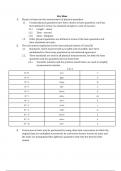
Key Ideas
1. Physics is based on the measurement of physical quantities
1.1. Certain physical quantities have been chosen as base quantities, each has
been defined in terms of a standard and given a unit of measure
1.1.1. Length - meter
1.1.2. Time - second
1.1.3. Mass - kilogram
1.2. Other physical quantities are defined in terms of the base quantities and
their standards and units
2. The unit system emphasized is the International System of Units (SI)
2.1. Standards, which must be both accessible and invariable, have been
established for these base quantities by international agreement
2.2. These standards are used in all physical measurements, for both the base
quantities and the quantities derived from them
2.2.1. Scientific notation and the prefixes stated below are used to simplify
measurement notation
2.2.1.1.
10^12 tera- T
10^9 giga- G
10^6 mega- M
10^3 kilo- k
10^2 hecto- h
10^1 deka- da
10^-1 deci- d
10^-2 centi- c
10^-3 milli- m
10^-6 micro- µ
10^-9 nano- n
10^-12 pico- p
3. Conversion of units may be performed by using chain-link conversions in which the
original data are multiplied successively by conversion factors written as unity and
the units are manipulated like algebraic quantities until only the desired units
remain
, 4. The meter is defined as the distance traveled by light during a precisely specified
time interval
Section 1.1 - Measurements
Measuring Things, Including length
○ Physics and engineering are based on the precise measurement of physical
quantities, to obtain precise measurements we need:
i. Rules for measurements and comparison
ii. Units for measurement
● Definition of a unit
○ The unique name assigned to the measure of a quantity
i. Mass, time, length, pressure, etc.
○ Corresponds to a standard, a physical quantity with a value of 1.0 unit
i. E.g. 1.0 m/s = one meter traveled every second
Base Quantities and Standards
● There are many different physical quantities, but not all are independent: distance
vs. speed (distance/time)
● Base quantities
○ Seven fundamental quantities such as length, time
○ Three are needed for mechanics: length, time, mass
○ All have been assigned standards
○ Are used to define all other physical quantities
● Base standards must be:
○ Accessible - so precise measurements can be taken
○ Invariable - so measurements do not change over time
International System of Units
● SI Units, the metric system, form the International System of Units
● SI base units include
○ Meters - length
○ Seconds - time
○ Kilograms - mass
● SI has many derived units, which are written in terms of base units
○ Joules, work energy: 1 J = 1 (kg)(m^2/s^2)
○ Watts, power: 1 W = 1 J/s = 1 (kg)(m^2/s^2)
Scientific Notation and Conversion Factors
● Scientific Notation employs powers of 10 to write large or small numbers
○ 3,560,000,000 m = 3.56x10^9 m
○ 0.000000492 s = 4.92x10^-7 s
● A conversion factor is
○ A ratio of units that is equal to 1
○ Used to convert between units
1. Physics is based on the measurement of physical quantities
1.1. Certain physical quantities have been chosen as base quantities, each has
been defined in terms of a standard and given a unit of measure
1.1.1. Length - meter
1.1.2. Time - second
1.1.3. Mass - kilogram
1.2. Other physical quantities are defined in terms of the base quantities and
their standards and units
2. The unit system emphasized is the International System of Units (SI)
2.1. Standards, which must be both accessible and invariable, have been
established for these base quantities by international agreement
2.2. These standards are used in all physical measurements, for both the base
quantities and the quantities derived from them
2.2.1. Scientific notation and the prefixes stated below are used to simplify
measurement notation
2.2.1.1.
10^12 tera- T
10^9 giga- G
10^6 mega- M
10^3 kilo- k
10^2 hecto- h
10^1 deka- da
10^-1 deci- d
10^-2 centi- c
10^-3 milli- m
10^-6 micro- µ
10^-9 nano- n
10^-12 pico- p
3. Conversion of units may be performed by using chain-link conversions in which the
original data are multiplied successively by conversion factors written as unity and
the units are manipulated like algebraic quantities until only the desired units
remain
, 4. The meter is defined as the distance traveled by light during a precisely specified
time interval
Section 1.1 - Measurements
Measuring Things, Including length
○ Physics and engineering are based on the precise measurement of physical
quantities, to obtain precise measurements we need:
i. Rules for measurements and comparison
ii. Units for measurement
● Definition of a unit
○ The unique name assigned to the measure of a quantity
i. Mass, time, length, pressure, etc.
○ Corresponds to a standard, a physical quantity with a value of 1.0 unit
i. E.g. 1.0 m/s = one meter traveled every second
Base Quantities and Standards
● There are many different physical quantities, but not all are independent: distance
vs. speed (distance/time)
● Base quantities
○ Seven fundamental quantities such as length, time
○ Three are needed for mechanics: length, time, mass
○ All have been assigned standards
○ Are used to define all other physical quantities
● Base standards must be:
○ Accessible - so precise measurements can be taken
○ Invariable - so measurements do not change over time
International System of Units
● SI Units, the metric system, form the International System of Units
● SI base units include
○ Meters - length
○ Seconds - time
○ Kilograms - mass
● SI has many derived units, which are written in terms of base units
○ Joules, work energy: 1 J = 1 (kg)(m^2/s^2)
○ Watts, power: 1 W = 1 J/s = 1 (kg)(m^2/s^2)
Scientific Notation and Conversion Factors
● Scientific Notation employs powers of 10 to write large or small numbers
○ 3,560,000,000 m = 3.56x10^9 m
○ 0.000000492 s = 4.92x10^-7 s
● A conversion factor is
○ A ratio of units that is equal to 1
○ Used to convert between units


