

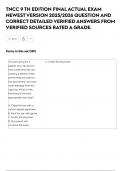
TNCC 9 TH EDITION FINAL ACTUAL EXAM
NEWEST VERSION 2025/2026 QUESTION AND
CORRECT DETAILED VERIFIED ANSWERS FROM
VERIFIED SOURCES RATED A GRADE.
Save
Terms in this set (189)
You are caring for a C. Notify the physician
patient who was thrown
from a bike and was not
wearing a helmet. While
performing the head-to-
toe assessment, you note
clear drainage from the
right ear. Which of the
following is the most
appropriate next step?
A. Clean the ear with a
cotton-tipped applicator.
B. Pack the ear with gauze.
C. Notify the physician
D. Document and
continue the exam.
,A patient is brought to the A. Initiate transfer to a trauma center
emergency department of
a rural hospital following a
high-speed motor vehicle
collision. When significant
abdominal and pelvic
injuries are noted in the
primary survey, what is the
priority intervention?
A. Initiate transfer to a
trauma center
B. Attempt family
notification
C. Obtain additional
imaging studies
D. Place an indwelling
urinary catheter
,An adult who fell from a A. Initiate cervical spine stabilization
second story roof is
brought to the emergency
department by private
vehicle. The patient is
confused with unlabored
respirations and has
strong, palpable radial
pulses. There is an open
wound in proximity to an
obvious deformity of the
left lower extremity. What
is the priority
intervention?
A. Initiate cervical spine
stabilization
B. Apply a splint to the
lower extremity
C. Put the patient on
portable oxygen.
D. Log roll the patient
onto a spine board
, An adult patient who A. Decrease the rate of manual ventilation.
sustained a severe head
trauma has been intubated
and is being manually
ventilated via a bag-mask
device at a rate of 18
breaths/minute. The
patient has received one
intravenous fluid bolus of
500 mL of warmed
isotonic crystalloid
solution. The PaCO2 is 30
mm Hg (4.0 kPa), and the
pulse oximetry is 92%. BP
is 142/70 mm Hg. What is
the most important
intervention to manage
the cerebral blood flow?
A. Decrease the rate of
manual ventilation.
B. Initiate another fluid
bolus.
C. Recheck endotracheal
tube placement.
D. Increase the amount of
oxygen delivered.
NEWEST VERSION 2025/2026 QUESTION AND
CORRECT DETAILED VERIFIED ANSWERS FROM
VERIFIED SOURCES RATED A GRADE.
Save
Terms in this set (189)
You are caring for a C. Notify the physician
patient who was thrown
from a bike and was not
wearing a helmet. While
performing the head-to-
toe assessment, you note
clear drainage from the
right ear. Which of the
following is the most
appropriate next step?
A. Clean the ear with a
cotton-tipped applicator.
B. Pack the ear with gauze.
C. Notify the physician
D. Document and
continue the exam.
,A patient is brought to the A. Initiate transfer to a trauma center
emergency department of
a rural hospital following a
high-speed motor vehicle
collision. When significant
abdominal and pelvic
injuries are noted in the
primary survey, what is the
priority intervention?
A. Initiate transfer to a
trauma center
B. Attempt family
notification
C. Obtain additional
imaging studies
D. Place an indwelling
urinary catheter
,An adult who fell from a A. Initiate cervical spine stabilization
second story roof is
brought to the emergency
department by private
vehicle. The patient is
confused with unlabored
respirations and has
strong, palpable radial
pulses. There is an open
wound in proximity to an
obvious deformity of the
left lower extremity. What
is the priority
intervention?
A. Initiate cervical spine
stabilization
B. Apply a splint to the
lower extremity
C. Put the patient on
portable oxygen.
D. Log roll the patient
onto a spine board
, An adult patient who A. Decrease the rate of manual ventilation.
sustained a severe head
trauma has been intubated
and is being manually
ventilated via a bag-mask
device at a rate of 18
breaths/minute. The
patient has received one
intravenous fluid bolus of
500 mL of warmed
isotonic crystalloid
solution. The PaCO2 is 30
mm Hg (4.0 kPa), and the
pulse oximetry is 92%. BP
is 142/70 mm Hg. What is
the most important
intervention to manage
the cerebral blood flow?
A. Decrease the rate of
manual ventilation.
B. Initiate another fluid
bolus.
C. Recheck endotracheal
tube placement.
D. Increase the amount of
oxygen delivered.


