
NUR-643E . Midterm . Exam . Study
. Guide
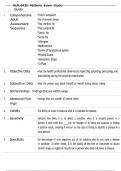
1. Comprehensive *Chief .Complaint
.Adult *Hx .of .present .illness
.Assessment *Past .medical .Hx
.Sequence *Past .surgical .Hx
*Family . Hx
*Social .Hx
*Allergies
*Medications
*Review .of .Symptoms .of .System
*Physical .Exam
*Assessment .Steps
*Tx .Plan
2. Objective .Data what .the .health .professional .observes .by .inspecting, .palpating, .percussing, .and
.auscultating .during .the .physical .examination
3. Subjective . Data what .the .person .says .about .himself .or .herself .during .history .taking
4. Normal .Findings . . findings .that .are .within .range
5. Abnormal .Find- findings .that .are .outside .of .normal .limits
.ings
6. Validity The .ability .of .a .test .to .measure .what .it .is .intended .to .measure
7. Sensitivity indicates .how .likely .it .is .to .detect .a .condition .when .it .is .actually .present .in .a
.patient. .A .test .with .low . can .be .thought .of .as .being .too .cautious .in .finding
.a .positive .result, .meaning .it .will .err .on .the .side .of .failing .to .identify .a .disease .in .a
.sick .person.
8. Specificity the .percentage .of .true .negatives .out .of .all .subjects .who .do .not .have .a .disease
.or .condition. .In .other .words, .it .is .the .ability .of .the .test .or .instrument .to .obtain
.normal .range .or .negative .results .for .a .person .who .does .not .have .a .disease.
.
.
, NUR-643E . Midterm . Exam . Study
. Guide
9. History .Taking A .step .within .the .patient .assessment .process .that .provides .detail .about .the
.pa- .tient's .chief .complaint .and .an .account .of .the .patient's .signs .and
.symptoms.
*Ask .open-ended .questions .and .listen .carefully .to .the .patient's .story.
*Craft .a .thorough .and .systematic .sequence .to .history .taking .and .physical .exami-
.nation.
*Keep .an .open .mind .toward .both .the .patient .and .the .clinical .data.
*Always .include ."the .worst-case .scenario" .in .your .list .of .possible .explanations .of
.the .patient's .problem, .and .make .sure .it .can .be .safely .eliminated.
*Analyze .any .mistakes .in .data .collection .or .interpretation.
*Confer .with .colleagues .and .review .the .pertinent .clinical .literature .to .clarify .uncer-
.tainties.
*Apply .the .principles .of .evaluating .clinical .evidence .to .patient .information .and
. testing.
10. Psychopathology . scientific .study .of .psychological .disorders
11. Pathophysiology . . the .study .of .how .disease .processes .attect .the .function .of .the .body
12. Interviewing .- .Se- The .key .to .a .thorough .and .accurate .physical .examination .is .developing .a .systematic
.quencing .sequence .of .examination.
13. Order .of .Cardinal Inspection, . palpation, . percussion, . and . auscultation
.Techniques .of .Ex-
.amination
14. Interviewing . - . In- leading .cause .of .serious .injury .and .the .second .leading .cause .of .death .among .U.S.
timate .Partner .Vi- .women .of .reproductive .age.
olence .and .Do-
mestic . Violence *Injuries .that .are .unexplained, .seem .inconsistent .with .the .patient's .story, .are
. concealed .by .the .patient, .or .cause .embarrassment
ÏDelay .in .getting .treatment .for .traumaÏHistory .of .repeated .injuries .or ."accidents"
.
.
. Guide
1. Comprehensive *Chief .Complaint
.Adult *Hx .of .present .illness
.Assessment *Past .medical .Hx
.Sequence *Past .surgical .Hx
*Family . Hx
*Social .Hx
*Allergies
*Medications
*Review .of .Symptoms .of .System
*Physical .Exam
*Assessment .Steps
*Tx .Plan
2. Objective .Data what .the .health .professional .observes .by .inspecting, .palpating, .percussing, .and
.auscultating .during .the .physical .examination
3. Subjective . Data what .the .person .says .about .himself .or .herself .during .history .taking
4. Normal .Findings . . findings .that .are .within .range
5. Abnormal .Find- findings .that .are .outside .of .normal .limits
.ings
6. Validity The .ability .of .a .test .to .measure .what .it .is .intended .to .measure
7. Sensitivity indicates .how .likely .it .is .to .detect .a .condition .when .it .is .actually .present .in .a
.patient. .A .test .with .low . can .be .thought .of .as .being .too .cautious .in .finding
.a .positive .result, .meaning .it .will .err .on .the .side .of .failing .to .identify .a .disease .in .a
.sick .person.
8. Specificity the .percentage .of .true .negatives .out .of .all .subjects .who .do .not .have .a .disease
.or .condition. .In .other .words, .it .is .the .ability .of .the .test .or .instrument .to .obtain
.normal .range .or .negative .results .for .a .person .who .does .not .have .a .disease.
.
.
, NUR-643E . Midterm . Exam . Study
. Guide
9. History .Taking A .step .within .the .patient .assessment .process .that .provides .detail .about .the
.pa- .tient's .chief .complaint .and .an .account .of .the .patient's .signs .and
.symptoms.
*Ask .open-ended .questions .and .listen .carefully .to .the .patient's .story.
*Craft .a .thorough .and .systematic .sequence .to .history .taking .and .physical .exami-
.nation.
*Keep .an .open .mind .toward .both .the .patient .and .the .clinical .data.
*Always .include ."the .worst-case .scenario" .in .your .list .of .possible .explanations .of
.the .patient's .problem, .and .make .sure .it .can .be .safely .eliminated.
*Analyze .any .mistakes .in .data .collection .or .interpretation.
*Confer .with .colleagues .and .review .the .pertinent .clinical .literature .to .clarify .uncer-
.tainties.
*Apply .the .principles .of .evaluating .clinical .evidence .to .patient .information .and
. testing.
10. Psychopathology . scientific .study .of .psychological .disorders
11. Pathophysiology . . the .study .of .how .disease .processes .attect .the .function .of .the .body
12. Interviewing .- .Se- The .key .to .a .thorough .and .accurate .physical .examination .is .developing .a .systematic
.quencing .sequence .of .examination.
13. Order .of .Cardinal Inspection, . palpation, . percussion, . and . auscultation
.Techniques .of .Ex-
.amination
14. Interviewing . - . In- leading .cause .of .serious .injury .and .the .second .leading .cause .of .death .among .U.S.
timate .Partner .Vi- .women .of .reproductive .age.
olence .and .Do-
mestic . Violence *Injuries .that .are .unexplained, .seem .inconsistent .with .the .patient's .story, .are
. concealed .by .the .patient, .or .cause .embarrassment
ÏDelay .in .getting .treatment .for .traumaÏHistory .of .repeated .injuries .or ."accidents"
.
.


