
Study unit 11
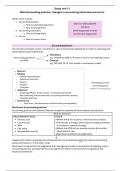
IAS 8 Accounting policies, changes in accounting estimates and errors
IAS 8 covers 3 areas:
1. Accounting policies:
How to select/develop them IAS 8 is a DISCLOSURE
How to change them standard
2. Accounting estimates: (what happened vs what
How to change them should have happened)
3. Errors:
How to correct them
Accounting policies
The specific principles, bases, conventions, rules and practices applied by an entity in preparing and
presenting financial statements
Mandatory
Accounting policies in e.g. Inventories (IAS 2) lower of cost or net realisable value
the IFRS Choices
e.g. PPE (IAS 16) Cost model or revaluation model
Relevant
Reliable
Faithful representation
Substance over form
Neutral Developing our own
Prudent accounting policy
Complete
(if there is no accounting policy)
Judgement
Guided by IFRS on similar issues + conceptual framework
Not conflicting: Pronouncements, accounting literature, Industry
accepted practices
Consistency
Over time + with disclosure of similar items (comparability)
Disclosure of accounting policies
Accounting policies are material if they are needed to understand other material transactions
What to disclose?
MEASUREMENT BASIS OTHER
Historic cost Where there was a choice: which one was chosen
Current cost If there was a change: what was the change and where
NRV it resulted in material changes
Fair value Where the IFRS did not provide a policy & the entity
Recoverable amount developed its own
Significant professional judgements
Judgements made in applying accounting policies may be disclosed with the material accounting
policy information or in the other notes
Disclosure is required for the judgments that management made in the process of applying entity’s
accounting policies and that has the most significant e ect on the amounts recognized in the
financial statements
, Changes in accounting policies
Can be:
1. Compulsory required by an IFRS
2. Voluntary entity believes the change will result in info being reliable and more relevant in
presentation of FS
The following is NOT considered a ‘change in accounting policy’:
Event/transaction di ers in substance from previous transactions
Did not occur previously/was previously immaterial
Change from cost model to revaluation model (accounted for as a revaluation ito IAS 16 or IAS 38)
How to disclose a change in accounting policy:
IAS 8 requires retrospective application except if its impracticable
Impractical cannot apply it after making every reasonable e ort to do so
Note: impracticable ≠ impossible
Retrospective application: Applying a new accounting policy ‘as if the policy had always been
applied’
Note: opposite = prospective application only current year’s figures are recalculated
All prior periods presented must be recalculated based on the new policy (where practical)
For periods that will be presented in the FS (current year & comparative years): e ect of change
in policy on each line item must be disclosed separately
For periods that will not be disclosed: cumulative e ect of change in policy on equity will be
disclosed as ‘change in policy’ line-item in SoCE
If it is not practicable to calculate the e ect on all prior year’s, new AP is applied to the elements from
the earliest prior period that is considered practicable to adjust. (The cumulative e ect on all
elements prior to when it's practicable is disregarded.)
What should be disclosed?
Title of IFRS (standard/interpretation)
Nature of the change
Extra year of comparative figures in SoFP (3 years)
Amount of adjustments made to each line-item in FS for all the periods presented
If prior period(s) are not adjusted:
Why it is impracticable to adjust
Description as to how & from what date the new policy has been applied
If transitional provisions were provided:
The fact that change has been made inn accordance with transitional provisions
Description of provisions Summary:
Possible e ect of provisions on future periods Description of what policy changed
For voluntary changes: Why it was changed (except if
compulsory)
Reason why new AP results in reliable & more relevant info
E ect on each line item
Nature of the change Extra year of comparatives
Extra year of comparative figures in SoFP (3 years)
Amount of adjustments made to each line-item in SoFP for all 3 years
Amount of adjustments made to previous years
If prior periods were not adjusted: why & from what date the new AP was applied
IAS 8 Accounting policies, changes in accounting estimates and errors
IAS 8 covers 3 areas:
1. Accounting policies:
How to select/develop them IAS 8 is a DISCLOSURE
How to change them standard
2. Accounting estimates: (what happened vs what
How to change them should have happened)
3. Errors:
How to correct them
Accounting policies
The specific principles, bases, conventions, rules and practices applied by an entity in preparing and
presenting financial statements
Mandatory
Accounting policies in e.g. Inventories (IAS 2) lower of cost or net realisable value
the IFRS Choices
e.g. PPE (IAS 16) Cost model or revaluation model
Relevant
Reliable
Faithful representation
Substance over form
Neutral Developing our own
Prudent accounting policy
Complete
(if there is no accounting policy)
Judgement
Guided by IFRS on similar issues + conceptual framework
Not conflicting: Pronouncements, accounting literature, Industry
accepted practices
Consistency
Over time + with disclosure of similar items (comparability)
Disclosure of accounting policies
Accounting policies are material if they are needed to understand other material transactions
What to disclose?
MEASUREMENT BASIS OTHER
Historic cost Where there was a choice: which one was chosen
Current cost If there was a change: what was the change and where
NRV it resulted in material changes
Fair value Where the IFRS did not provide a policy & the entity
Recoverable amount developed its own
Significant professional judgements
Judgements made in applying accounting policies may be disclosed with the material accounting
policy information or in the other notes
Disclosure is required for the judgments that management made in the process of applying entity’s
accounting policies and that has the most significant e ect on the amounts recognized in the
financial statements
, Changes in accounting policies
Can be:
1. Compulsory required by an IFRS
2. Voluntary entity believes the change will result in info being reliable and more relevant in
presentation of FS
The following is NOT considered a ‘change in accounting policy’:
Event/transaction di ers in substance from previous transactions
Did not occur previously/was previously immaterial
Change from cost model to revaluation model (accounted for as a revaluation ito IAS 16 or IAS 38)
How to disclose a change in accounting policy:
IAS 8 requires retrospective application except if its impracticable
Impractical cannot apply it after making every reasonable e ort to do so
Note: impracticable ≠ impossible
Retrospective application: Applying a new accounting policy ‘as if the policy had always been
applied’
Note: opposite = prospective application only current year’s figures are recalculated
All prior periods presented must be recalculated based on the new policy (where practical)
For periods that will be presented in the FS (current year & comparative years): e ect of change
in policy on each line item must be disclosed separately
For periods that will not be disclosed: cumulative e ect of change in policy on equity will be
disclosed as ‘change in policy’ line-item in SoCE
If it is not practicable to calculate the e ect on all prior year’s, new AP is applied to the elements from
the earliest prior period that is considered practicable to adjust. (The cumulative e ect on all
elements prior to when it's practicable is disregarded.)
What should be disclosed?
Title of IFRS (standard/interpretation)
Nature of the change
Extra year of comparative figures in SoFP (3 years)
Amount of adjustments made to each line-item in FS for all the periods presented
If prior period(s) are not adjusted:
Why it is impracticable to adjust
Description as to how & from what date the new policy has been applied
If transitional provisions were provided:
The fact that change has been made inn accordance with transitional provisions
Description of provisions Summary:
Possible e ect of provisions on future periods Description of what policy changed
For voluntary changes: Why it was changed (except if
compulsory)
Reason why new AP results in reliable & more relevant info
E ect on each line item
Nature of the change Extra year of comparatives
Extra year of comparative figures in SoFP (3 years)
Amount of adjustments made to each line-item in SoFP for all 3 years
Amount of adjustments made to previous years
If prior periods were not adjusted: why & from what date the new AP was applied



