COMPUTER NETWORKING TEST 1
QUESTIONS AND ANSWERS
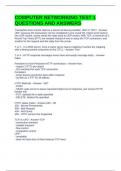
Transaction from remote client to a server as fast as possible. UDP or TCP? - Answer-
UDP, because the transaction can be completed in one round trip. Client send request
into UDP socket, server sends the reply back to UDP socket. With TCP, a minimum of 2
Round Trip Times (RTT) are needed instead of one to setup the TCP connection, and
another for the request and the reply from the server.
T or F - In a DNS server, once a name server learns mapping it caches the mapping
with a timeout period using time-to-live (TTL). - Answer-True
T or F - HTTP response messages never have and empty message body. - Answer-
False
Persistent vs Non-Persistent HTTP connections - Answer-Non :
- require 2 RTTs per object
- OS overhead for each TCP connection
Persistent:
- sever leaves connection open after response
- as little as 1 RTT for all objects
HTTP Methods - Answer-- GET
- POST
- HEAD: asks server to leave requested object out of response, just receive HTTP
header info
- PUT: uploads file to path specified
- DELETE: deletes file specified
HTTP status codes - Answer-200 - OK
301 - Moved Permanently
400 - Bad Request
404 - Not Found
505 - HTTP version Not Supported
TCP vs UPD - Answer-TCP:
- connection-oriented
- reliable transport
- flow control
- congestion control
UDP:
- unreliable
- does not have lots of other features TCP does
QUESTIONS AND ANSWERS
Transaction from remote client to a server as fast as possible. UDP or TCP? - Answer-
UDP, because the transaction can be completed in one round trip. Client send request
into UDP socket, server sends the reply back to UDP socket. With TCP, a minimum of 2
Round Trip Times (RTT) are needed instead of one to setup the TCP connection, and
another for the request and the reply from the server.
T or F - In a DNS server, once a name server learns mapping it caches the mapping
with a timeout period using time-to-live (TTL). - Answer-True
T or F - HTTP response messages never have and empty message body. - Answer-
False
Persistent vs Non-Persistent HTTP connections - Answer-Non :
- require 2 RTTs per object
- OS overhead for each TCP connection
Persistent:
- sever leaves connection open after response
- as little as 1 RTT for all objects
HTTP Methods - Answer-- GET
- POST
- HEAD: asks server to leave requested object out of response, just receive HTTP
header info
- PUT: uploads file to path specified
- DELETE: deletes file specified
HTTP status codes - Answer-200 - OK
301 - Moved Permanently
400 - Bad Request
404 - Not Found
505 - HTTP version Not Supported
TCP vs UPD - Answer-TCP:
- connection-oriented
- reliable transport
- flow control
- congestion control
UDP:
- unreliable
- does not have lots of other features TCP does