

1
Problem 1: Perception and Motor System
Chapter 9: Organization of the motor system
➔ How do we move?
, 2
◆ visual system: inspects the objects
◆ visual cortex: relays the information to motor cortex
◆ frontal-lobe motor areas: plan and command the movement
◆ spinal cord: passes on the instructions to the limb (arm, hand etc.)
◆ sensory cortex: interprets the information received from the sensory receptors in
your fingers, and informs the motor cortex
◆ basal ganglia: regulates the appropriate amount of force
◆ cerebellum: regulates the movement's timing & accuracy
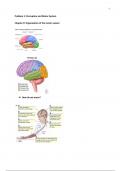
◆ there are so many brain regions involved in even the simplest movements, but
only the regions in the graph below are called the motor system
➔ Initiating movement
◆ 4 neocortical regions are involved
◆ The neocortex specifically refers to the newer, evolutionarily advanced part of
the cerebral cortex found in mammals. It is involved in higher cognitive functions,
sensory perception, motor commands, spatial reasoning, and language
processing.
1. The posterior cortex takes visual, auditory, tactile etc. information. In the case
of relatively automatic movements, it sends the info directly to the premotor and
motor cortex. In more elaborate movements, take it to the frontal lobe.
2. prefrontal cortex (PFC) plans movements
, 3
3. Premotor cortex can recognize others' movements and can select different or
similar movements, coordinates complex movements— means supplementary
motor cortex/area (SMA)
4. primary motor cortex (M1/ Brodmann's area 4/ precentral gyrus)--- simpler
movements than the premotor cortex
➔ Homunculus
◆ in M1– the motor homunculus
◆ a secondary homunculus is located in the supplementary motor cortex
◆ sizes reflect that large parts of the motor cortex regulate hands, fingers, lip and
tongue movements; giving us precise and fine motor control over these body
parts
◆ because the body is symmetrical, each hemisphere has a mirror-image
representation of this homunculus
, 4
➔ visual-parietal-motor connections
◆ some movements can also be elicited by electrical stimulation of the parietal
cortex
◆ dual pathway for reaching:
● visual cortex: identifies the spatial location of the target and its shape
● parietal cortex: identifies the body part that will contact the object
● motor cortex: in turn represents the elements required to move the arm
to the target and shape the digits to grasp it
● the actual movement might be orchestrated in the brainstem or in the
spinal cord
➔ movement lexicon
◆ humans have a lexicon (=repertoire) of movements
◆ we can see this in the very similar ways different people perform same
movements; e.g. grabbing objects
Problem 1: Perception and Motor System
Chapter 9: Organization of the motor system
➔ How do we move?
, 2
◆ visual system: inspects the objects
◆ visual cortex: relays the information to motor cortex
◆ frontal-lobe motor areas: plan and command the movement
◆ spinal cord: passes on the instructions to the limb (arm, hand etc.)
◆ sensory cortex: interprets the information received from the sensory receptors in
your fingers, and informs the motor cortex
◆ basal ganglia: regulates the appropriate amount of force
◆ cerebellum: regulates the movement's timing & accuracy
◆ there are so many brain regions involved in even the simplest movements, but
only the regions in the graph below are called the motor system
➔ Initiating movement
◆ 4 neocortical regions are involved
◆ The neocortex specifically refers to the newer, evolutionarily advanced part of
the cerebral cortex found in mammals. It is involved in higher cognitive functions,
sensory perception, motor commands, spatial reasoning, and language
processing.
1. The posterior cortex takes visual, auditory, tactile etc. information. In the case
of relatively automatic movements, it sends the info directly to the premotor and
motor cortex. In more elaborate movements, take it to the frontal lobe.
2. prefrontal cortex (PFC) plans movements
, 3
3. Premotor cortex can recognize others' movements and can select different or
similar movements, coordinates complex movements— means supplementary
motor cortex/area (SMA)
4. primary motor cortex (M1/ Brodmann's area 4/ precentral gyrus)--- simpler
movements than the premotor cortex
➔ Homunculus
◆ in M1– the motor homunculus
◆ a secondary homunculus is located in the supplementary motor cortex
◆ sizes reflect that large parts of the motor cortex regulate hands, fingers, lip and
tongue movements; giving us precise and fine motor control over these body
parts
◆ because the body is symmetrical, each hemisphere has a mirror-image
representation of this homunculus
, 4
➔ visual-parietal-motor connections
◆ some movements can also be elicited by electrical stimulation of the parietal
cortex
◆ dual pathway for reaching:
● visual cortex: identifies the spatial location of the target and its shape
● parietal cortex: identifies the body part that will contact the object
● motor cortex: in turn represents the elements required to move the arm
to the target and shape the digits to grasp it
● the actual movement might be orchestrated in the brainstem or in the
spinal cord
➔ movement lexicon
◆ humans have a lexicon (=repertoire) of movements
◆ we can see this in the very similar ways different people perform same
movements; e.g. grabbing objects


