

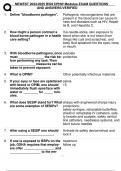
NEWEST 2024/2025 BSN CPNW Modules EXAM QUESTIONS
AND ANSWERS/VERIFIED
1. Define "bloodborne pathogen". Pathogenic microorganisms that are
present in the blood and can cause ill-
ness and diseases such as HIV, Hepati-
tis B, and Hepatitis C.
2. How might a person contract a Via needle-sticks, skin exposure to
blood borne pathogen in a health blood when skin is not intact (from
care setting? things like cuts and scratches), and
body fluid splashed into the eyes, nose,
or mouth.
3. With bloodborne pathogens, once evaluate
must ______________ the risk be- protective
fore performing any task. Then
______________ measures can be
taken to prevent exposure.
4. What is OPIM? Other potentially infectious materials
5. If your eyes or face are splattered saline
with blood or OPIM, one should 15
immediately flush eyes/face with
water or ________ for _____ min-
utes.
6. What does SESIP stand for? What sharps with engineered sharps injury
are some examples of SESIPs? protections;
safety syringes, retractable butterflies,
shield or retractable IV catheters, safe-
ty lancets and scalpels, safety central
line catheters, needleless systems, and
blunt suture needles
7. After using a SESIP one should Activate its safety device/retract and
________________________. lock it
8. If one is exposed to BBPs on the treatment
job, OSHA requires that employ- follow up
ers offer _________________ and
_________________ to the em-
1/3
AND ANSWERS/VERIFIED
1. Define "bloodborne pathogen". Pathogenic microorganisms that are
present in the blood and can cause ill-
ness and diseases such as HIV, Hepati-
tis B, and Hepatitis C.
2. How might a person contract a Via needle-sticks, skin exposure to
blood borne pathogen in a health blood when skin is not intact (from
care setting? things like cuts and scratches), and
body fluid splashed into the eyes, nose,
or mouth.
3. With bloodborne pathogens, once evaluate
must ______________ the risk be- protective
fore performing any task. Then
______________ measures can be
taken to prevent exposure.
4. What is OPIM? Other potentially infectious materials
5. If your eyes or face are splattered saline
with blood or OPIM, one should 15
immediately flush eyes/face with
water or ________ for _____ min-
utes.
6. What does SESIP stand for? What sharps with engineered sharps injury
are some examples of SESIPs? protections;
safety syringes, retractable butterflies,
shield or retractable IV catheters, safe-
ty lancets and scalpels, safety central
line catheters, needleless systems, and
blunt suture needles
7. After using a SESIP one should Activate its safety device/retract and
________________________. lock it
8. If one is exposed to BBPs on the treatment
job, OSHA requires that employ- follow up
ers offer _________________ and
_________________ to the em-
1/3


