
lOMoAR cPSD| 24448587
RN VATI ADULT MEDICAL SURGICAL 2024-2025
latest VERSION QUESTIONS AND CORRECT
DETAILED ANSWERS WITH DETAILED RATIONALES
GUARANTEED PASS A+
ovide d
CORRECT • Time Remaining: 00:37:02
• Pause Remaining: 00:05:00
PAUSE
FLAG
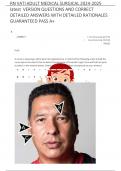
A nurse is assessing a client who has hypocalcemia. In which of the following areas should the
nurse tap on the client's face to detect the presence of Chvostek's sign? (You will find hot spots
to select in the artwork below. Select only the hot spot that corresponds to your answer.)
lOMoAR cPSD| 24448587
,2|Page
A is correct. The nurse should tap the client's cheek just in front of the ear and below the
zygomatic arch. The client who has hypocalcemia will display a Chvostek's sign, which is a
twitching of the facial muscle.
B is incorrect. The nurse should apply upward pressure at the supraorbital ridge, below
the eyebrow, to assess for tenderness and inflammation of the frontal sinuses.
C is incorrect. The nurse should palpate the jaw and mastoid muscle of a client who has
temporomandibular joint dysfunction. This can be caused by misaligned teeth, arthritis, or
grinding of the teeth. With palpation, the nurse might feel a click, pop, or grating sensation
when the client opens or closes the jaw.
RN VATI Adult Medical Surgical 2019
Q u e s ti o n 8 4 l oa d e d r a ti o n al s CLOSE p r o vi d e d
CORRECT
A nurse in an emergency department is assessing a client who is overusing prescribed diuretics
and has a sodium level of 127 mEq/L. Which of the following laboratory findings should the
nurse expect?
High lipase
A high lipase level is associated with pancreatic dysfunction or renal failure and is not an
expected finding with hyponatremia or dehydration.
Low urine specific gravity
MY ANSWER
A client who has hyponatremia as a result of diuretic overuse has a low urine specific
gravity. The increased excretion of water alters the ratio of particulate matter, which
affects the specific gravity.
Low hemoglobin
A client who is dehydrated as a result of diuretic overuse can have an elevated hemoglobin
level because of the difference in ratio between intravascular fluid and blood cells.
High creatine kinase-MB (CK-MB)
An elevated CK-MB level indicates a myocardial infarction and is not an expected finding with
hyponatremia.
RN VATI Adult Medical Surgical 2019
A home health nurse is assisting a client with planning care for a family member who has
Alzheimer's disease. Which of the following instructions should the nurse include?
, lOMoAR cPSD| 24448587
Remove clutter from rooms and hallways.
The nurse should instruct the family member to remove clutter from rooms and hallways so the
client is able to walk without the risk of falling or tripping over objects. Later in the disease, the
client can experience seizures, so cluttered areas could be a risk to the client.
Place a monthly calendar in the client's room.
MY ANSWER
The nurse should instruct the family member to place a single-date calendar in the client's room. A
monthly calendar can be overwhelming and confusing to a client who has Alzheimer's disease.
Use confrontation to manage the client's behavior.
The nurse should instruct the family member to redirect the client by starting another activity
when the client begins to act out or becomes overstimulated. Redirecting the client might help
them gain focus.
Review the daily schedule with the client every morning.
The nurse should instruct the family member to use short, simple sentences when explaining an
activity to the client. The explanation should be done immediately before the activity to aid the
client's memory and ability to follow directions.
RN VATI Adult Medical Surgical 2019
Q u e s tio n 8 2 lo a d e d ra tio n al s CLOSE pr o vid e d
CORRECT
Time Remaining: 00:36:39
Pause 00:05:00
FLAG PAUSE
, 4|Page
A nurse is caring for a client who has developed acute respiratory distress syndrome (ARDS).
Which of the following findings should the nurse identify as a manifestation of this syndrome?
An audible pleural friction rub
A client who has a pulmonary embolism can have a pleural friction rub along with tachypnea,
tachycardia, dyspnea, and sudden, sharp chest pain. However, a pleural friction rub is not a
manifestation of ARDS.
Tracheal deviation from the midline
A client who has a tension pneumothorax can have tracheal deviation with dyspnea,
tachycardia, and tachypnea. On auscultation, breath sounds over the area of the pneumothorax
are decreased or absent. However, tracheal deviation is not a manifestation of ARDS.
Refractory hypoxemia
MY ANSWER
ARDS is a systemic inflammatory response to trauma, sepsis, burns, pancreatitis, and blood
transfusions, when excess lung fluid dilutes surfactant activity in the lungs. A client who has
ARDS has refractory hypoxemia, which is hypoxemia that does not improve with oxygen
therapy. Extensive pulmonary edema evident on a chest x-ray is a manifestation of ARDS.
A client who has lung cancer or laryngeal trauma can have hemoptysis. However, bloody
expectorant is not a manifestation of ARDS.
RN VATI Adult Medical Surgical 2019
Q u e s tio n 8 1 lo a d e d ra tio n al s CLOSE pr o vid e d
CORRECT
Time Remaining:
00:36:33
Pause 00:05:00
FLAG PAUSE
An emergency room nurse is assessing a client who has asthma and difficulty breathing. Which of
the following findings should indicate to the nurse that the client is experiencing status
asthmaticus?
Coughing
RN VATI ADULT MEDICAL SURGICAL 2024-2025
latest VERSION QUESTIONS AND CORRECT
DETAILED ANSWERS WITH DETAILED RATIONALES
GUARANTEED PASS A+
ovide d
CORRECT • Time Remaining: 00:37:02
• Pause Remaining: 00:05:00
PAUSE
FLAG
A nurse is assessing a client who has hypocalcemia. In which of the following areas should the
nurse tap on the client's face to detect the presence of Chvostek's sign? (You will find hot spots
to select in the artwork below. Select only the hot spot that corresponds to your answer.)
lOMoAR cPSD| 24448587
,2|Page
A is correct. The nurse should tap the client's cheek just in front of the ear and below the
zygomatic arch. The client who has hypocalcemia will display a Chvostek's sign, which is a
twitching of the facial muscle.
B is incorrect. The nurse should apply upward pressure at the supraorbital ridge, below
the eyebrow, to assess for tenderness and inflammation of the frontal sinuses.
C is incorrect. The nurse should palpate the jaw and mastoid muscle of a client who has
temporomandibular joint dysfunction. This can be caused by misaligned teeth, arthritis, or
grinding of the teeth. With palpation, the nurse might feel a click, pop, or grating sensation
when the client opens or closes the jaw.
RN VATI Adult Medical Surgical 2019
Q u e s ti o n 8 4 l oa d e d r a ti o n al s CLOSE p r o vi d e d
CORRECT
A nurse in an emergency department is assessing a client who is overusing prescribed diuretics
and has a sodium level of 127 mEq/L. Which of the following laboratory findings should the
nurse expect?
High lipase
A high lipase level is associated with pancreatic dysfunction or renal failure and is not an
expected finding with hyponatremia or dehydration.
Low urine specific gravity
MY ANSWER
A client who has hyponatremia as a result of diuretic overuse has a low urine specific
gravity. The increased excretion of water alters the ratio of particulate matter, which
affects the specific gravity.
Low hemoglobin
A client who is dehydrated as a result of diuretic overuse can have an elevated hemoglobin
level because of the difference in ratio between intravascular fluid and blood cells.
High creatine kinase-MB (CK-MB)
An elevated CK-MB level indicates a myocardial infarction and is not an expected finding with
hyponatremia.
RN VATI Adult Medical Surgical 2019
A home health nurse is assisting a client with planning care for a family member who has
Alzheimer's disease. Which of the following instructions should the nurse include?
, lOMoAR cPSD| 24448587
Remove clutter from rooms and hallways.
The nurse should instruct the family member to remove clutter from rooms and hallways so the
client is able to walk without the risk of falling or tripping over objects. Later in the disease, the
client can experience seizures, so cluttered areas could be a risk to the client.
Place a monthly calendar in the client's room.
MY ANSWER
The nurse should instruct the family member to place a single-date calendar in the client's room. A
monthly calendar can be overwhelming and confusing to a client who has Alzheimer's disease.
Use confrontation to manage the client's behavior.
The nurse should instruct the family member to redirect the client by starting another activity
when the client begins to act out or becomes overstimulated. Redirecting the client might help
them gain focus.
Review the daily schedule with the client every morning.
The nurse should instruct the family member to use short, simple sentences when explaining an
activity to the client. The explanation should be done immediately before the activity to aid the
client's memory and ability to follow directions.
RN VATI Adult Medical Surgical 2019
Q u e s tio n 8 2 lo a d e d ra tio n al s CLOSE pr o vid e d
CORRECT
Time Remaining: 00:36:39
Pause 00:05:00
FLAG PAUSE
, 4|Page
A nurse is caring for a client who has developed acute respiratory distress syndrome (ARDS).
Which of the following findings should the nurse identify as a manifestation of this syndrome?
An audible pleural friction rub
A client who has a pulmonary embolism can have a pleural friction rub along with tachypnea,
tachycardia, dyspnea, and sudden, sharp chest pain. However, a pleural friction rub is not a
manifestation of ARDS.
Tracheal deviation from the midline
A client who has a tension pneumothorax can have tracheal deviation with dyspnea,
tachycardia, and tachypnea. On auscultation, breath sounds over the area of the pneumothorax
are decreased or absent. However, tracheal deviation is not a manifestation of ARDS.
Refractory hypoxemia
MY ANSWER
ARDS is a systemic inflammatory response to trauma, sepsis, burns, pancreatitis, and blood
transfusions, when excess lung fluid dilutes surfactant activity in the lungs. A client who has
ARDS has refractory hypoxemia, which is hypoxemia that does not improve with oxygen
therapy. Extensive pulmonary edema evident on a chest x-ray is a manifestation of ARDS.
A client who has lung cancer or laryngeal trauma can have hemoptysis. However, bloody
expectorant is not a manifestation of ARDS.
RN VATI Adult Medical Surgical 2019
Q u e s tio n 8 1 lo a d e d ra tio n al s CLOSE pr o vid e d
CORRECT
Time Remaining:
00:36:33
Pause 00:05:00
FLAG PAUSE
An emergency room nurse is assessing a client who has asthma and difficulty breathing. Which of
the following findings should indicate to the nurse that the client is experiencing status
asthmaticus?
Coughing


