Chemistry Essentials
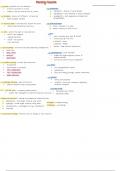
& atoms - smallest units of elements
• atomic - protons in nucleus
# > properties
• mass - protons and neutron in nucleus
# • hydrophilic - dissolve in water (polar)
• hydrophobic - don't dissolve in water (nonpolar)
& isotopes - atoms with different of neutrons • amphipathic - both properties (micelles and
• make isotopes unstable phospholipids)
7 electron shells - hold electrons around the atom > acids and bases
• valence shell determines reactivity • acids - increase H in water
• bases - donate OH and tie up H
7
ions - atoms that gain or lose electrons
-
• anion - net negative >
- pH
- gained electrons • most microbes grow best @ 6.5-8.5
T
• cation - net positive • human blood @ 7.35-7.45
- lost electrons - acidosis - lower
- alkalosis - higher
• buffers - help maintain optimal pH
& ionic bonding - attraction between oppositely charged ions
• weak bond
• salts - NaCl - carbohydrates - most abundant
• proteins • sugars and sugar polymers (mono, di,
• electrolytes polysaccharide)
• fuel source and structural component
↳
covalent bonding - atoms share electrons
• strong bond - lipids
• can be polar or nonpolar • fats, phospholipids, sterols
• CH4 - single bond • hydrophobic
• CO2 - double bond • long term energy storage, cellular membranes
• sugar molecules
>
- protein
• amino acid polymers
> hydrogen bonding - polar attractions • versatile - structural, transport, regulatory,
• weak but powerful when many present receptor, enzymes
nucleic acids
>
>
van der waals - temporary diple bonding • deoxyribonucleic (DNA)
• weaker than hydrogen but stabilize molecular structures • ribonucleic (RNA)
-
chemical reactions - making and breaking of chemical bonds
• dehydration - build larger molecule, lose water
• hydrolysis - break larger molecule using water exergonic - release energy
• recombination - exchanged into new combination endergonic - use energy
• reversible
> activation energy - minimum amt of energy to start reaction
& atoms - smallest units of elements
• atomic - protons in nucleus
# > properties
• mass - protons and neutron in nucleus
# • hydrophilic - dissolve in water (polar)
• hydrophobic - don't dissolve in water (nonpolar)
& isotopes - atoms with different of neutrons • amphipathic - both properties (micelles and
• make isotopes unstable phospholipids)
7 electron shells - hold electrons around the atom > acids and bases
• valence shell determines reactivity • acids - increase H in water
• bases - donate OH and tie up H
7
ions - atoms that gain or lose electrons
-
• anion - net negative >
- pH
- gained electrons • most microbes grow best @ 6.5-8.5
T
• cation - net positive • human blood @ 7.35-7.45
- lost electrons - acidosis - lower
- alkalosis - higher
• buffers - help maintain optimal pH
& ionic bonding - attraction between oppositely charged ions
• weak bond
• salts - NaCl - carbohydrates - most abundant
• proteins • sugars and sugar polymers (mono, di,
• electrolytes polysaccharide)
• fuel source and structural component
↳
covalent bonding - atoms share electrons
• strong bond - lipids
• can be polar or nonpolar • fats, phospholipids, sterols
• CH4 - single bond • hydrophobic
• CO2 - double bond • long term energy storage, cellular membranes
• sugar molecules
>
- protein
• amino acid polymers
> hydrogen bonding - polar attractions • versatile - structural, transport, regulatory,
• weak but powerful when many present receptor, enzymes
nucleic acids
>
>
van der waals - temporary diple bonding • deoxyribonucleic (DNA)
• weaker than hydrogen but stabilize molecular structures • ribonucleic (RNA)
-
chemical reactions - making and breaking of chemical bonds
• dehydration - build larger molecule, lose water
• hydrolysis - break larger molecule using water exergonic - release energy
• recombination - exchanged into new combination endergonic - use energy
• reversible
> activation energy - minimum amt of energy to start reaction