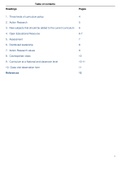
Table of contents
Headings Pages
1. Three kinds of curriculum policy 4
2. Action Research 5
3. New subjects that should be added to the current curriculum 6
4. Open Educational Resource 6-7
5. Assessment 7
6. Distributed leadership 8
7. Action Research values 9
8. Cosmopolitan class 10
9. Curriculum at a National and classroom level 10-11
10. Class visit observation form 11
References 12
1
, Question 1
Three kinds of curriculum policy can be distinguished according to Connelly and Connelly (2010).
Discuss each one and give examples from your own teaching of each of these policies. Discuss how
each type of policy affects your day-to-day teaching. [10] (Page 22)
There are three kinds of curriculum policy that can be distinguished according to Connelly and
Connelly (2010:227):
1. Formal Policy
Formal policy is the official mandatory statement of what is to be taught to students. It is
developed by those responsible (government-sanctioned officials) and expressed in different
ways. Final documents are linked to philosophical perspectives, goals, subject matter knowledge
standards, what students should know and be able to do.
It is also called explicit intended curriculum. It is the prescribed curriculum, also described as the
blueprint for teaching. It includes the plan or intentions of, for instance, the Department of Basic
Education.
The formal policy encompasses the subject skills, knowledge and time allocation that may be
utilized to teach that particular subject or content.
On the Annual Teaching Plan for Accounting Term 1, example for week three the Topic to be
taught is Internal Control Ethics (GAAP) and the time allocation for is one week.
The teachers have to ensure that they teach leaners according to the ATP and use the allocated
time.
Lack inadequate resources, skills and knowledge and lack of planning affects teaching and
learning.
2. Implicit Policy
Implicit curriculum refers to policies at various administrative and government levels that influence
practices. Policies with normally significant impact on local practices refer to statements,
documents and suggestions that accompany formal curriculum policy and that do not carry the
weight of a mandatory requirement but are often treated as such in practice.
It is also referred to as non-official, enacted curriculum as practice. It is the curriculum as it is
experienced and implemented by a teacher, and is what is actually taught and learnt.
Most learning occurs within the implicit curriculum, it is the actual curricular that teachers and
learners engage in.
It refers to what occurs in the classroom on a daily basis experiences of a learners through
various practices, teaching aids, and technologies.
Misunderstandings, resource constraints and so on can interfere with the teacher’s abilities to
implement a curriculum plan exactly as intended.
It varies from teacher to teacher and even changes across classrooms taught by the same
teacher.
3. Prudential
Prudential curriculum policy refers to the practical wisdom and practical knowledge used by
teachers and/ or school administrators as they adopt formal and implicit curriculum policy for local
situations.
Also known as Covert curriculum. This is teaching that is implicit (that is not spelt out), but
nonetheless deliberate on the part of the teacher or school. It is especially important in early
schooling, when consideration for others, order and obedience, teamwork and cooperation are
focal points. “Play” in early schooling is a deliberate curriculum strategy to develop important
attitudes and skills such as fine motor skills, spatial differentiation and various pre-numeracy
skills.
2|Page
Headings Pages
1. Three kinds of curriculum policy 4
2. Action Research 5
3. New subjects that should be added to the current curriculum 6
4. Open Educational Resource 6-7
5. Assessment 7
6. Distributed leadership 8
7. Action Research values 9
8. Cosmopolitan class 10
9. Curriculum at a National and classroom level 10-11
10. Class visit observation form 11
References 12
1
, Question 1
Three kinds of curriculum policy can be distinguished according to Connelly and Connelly (2010).
Discuss each one and give examples from your own teaching of each of these policies. Discuss how
each type of policy affects your day-to-day teaching. [10] (Page 22)
There are three kinds of curriculum policy that can be distinguished according to Connelly and
Connelly (2010:227):
1. Formal Policy
Formal policy is the official mandatory statement of what is to be taught to students. It is
developed by those responsible (government-sanctioned officials) and expressed in different
ways. Final documents are linked to philosophical perspectives, goals, subject matter knowledge
standards, what students should know and be able to do.
It is also called explicit intended curriculum. It is the prescribed curriculum, also described as the
blueprint for teaching. It includes the plan or intentions of, for instance, the Department of Basic
Education.
The formal policy encompasses the subject skills, knowledge and time allocation that may be
utilized to teach that particular subject or content.
On the Annual Teaching Plan for Accounting Term 1, example for week three the Topic to be
taught is Internal Control Ethics (GAAP) and the time allocation for is one week.
The teachers have to ensure that they teach leaners according to the ATP and use the allocated
time.
Lack inadequate resources, skills and knowledge and lack of planning affects teaching and
learning.
2. Implicit Policy
Implicit curriculum refers to policies at various administrative and government levels that influence
practices. Policies with normally significant impact on local practices refer to statements,
documents and suggestions that accompany formal curriculum policy and that do not carry the
weight of a mandatory requirement but are often treated as such in practice.
It is also referred to as non-official, enacted curriculum as practice. It is the curriculum as it is
experienced and implemented by a teacher, and is what is actually taught and learnt.
Most learning occurs within the implicit curriculum, it is the actual curricular that teachers and
learners engage in.
It refers to what occurs in the classroom on a daily basis experiences of a learners through
various practices, teaching aids, and technologies.
Misunderstandings, resource constraints and so on can interfere with the teacher’s abilities to
implement a curriculum plan exactly as intended.
It varies from teacher to teacher and even changes across classrooms taught by the same
teacher.
3. Prudential
Prudential curriculum policy refers to the practical wisdom and practical knowledge used by
teachers and/ or school administrators as they adopt formal and implicit curriculum policy for local
situations.
Also known as Covert curriculum. This is teaching that is implicit (that is not spelt out), but
nonetheless deliberate on the part of the teacher or school. It is especially important in early
schooling, when consideration for others, order and obedience, teamwork and cooperation are
focal points. “Play” in early schooling is a deliberate curriculum strategy to develop important
attitudes and skills such as fine motor skills, spatial differentiation and various pre-numeracy
skills.
2|Page