
Learning
★ Process of acquiring new knowledge or behaviours through experiences and
association (connecting events that occur in sequence, e.g lightning & thunder)
★ Relatively permanent change
a. Classical Conditioning (type of associative learning)
★ 2 events occur together
★ Developed by Pavlov (via a experiment on salivary conditioning)
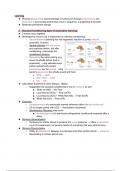
○ Unconditioned (learning has not happened; reaction is purely natural,
automatic, & quick)
○ Neutral stimulus did not cause
any response before, but after
conditioning, it becomes the
conditioned stimulus
○ Repeating the same pairing (e.g
sound of whistle before food is
presented) → dog salivated even
without actual food present
(responses are the same) → dog
learnt to associate the whistle sound with food
■ UCS → UCR
■ NS + UCS → UCR
■ CS → CR
★ Little Albert Experiment (John Watson, 1920s)
○ Suggested that classical conditioning is true in humans as well
■ White rat (NS) → No Fear
■ Loud Sound (UCS) → Fear (UCR)
■ Loud Sound (UCS) + White Rat (NS) → Fear (UCR)
■ White Rat (CS) → Fear (CR)
★ Extinction
○ Disappearance of a previously learned behaviour after it is not reinforced
○ CS no longer paired with UCS → Association not present
○ Spontaneous Recovery may occur
■ Re-emergence of a previously extinguished conditioned response after a
delay
★ Stimulus Generalization
○ Tendency for similar stimuli to produce the same response → offers protection!
○ e.g in lil a experiment, he became fearful of everything that was white & fuzzy
★ Stimulus Discrimination
○ Ability to distinguish between one stimulus and other similar stimuli → adaptive
○ Responding to certain stimuli only


