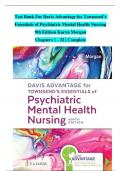
Test Bank For Davis Advantage for Townsend’s
Essentials of Psychiatric Mental Health Nursing
9th Edition Karyn Morgan
Chapters 1 - 32 | Complete
,TABLE OF CONTENTS
INTRODUCTION TO PSYCHIATRIC MENTAL HEALTH CONCEPTS
1. Mental Health and Mental Illness
2. Biological Implications
3. Ethical and Legal Issues
4. Psychopharmacology
II. PSYCHIATRIC MENTAL HEALTH NURSING INTERVENTIONS
5. Relationship Development and Therapeutic Communication
6. The Nursing Process in Psychiatric/Mental Health Nursing
7. Psychosocial Interventions and Spiritual Care
8. Intervention in Groups
9. Crisis Intervention
10. The Recovery Model
11. Suicide Prevention
III. CARE OF PATIENTS WITH PSYCHIATRIC DISORDERS
12. Caring for Patients with Mental Illness and Substance Use Disorders in General Practice Settings
13. Neurocognitive Disorders
14. Substance Use and Addiction Disorders
15. Schizophrenia Spectrum and Other Psychotic Disorders
16. Depressive Disorders
17. Bipolar and Related Disorders
18. Anxiety, Obsessive-Compulsive, and Related Disorders
19. Trauma- and Stressor-Related Disorders
20. Somatic Symptom and Dissociative Disorders
21. Eating Disorders
22. Personality Disorders
IV. PSYCHIATRIC MENTAL HEALTH NURSING OF SPECIAL POPULATIONS
23. Children and Adolescents
24. The Aging Individual
25. Survivors of Abuse or Neglect
26. Community Mental Health Nursing
27. The t Bereaved t Individual
28. t Military t Families
V. t ONLINE t CHAPTERS
29. t Concepts t of t Personality t Development
30. t Complementary t and t Integrative t Therapies
31. t Cultural t Concepts t Relevant t to t Psychiatric t Mental t Health t Nursing
32. t Issues t Related t to t Human t Sexuality t and t Gender t Dysphoria t
,Chapter t 1. t Mental t Health t and t Mental t
IllnesstMultiple t Choice
1. t A t nurse t is t assessing t a t client t who t is t experiencing t occasional t feelings t of t sadness t
because t of t thetrecent t death t of t a t beloved t pet. t The t clients t appetite, t sleep t patterns, t and t
daily t routine t have t not t changed. t How t should t the t nurse t interpret t the t clients t behaviors?
1. The t clients t behaviors t demonstrate t mental t illness t in t the t form t of t depression.
2. The t clients t behaviors t are t extensive, t which t indicates t the t presence t of t mental t illness.
3. The t clients t behaviors t are t not t congruent t with t cultural t norms.
4. The t clients t behaviors t demonstrate t no t functional t impairment, t indicating t no t mental t illness.
ANSWER: t 4
Rationale: t The t nurse t should t assess t that t the t clients t daily t functioning t is t not t impaired. t The t
clienttwho t experiences t feelings t of t sadness t after t the t loss t of t a t pet t is t responding t within t
normal t expectations. t Without t significant t impairment, t the t clients t distress t does t not t indicate
t a t mental t illness.
Cognitive t Level: t Analysis t
Integrated t Process: t
Assessment
2. t At t what t point t should t the t nurse t determine t that t a t client t is t at t risk t for t
developing t a t mentaltillness?
1. When t thoughts, t feelings, t and t behaviors t are t not t reflective t of t the t DSM-5 t criteria.
2. When t maladaptive t responses t to t stress t are t coupled t with t interference t in t daily t functioning.
3. When t a t client t communicates t significant t distress.
4. When t a t client t uses t defense t mechanisms t as t ego t protection.
ANSWER: t 2
Rationale: t The t nurse t should t determine t that t the t client t is t at t risk t for t mental t illness t when t
responsestto t stress t are t maladaptive t and t interfere t with t daily t functioning. t The t DSM-5 t
indicates t that t in t ordertto t be t diagnosed t with t a t mental t illness, t daily t functioning t must t be t
significantly t impaired. t The t clients t ability t to t communicate t distress t would t be t considered t a
t positive t attribute.
Cognitive t Level: t Application
t Integrated t Process: t
Assessment
3. t A t nurse t is t assessing t a t set t of t 15-year-old t identical t twins t who t respond t very t differently t
to t stress.tOne t twin t becomes t anxious t and t irritable, t and t the t other t withdraws t and t cries. t
How t should t the t nurse t explain t these t different t stress t responses t to t the t parents?
1. Reactions t to t stress t are t relative t rather t than t absolute; t individual t responses t to t stress t vary.
2. It t is t abnormal t for t identical t twins t to t react t differently t to t similar t stressors.
3. Identical t twins t should t share t the t same t temperament t and t respond t similarly t to t stress.
4. Environmental t influences t to t stress t weigh t more t heavily t than t genetic t influences.
, ANSWER: t 1
Rationale: t The t nurse t should t explain t to t the t parents t that, t although t the t twins t have t
identical t DNA,tthere t are t several t other t factors t that t affect t reactions t to t stress. t Mental t health
t is t a t state t of t being t thattis t relative t to t the t individual t client. t Environmental t influences t and t
temperament t can t affect t stress t reactions.
Cognitive t Level: t Application t
Integrated t Process: t
Implementation
4. t Which t client t should t the t nurse t anticipate t to t be t most t receptive t to t psychiatric t
treatment?t1. t A t Jewish, t female t social t worker.
2. A t Baptist, t homeless t male.
3. A t Catholic, t black t male.
4. A t Protestant, t Swedish t business t executive.
ANSWER: t 1
Rationale: t The t nurse t should t anticipate t that t the t client t of t Jewish t culture t would t place t a t
high t importance t on t preventative t health t care t and t would t consider t mental t health t as t equally
t important t astphysical t health. t Women t are t also t more t likely t to t seek t treatment t for t mental t
health t problems t than t men.
Cognitive t Level: t
ApplicationtIntegrated t
Process: t Planning
5. A t psychiatric t nurse t intern t states, t This t clients t use t of t defense t mechanisms t should t be t
eliminated.tWhich t is t a t correct t evaluation t of t this t nurses t statement?
1. Defense t mechanisms t can t be t appropriate t responses t to t stress t and t need t not t be t eliminated.
2. Defense t mechanisms t are t a t maladaptive t attempt t of t the t ego t to t manage t anxiety t
andshouldtalways t be t eliminated.
3. Defense t mechanisms, t used t by t individuals t with t weak t ego t integrity, t should t be t
discouragedandtnot t eliminated.
4. Defense t mechanisms t cause t disintegration t of t the t ego t and t should t be t fostered t and t
encouraged.
ANSWER: t 1
Rationale: t The t nurse t should t determine t that t defense t mechanisms t can t be t appropriate t during
t timestof t stress. t The t client t with t no t defense t mechanisms t may t have t a t lower t tolerance t for t
stress, t thus t leading t to t anxiety t disorders. t Defense t mechanisms t should t be t confronted t when
t they t impede t the t client t from t developing t healthy t coping t skills.
Cognitive t Level: t
Application t Integrated t
Process: t Evaluation
6. t During t an t intake t assessment, t a t nurse t asks t both t physiological t and t psychosocial t
questions. t Thetclient t angrily t responds, t Im t here t for t my t heart, t not t my t head t problems. t
Which t is t the t nurses t best t response?
1. Its t just t a t routine t part t of t our t assessment. t All t clients t are t asked t these t same t questions.
2. Why t are t you t concerned t about t these t types t of t questions?
3. Psychological t factors, t like t excessive t stress, t have t been t found t to t affect t medical t conditions.
4. We t can t skip t these t questions, t if t you t like. t It t isnt t imperative t that t we t complete t this t section.
Essentials of Psychiatric Mental Health Nursing
9th Edition Karyn Morgan
Chapters 1 - 32 | Complete
,TABLE OF CONTENTS
INTRODUCTION TO PSYCHIATRIC MENTAL HEALTH CONCEPTS
1. Mental Health and Mental Illness
2. Biological Implications
3. Ethical and Legal Issues
4. Psychopharmacology
II. PSYCHIATRIC MENTAL HEALTH NURSING INTERVENTIONS
5. Relationship Development and Therapeutic Communication
6. The Nursing Process in Psychiatric/Mental Health Nursing
7. Psychosocial Interventions and Spiritual Care
8. Intervention in Groups
9. Crisis Intervention
10. The Recovery Model
11. Suicide Prevention
III. CARE OF PATIENTS WITH PSYCHIATRIC DISORDERS
12. Caring for Patients with Mental Illness and Substance Use Disorders in General Practice Settings
13. Neurocognitive Disorders
14. Substance Use and Addiction Disorders
15. Schizophrenia Spectrum and Other Psychotic Disorders
16. Depressive Disorders
17. Bipolar and Related Disorders
18. Anxiety, Obsessive-Compulsive, and Related Disorders
19. Trauma- and Stressor-Related Disorders
20. Somatic Symptom and Dissociative Disorders
21. Eating Disorders
22. Personality Disorders
IV. PSYCHIATRIC MENTAL HEALTH NURSING OF SPECIAL POPULATIONS
23. Children and Adolescents
24. The Aging Individual
25. Survivors of Abuse or Neglect
26. Community Mental Health Nursing
27. The t Bereaved t Individual
28. t Military t Families
V. t ONLINE t CHAPTERS
29. t Concepts t of t Personality t Development
30. t Complementary t and t Integrative t Therapies
31. t Cultural t Concepts t Relevant t to t Psychiatric t Mental t Health t Nursing
32. t Issues t Related t to t Human t Sexuality t and t Gender t Dysphoria t
,Chapter t 1. t Mental t Health t and t Mental t
IllnesstMultiple t Choice
1. t A t nurse t is t assessing t a t client t who t is t experiencing t occasional t feelings t of t sadness t
because t of t thetrecent t death t of t a t beloved t pet. t The t clients t appetite, t sleep t patterns, t and t
daily t routine t have t not t changed. t How t should t the t nurse t interpret t the t clients t behaviors?
1. The t clients t behaviors t demonstrate t mental t illness t in t the t form t of t depression.
2. The t clients t behaviors t are t extensive, t which t indicates t the t presence t of t mental t illness.
3. The t clients t behaviors t are t not t congruent t with t cultural t norms.
4. The t clients t behaviors t demonstrate t no t functional t impairment, t indicating t no t mental t illness.
ANSWER: t 4
Rationale: t The t nurse t should t assess t that t the t clients t daily t functioning t is t not t impaired. t The t
clienttwho t experiences t feelings t of t sadness t after t the t loss t of t a t pet t is t responding t within t
normal t expectations. t Without t significant t impairment, t the t clients t distress t does t not t indicate
t a t mental t illness.
Cognitive t Level: t Analysis t
Integrated t Process: t
Assessment
2. t At t what t point t should t the t nurse t determine t that t a t client t is t at t risk t for t
developing t a t mentaltillness?
1. When t thoughts, t feelings, t and t behaviors t are t not t reflective t of t the t DSM-5 t criteria.
2. When t maladaptive t responses t to t stress t are t coupled t with t interference t in t daily t functioning.
3. When t a t client t communicates t significant t distress.
4. When t a t client t uses t defense t mechanisms t as t ego t protection.
ANSWER: t 2
Rationale: t The t nurse t should t determine t that t the t client t is t at t risk t for t mental t illness t when t
responsestto t stress t are t maladaptive t and t interfere t with t daily t functioning. t The t DSM-5 t
indicates t that t in t ordertto t be t diagnosed t with t a t mental t illness, t daily t functioning t must t be t
significantly t impaired. t The t clients t ability t to t communicate t distress t would t be t considered t a
t positive t attribute.
Cognitive t Level: t Application
t Integrated t Process: t
Assessment
3. t A t nurse t is t assessing t a t set t of t 15-year-old t identical t twins t who t respond t very t differently t
to t stress.tOne t twin t becomes t anxious t and t irritable, t and t the t other t withdraws t and t cries. t
How t should t the t nurse t explain t these t different t stress t responses t to t the t parents?
1. Reactions t to t stress t are t relative t rather t than t absolute; t individual t responses t to t stress t vary.
2. It t is t abnormal t for t identical t twins t to t react t differently t to t similar t stressors.
3. Identical t twins t should t share t the t same t temperament t and t respond t similarly t to t stress.
4. Environmental t influences t to t stress t weigh t more t heavily t than t genetic t influences.
, ANSWER: t 1
Rationale: t The t nurse t should t explain t to t the t parents t that, t although t the t twins t have t
identical t DNA,tthere t are t several t other t factors t that t affect t reactions t to t stress. t Mental t health
t is t a t state t of t being t thattis t relative t to t the t individual t client. t Environmental t influences t and t
temperament t can t affect t stress t reactions.
Cognitive t Level: t Application t
Integrated t Process: t
Implementation
4. t Which t client t should t the t nurse t anticipate t to t be t most t receptive t to t psychiatric t
treatment?t1. t A t Jewish, t female t social t worker.
2. A t Baptist, t homeless t male.
3. A t Catholic, t black t male.
4. A t Protestant, t Swedish t business t executive.
ANSWER: t 1
Rationale: t The t nurse t should t anticipate t that t the t client t of t Jewish t culture t would t place t a t
high t importance t on t preventative t health t care t and t would t consider t mental t health t as t equally
t important t astphysical t health. t Women t are t also t more t likely t to t seek t treatment t for t mental t
health t problems t than t men.
Cognitive t Level: t
ApplicationtIntegrated t
Process: t Planning
5. A t psychiatric t nurse t intern t states, t This t clients t use t of t defense t mechanisms t should t be t
eliminated.tWhich t is t a t correct t evaluation t of t this t nurses t statement?
1. Defense t mechanisms t can t be t appropriate t responses t to t stress t and t need t not t be t eliminated.
2. Defense t mechanisms t are t a t maladaptive t attempt t of t the t ego t to t manage t anxiety t
andshouldtalways t be t eliminated.
3. Defense t mechanisms, t used t by t individuals t with t weak t ego t integrity, t should t be t
discouragedandtnot t eliminated.
4. Defense t mechanisms t cause t disintegration t of t the t ego t and t should t be t fostered t and t
encouraged.
ANSWER: t 1
Rationale: t The t nurse t should t determine t that t defense t mechanisms t can t be t appropriate t during
t timestof t stress. t The t client t with t no t defense t mechanisms t may t have t a t lower t tolerance t for t
stress, t thus t leading t to t anxiety t disorders. t Defense t mechanisms t should t be t confronted t when
t they t impede t the t client t from t developing t healthy t coping t skills.
Cognitive t Level: t
Application t Integrated t
Process: t Evaluation
6. t During t an t intake t assessment, t a t nurse t asks t both t physiological t and t psychosocial t
questions. t Thetclient t angrily t responds, t Im t here t for t my t heart, t not t my t head t problems. t
Which t is t the t nurses t best t response?
1. Its t just t a t routine t part t of t our t assessment. t All t clients t are t asked t these t same t questions.
2. Why t are t you t concerned t about t these t types t of t questions?
3. Psychological t factors, t like t excessive t stress, t have t been t found t to t affect t medical t conditions.
4. We t can t skip t these t questions, t if t you t like. t It t isnt t imperative t that t we t complete t this t section.