

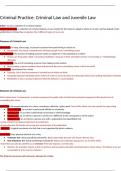
Criminal Practice: Criminal Law and Juvenile Law
Crime- an act in violation of a criminal statute
Model Penal Code- a collection of criminal statutes, it was created for the states to adopt in whole or in part, and has helped create
uniformity in criminal law-recognizes the 4 different types of mens rea
Purposes of Criminal Law:
Deterrence- to stop, discourage, or prevent a person from performing a certain act
● Presumably, the threat of punishment will deter people from committing crimes
Rehabilitation- the process of helping a person attain or regain his or her potential as a citizen
● Prisons are frequently called "correctional institutes" because of their intended function of correcting or "rehabilitating"
offenders
Incapacitation- the act of restraining a person from taking certain actions
● Incarcerating a person confines them and prevents her from committing crimes in the free world
Retribution- punishment for a crime
● Typically, this is the first purpose of criminal law of which we think
● Societally-imposed retribution gives victims of crimes a sense of justice and dissuades them from seeking individual retribution
● Retribution is also a societal statement that the behavior is unacceptable
Elements of Criminal Law:
Most crimes have 2 components- a mental component (or guilty state of mind) and a physical component (the physical act of
committing the crime)
Mens Rea- the mental element of a crime; sometimes called the "guilty mind"-kind of like intent, but not exactly the same thing
● Purposeful Act- an act that is performed willfully or voluntarily
● Knowing Act- an act that is performed consciously or with knowledge
● Reckless Act- an act where a person is careless or indifferent to the consequences of the action
● Negligent Act- an act where a person acts with a substantial and unjustifiable risk
-Levels of intent correspond with level of punishment
-Prosecution has the burden of proving the mental state of the defendant
-Inference- a logical conclusion of a fact that is not supported by direct evidence
Actus Reus- they physical element of a crime
● Voluntary Act- doing something voluntarily- Betsy slaps Haley because she doesn't like her face
● Non-Voluntary Act- doing something involuntarily- Betsy has involuntary leg spasms, so she kicks Haley
-Actus Reus can also be satisfied as an omission if the law imposes a certain duty:
● Statutes, for example, impose a duty on primary and secondary education professionals to report abuse. The fialure to do so i
an example of actus reus by omission.
The State has to prove each and every element of a crime.
Crime- an act in violation of a criminal statute
Model Penal Code- a collection of criminal statutes, it was created for the states to adopt in whole or in part, and has helped create
uniformity in criminal law-recognizes the 4 different types of mens rea
Purposes of Criminal Law:
Deterrence- to stop, discourage, or prevent a person from performing a certain act
● Presumably, the threat of punishment will deter people from committing crimes
Rehabilitation- the process of helping a person attain or regain his or her potential as a citizen
● Prisons are frequently called "correctional institutes" because of their intended function of correcting or "rehabilitating"
offenders
Incapacitation- the act of restraining a person from taking certain actions
● Incarcerating a person confines them and prevents her from committing crimes in the free world
Retribution- punishment for a crime
● Typically, this is the first purpose of criminal law of which we think
● Societally-imposed retribution gives victims of crimes a sense of justice and dissuades them from seeking individual retribution
● Retribution is also a societal statement that the behavior is unacceptable
Elements of Criminal Law:
Most crimes have 2 components- a mental component (or guilty state of mind) and a physical component (the physical act of
committing the crime)
Mens Rea- the mental element of a crime; sometimes called the "guilty mind"-kind of like intent, but not exactly the same thing
● Purposeful Act- an act that is performed willfully or voluntarily
● Knowing Act- an act that is performed consciously or with knowledge
● Reckless Act- an act where a person is careless or indifferent to the consequences of the action
● Negligent Act- an act where a person acts with a substantial and unjustifiable risk
-Levels of intent correspond with level of punishment
-Prosecution has the burden of proving the mental state of the defendant
-Inference- a logical conclusion of a fact that is not supported by direct evidence
Actus Reus- they physical element of a crime
● Voluntary Act- doing something voluntarily- Betsy slaps Haley because she doesn't like her face
● Non-Voluntary Act- doing something involuntarily- Betsy has involuntary leg spasms, so she kicks Haley
-Actus Reus can also be satisfied as an omission if the law imposes a certain duty:
● Statutes, for example, impose a duty on primary and secondary education professionals to report abuse. The fialure to do so i
an example of actus reus by omission.
The State has to prove each and every element of a crime.


