
Manufacturing Industries
Heading Point wise Summary
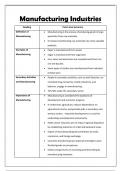
Definition of • Manufacturing is the process of producing goods in large
Manufacturing quantities from raw materials.
• It involves transforming raw materials into more valuable
products.
Examples of • Paper is manufactured from wood.
Manufacturing • Sugar is manufactured from sugarcane.
• Iron, steel, and aluminium are manufactured from iron
ore and bauxite.
• Some types of clothes are manufactured from industrial
product yarn.
Secondary Activities • People in secondary activities, such as steel factories, car
and Manufacturing manufacturing, breweries, textile industries, and
bakeries, engage in manufacturing.
• This falls under the secondary sector.
Importance of • Manufacturing is considered the backbone of
Manufacturing development and economic progress.
• It modernizes agriculture, reduces dependence on
agricultural income, and provides jobs in secondary and
tertiary sectors. Industrial development is crucial for
eradicating unemployment and poverty.
• Public sector industries aim to reduce regional disparities
by establishing industries in tribal and backward areas.
• Export of manufactured goods contributes to trade,
commerce, and foreign exchange.
• Countries transforming raw materials into higher value
finished goods are prosperous.
• India's prosperity lies in increasing and diversifying its
manufacturing industries.
, Agriculture and • Agriculture and industry are interlinked, agro industries in
Industry Connection India boost agriculture's productivity.
• Agro industries sell products like irrigation pumps,
fertilizers, etc., to farmers, enhancing production
efficiency.
Global • In the era of globalization, industries must be efficient
Competitiveness and competitive.
• Self-sufficiency is not enough; manufactured goods must
match international quality standards for global
competition.
Now, let's proceed with the questions:
Multiple Choice Questions (MCQs):
1. What is the primary focus of the chapter?
a) Agriculture b) Industrial development c) Services d) Unemployment
Answer: b) Industrial development
2. Why are manufacturing industries considered the backbone of economic
development?
a) They increase agricultural income.
b) They reduce dependence on agricultural income.
c) They focus on public sector ventures.
d) They establish industries in tribal areas.
Answer: b) They reduce dependence on agricultural income.
Assertion and Reasoning Questions:
3. Assertion: Export of manufactured goods is crucial for a country's prosperity.
Reason: Countries transforming raw materials into higher-value finished goods are
Answer: a) Both assertion and reason are true, and the reason is the correct
explanation of the assertion.
, Short Answer Question:
4. Explain the connection between agro-industries and agriculture in India.
OR
Agriculture and Industry can’t remain exclusive of each other. Substantiate.
Answer:
• Agro-industries in India enhance agriculture by providing products like irrigation
pumps and fertilizers to farmers, boosting productivity and efficiency.
• Agriculture supplies raw materials to agro based industries. Cotton to cotton
textile, fruits and vegetables to food processing industries etc are examples.
5. Discuss the role of manufacturing industries in the globalization era and why global
competitiveness is crucial for India.
Answer:
• Manufacturing industries, in the age of globalization, need to be efficient and
competitive to match international standards.
• India's prosperity relies on increasing and diversifying manufacturing industries
to compete globally and contribute to economic growth.
6. Manufacturing Industries are considered as the back bone of economic
development. Examine the statement.
Ans: Refer the table above.
Classification of Industries
Heading Point wise Summary
Introduction List of various manufactured products in daily life, e.g.,
transistors, electric bulbs, vegetable oil, cement, glassware,
petrol, matches, scooters, automobiles, medicines, etc.
Classification Based Agro based: Includes cotton, woollen, jute, silk textiles, rubber,
on Raw Materials sugar, tea, coffee, edible oil.
Mineral based: Includes iron and steel, cement, aluminium,
machine tools, petrochemicals.
Heading Point wise Summary
Definition of • Manufacturing is the process of producing goods in large
Manufacturing quantities from raw materials.
• It involves transforming raw materials into more valuable
products.
Examples of • Paper is manufactured from wood.
Manufacturing • Sugar is manufactured from sugarcane.
• Iron, steel, and aluminium are manufactured from iron
ore and bauxite.
• Some types of clothes are manufactured from industrial
product yarn.
Secondary Activities • People in secondary activities, such as steel factories, car
and Manufacturing manufacturing, breweries, textile industries, and
bakeries, engage in manufacturing.
• This falls under the secondary sector.
Importance of • Manufacturing is considered the backbone of
Manufacturing development and economic progress.
• It modernizes agriculture, reduces dependence on
agricultural income, and provides jobs in secondary and
tertiary sectors. Industrial development is crucial for
eradicating unemployment and poverty.
• Public sector industries aim to reduce regional disparities
by establishing industries in tribal and backward areas.
• Export of manufactured goods contributes to trade,
commerce, and foreign exchange.
• Countries transforming raw materials into higher value
finished goods are prosperous.
• India's prosperity lies in increasing and diversifying its
manufacturing industries.
, Agriculture and • Agriculture and industry are interlinked, agro industries in
Industry Connection India boost agriculture's productivity.
• Agro industries sell products like irrigation pumps,
fertilizers, etc., to farmers, enhancing production
efficiency.
Global • In the era of globalization, industries must be efficient
Competitiveness and competitive.
• Self-sufficiency is not enough; manufactured goods must
match international quality standards for global
competition.
Now, let's proceed with the questions:
Multiple Choice Questions (MCQs):
1. What is the primary focus of the chapter?
a) Agriculture b) Industrial development c) Services d) Unemployment
Answer: b) Industrial development
2. Why are manufacturing industries considered the backbone of economic
development?
a) They increase agricultural income.
b) They reduce dependence on agricultural income.
c) They focus on public sector ventures.
d) They establish industries in tribal areas.
Answer: b) They reduce dependence on agricultural income.
Assertion and Reasoning Questions:
3. Assertion: Export of manufactured goods is crucial for a country's prosperity.
Reason: Countries transforming raw materials into higher-value finished goods are
Answer: a) Both assertion and reason are true, and the reason is the correct
explanation of the assertion.
, Short Answer Question:
4. Explain the connection between agro-industries and agriculture in India.
OR
Agriculture and Industry can’t remain exclusive of each other. Substantiate.
Answer:
• Agro-industries in India enhance agriculture by providing products like irrigation
pumps and fertilizers to farmers, boosting productivity and efficiency.
• Agriculture supplies raw materials to agro based industries. Cotton to cotton
textile, fruits and vegetables to food processing industries etc are examples.
5. Discuss the role of manufacturing industries in the globalization era and why global
competitiveness is crucial for India.
Answer:
• Manufacturing industries, in the age of globalization, need to be efficient and
competitive to match international standards.
• India's prosperity relies on increasing and diversifying manufacturing industries
to compete globally and contribute to economic growth.
6. Manufacturing Industries are considered as the back bone of economic
development. Examine the statement.
Ans: Refer the table above.
Classification of Industries
Heading Point wise Summary
Introduction List of various manufactured products in daily life, e.g.,
transistors, electric bulbs, vegetable oil, cement, glassware,
petrol, matches, scooters, automobiles, medicines, etc.
Classification Based Agro based: Includes cotton, woollen, jute, silk textiles, rubber,
on Raw Materials sugar, tea, coffee, edible oil.
Mineral based: Includes iron and steel, cement, aluminium,
machine tools, petrochemicals.


