

Chamizo’s Crusade Mental Health
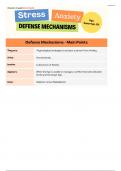
S tress Anxiety Ego,
DEFENSE MECHANISMS
Superego
, ID!
Defense Mechanisms - Main Points
They are: Psychological strategies to protect a person from Anxiety.
Arise: Unconsciously
Involve: A distortion of Reality
Appears: When the Ego is unable to manage a conflict that exits between
the ID and the Super Ego
Uses: Adaptive versus Maladaptive
, Selected Defense Mechanism!!!
Repression: Unconsciously putting unacceptable ideas, thoughts, and emotions
out of awareness
Regression: Sudden use of childlike or primitive behaviors that do not correlate
with the person’s current developmental level
Suppression: Voluntarily denying unpleasant thoughts and feelings
Displacement: Shifting feelings related to an object, person, or situation to another
less threatening object, person, or situation
Reaction Formation: Overcompensating or demonstrating the opposite behavior of what
is felt
Rationalization: Creating reasonable and acceptable explanations for unacceptable
behavior
Sublimation: Dealing with unacceptable feelings or impulses by unconsciously
substituting acceptable forms of expressing
Compensation: Emphasizing strengths to make up for weaknesses
Identification: Conscious or unconscious assumption of the characteristics of
another individual or group
Intellectualization: ·Separation of emotions and logical facts when analyzing or coping
with a situation or event
Denial: Pretending the truth is not reality to manage the anxiety of
acknowledging what is real
Undoing: Performing an act to make up for prior behavior
Altruism: Dealing with anxiety by reaching out to others
Dissociation: Creating a temporary compartmentalization or lack of connection
, between the person’s identity, memory, or how they perceive the
environment
Conversion: Responding to stress through the unconscious development of
physical manifestations not caused by physical illness
Projection: Attributing one’s unacceptable thoughts and feelings onto another
who does not have them
Splitting: Demonstrating an inability to reconcile negative and positive
attributes of self or others
Personality- S Freud- Components
ID: Based on Pleasure Principle/ Demands immediate gratification of needs/ only
component of personality that is present from birth/ includes instinctive and
primitive behaviors.
Ego: Based on Reality Principle/ Develops from the id and ensures that the impulses
of the id can be expressed in a manner acceptable in the real world/
responsible for dealing with reality
Super Ego: Based on Morality Principle/ begins to emerge at around age five/ provides
guidelines for making judgments
, Chamizo’s Crusade MENTAL HEALTH
Presupposition Clarifying O
C
EFFECTIVE COMMUNICATION
Effective Communication
Barriers : Offering advice ( limits patient autonomy and problem-solving skills)
Asking irrelevant personal questions
Offering personal opinions
Giving false reassurance ( assure or comfort the client about something tha
Minimizing feelings
Changing the topic
Asking “why” questions
Offering value judgements
Excessive questioning
Responding approvingly or disapprovingly
Effective Silence: It allows time for meaningful reflection
communication skills Active listening: It allows the nurse to provide feedback
and techniques: Type of Questions:
Open-ended: facilitates spontaneous responses and discussion
Closed-ended: helpful if used sparingly during the initial interaction to obtain
these repeatedly.
Projective: uses “what if” or similar questions to assist patients in exploring fe
understanding of problems and possible solutions
Presupposition: explores the patient’s life goals or motivations by presenting a
which the patient no longer has the mental health disorder
Clarifying techniques:
Restating: use the patient’ exact words
Reflecting: directs the focus back to the patient in order for the patient to ex
Paraphrasing: restates the patient’s feelings and thoughts for the patient to
communicated
Exploring: allows the nurse to gather more information regarding important t
patient
Offering general leads, broad opening statements: encourages the patient t
communication can start and to continue talking
Showing acceptance and recognition: acknowledges the nurse’s interest an
Focusing: helps the patient to concentrate on what is important
Giving information: provides details that the patient might need for decision
S tress Anxiety Ego,
DEFENSE MECHANISMS
Superego
, ID!
Defense Mechanisms - Main Points
They are: Psychological strategies to protect a person from Anxiety.
Arise: Unconsciously
Involve: A distortion of Reality
Appears: When the Ego is unable to manage a conflict that exits between
the ID and the Super Ego
Uses: Adaptive versus Maladaptive
, Selected Defense Mechanism!!!
Repression: Unconsciously putting unacceptable ideas, thoughts, and emotions
out of awareness
Regression: Sudden use of childlike or primitive behaviors that do not correlate
with the person’s current developmental level
Suppression: Voluntarily denying unpleasant thoughts and feelings
Displacement: Shifting feelings related to an object, person, or situation to another
less threatening object, person, or situation
Reaction Formation: Overcompensating or demonstrating the opposite behavior of what
is felt
Rationalization: Creating reasonable and acceptable explanations for unacceptable
behavior
Sublimation: Dealing with unacceptable feelings or impulses by unconsciously
substituting acceptable forms of expressing
Compensation: Emphasizing strengths to make up for weaknesses
Identification: Conscious or unconscious assumption of the characteristics of
another individual or group
Intellectualization: ·Separation of emotions and logical facts when analyzing or coping
with a situation or event
Denial: Pretending the truth is not reality to manage the anxiety of
acknowledging what is real
Undoing: Performing an act to make up for prior behavior
Altruism: Dealing with anxiety by reaching out to others
Dissociation: Creating a temporary compartmentalization or lack of connection
, between the person’s identity, memory, or how they perceive the
environment
Conversion: Responding to stress through the unconscious development of
physical manifestations not caused by physical illness
Projection: Attributing one’s unacceptable thoughts and feelings onto another
who does not have them
Splitting: Demonstrating an inability to reconcile negative and positive
attributes of self or others
Personality- S Freud- Components
ID: Based on Pleasure Principle/ Demands immediate gratification of needs/ only
component of personality that is present from birth/ includes instinctive and
primitive behaviors.
Ego: Based on Reality Principle/ Develops from the id and ensures that the impulses
of the id can be expressed in a manner acceptable in the real world/
responsible for dealing with reality
Super Ego: Based on Morality Principle/ begins to emerge at around age five/ provides
guidelines for making judgments
, Chamizo’s Crusade MENTAL HEALTH
Presupposition Clarifying O
C
EFFECTIVE COMMUNICATION
Effective Communication
Barriers : Offering advice ( limits patient autonomy and problem-solving skills)
Asking irrelevant personal questions
Offering personal opinions
Giving false reassurance ( assure or comfort the client about something tha
Minimizing feelings
Changing the topic
Asking “why” questions
Offering value judgements
Excessive questioning
Responding approvingly or disapprovingly
Effective Silence: It allows time for meaningful reflection
communication skills Active listening: It allows the nurse to provide feedback
and techniques: Type of Questions:
Open-ended: facilitates spontaneous responses and discussion
Closed-ended: helpful if used sparingly during the initial interaction to obtain
these repeatedly.
Projective: uses “what if” or similar questions to assist patients in exploring fe
understanding of problems and possible solutions
Presupposition: explores the patient’s life goals or motivations by presenting a
which the patient no longer has the mental health disorder
Clarifying techniques:
Restating: use the patient’ exact words
Reflecting: directs the focus back to the patient in order for the patient to ex
Paraphrasing: restates the patient’s feelings and thoughts for the patient to
communicated
Exploring: allows the nurse to gather more information regarding important t
patient
Offering general leads, broad opening statements: encourages the patient t
communication can start and to continue talking
Showing acceptance and recognition: acknowledges the nurse’s interest an
Focusing: helps the patient to concentrate on what is important
Giving information: provides details that the patient might need for decision


