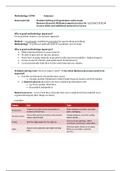
Methodology 1ZV00 Summary
Exam material Problem Solving in Organization: entire book
Business Research Methods (empirical cycle): Ch. 1,2,3,5,6,7,9,12,14
Lecture slides and additional material on Canvas
Why is good methodology important?
Every problem requires a systematic approach.
Method = A systematic established procedure for approaching something
Methodology = A system of methods used in a particular area of study
Why is good methodology important?
Make informed choices in your projects;
Be able to plan and set-up your project;
Know how to apply methods to get good results (and avoid pitfalls = hidden danger);
Assess research critically (and understand its limitations!);
Learn transferable skills that will be useful beyond your studies.
Problem-solving cycle = How to make it work? Use when Business processes need to be
improved
Used for performance-related business issues
Context specific! (Solution for Albert Heijn does not need to work for Jumbo)
A business process that does not meet a defined performance level
e.g. Costs, quality, timeliness
Dissatisfied stakeholders
Business process = A set of activities and tasks that, once completed will accomplish in an
organisational goal (How things are done)
examples
,Problem Solving Cycle
Step 1: Problem Definition = Search, choose, demarcate, plan
(Figuring out what the problem is and defining is)
Step 2: Analysis and Diagnoses = Systematically gather and interpret information on context
and possibly causes
Step 3: Solution Design = Propose a solution and plan how to implement it
Step 4: Intervention = Implement the solution
Step 5: Evaluation and learning = Does it work/improve?
Empirical Cycle
Used for generic business problems that many businesses encounter
Relationships between variables
Develop and empirically test theories
Aim: generalizable insights, usable across contexts
Step 1: Observation = Observe a business problem
Is this likely to apply in many instances?
Does academic literature already say something?
Step 2: Induction (developing theory) = Possible explanations in literature or based on data?
Step 3: Deduction (generalizing hypotheses) = formulate generic hypotheses
Step 4: Testing (of hypotheses) = Empirical hypothesis testing (quantitative data and
qualitative case studies)
Step 5: Evaluation = is this the right explanation?
, PROBLEM-SOLVING CYCLE STEP 1 : PROBLEM DEFINITION
Defining a Business problem
Problem mess and problem statement
Setting up a problem-solving project
Problem Definition = Search, Choose, Demarcate and plan
Collect insights both internally and externally
Synthesise all information
Select business problem and demarcate
Decide on research framework: theory and deliverables
Plan: when to do what and why, using which resources
Write project proposal
Business problem= A state of affairs in the real world where important stakeholders are
dissatisfied, while they believe that things can be improved. A business process that does not
meet expectations and can be improved.
Problem mess Problem statement
Problem: Food waste at Albert Heijn
, Problem definition: The accuracy of the replenishment process is too low.
When do store managers deviate from the suggested order quantity?
What does the academic literature say on human forecasting?
When are humans better than forecasting that algorithms?
Adjust the order system so that store managers are:
Encouraged to change the order in certain situations
Discouraged to change the order in other situations
Includes: training, awareness, openness to change, etc.
Problem statement = a description of a business problem
No problem-solving project without problem statement!
Generic form of IE problem statements: Y of X is Z
Y = Performance indicator e.g. costs, quality, throughput time
X = Business process
Z = Unwanted value of Y
Examples:
A problem statement is a statement (e.g. “The runtime of X is too long”)
Not a question (“What is the causes of the long runtime?”)
Not an assignment ( “Shorten the runtime.”)
Not a cause-effect relationship (“Limited capacity of Y causes the long runtime”.)
Try to make your problem statement as specific as possible in terms of structure, content, time
and place.
“Workload (performance indicator) in production (Business process) is too high
(unwanted outcome)
Characteristics of Business Problems
Part of a problem mess
Embedded in social systems
o Several stakeholders with potentially contradicting perspectives and
interests
Open ended, multiple solutions possible
Often solved within constraints of time and resources
Exam material Problem Solving in Organization: entire book
Business Research Methods (empirical cycle): Ch. 1,2,3,5,6,7,9,12,14
Lecture slides and additional material on Canvas
Why is good methodology important?
Every problem requires a systematic approach.
Method = A systematic established procedure for approaching something
Methodology = A system of methods used in a particular area of study
Why is good methodology important?
Make informed choices in your projects;
Be able to plan and set-up your project;
Know how to apply methods to get good results (and avoid pitfalls = hidden danger);
Assess research critically (and understand its limitations!);
Learn transferable skills that will be useful beyond your studies.
Problem-solving cycle = How to make it work? Use when Business processes need to be
improved
Used for performance-related business issues
Context specific! (Solution for Albert Heijn does not need to work for Jumbo)
A business process that does not meet a defined performance level
e.g. Costs, quality, timeliness
Dissatisfied stakeholders
Business process = A set of activities and tasks that, once completed will accomplish in an
organisational goal (How things are done)
examples
,Problem Solving Cycle
Step 1: Problem Definition = Search, choose, demarcate, plan
(Figuring out what the problem is and defining is)
Step 2: Analysis and Diagnoses = Systematically gather and interpret information on context
and possibly causes
Step 3: Solution Design = Propose a solution and plan how to implement it
Step 4: Intervention = Implement the solution
Step 5: Evaluation and learning = Does it work/improve?
Empirical Cycle
Used for generic business problems that many businesses encounter
Relationships between variables
Develop and empirically test theories
Aim: generalizable insights, usable across contexts
Step 1: Observation = Observe a business problem
Is this likely to apply in many instances?
Does academic literature already say something?
Step 2: Induction (developing theory) = Possible explanations in literature or based on data?
Step 3: Deduction (generalizing hypotheses) = formulate generic hypotheses
Step 4: Testing (of hypotheses) = Empirical hypothesis testing (quantitative data and
qualitative case studies)
Step 5: Evaluation = is this the right explanation?
, PROBLEM-SOLVING CYCLE STEP 1 : PROBLEM DEFINITION
Defining a Business problem
Problem mess and problem statement
Setting up a problem-solving project
Problem Definition = Search, Choose, Demarcate and plan
Collect insights both internally and externally
Synthesise all information
Select business problem and demarcate
Decide on research framework: theory and deliverables
Plan: when to do what and why, using which resources
Write project proposal
Business problem= A state of affairs in the real world where important stakeholders are
dissatisfied, while they believe that things can be improved. A business process that does not
meet expectations and can be improved.
Problem mess Problem statement
Problem: Food waste at Albert Heijn
, Problem definition: The accuracy of the replenishment process is too low.
When do store managers deviate from the suggested order quantity?
What does the academic literature say on human forecasting?
When are humans better than forecasting that algorithms?
Adjust the order system so that store managers are:
Encouraged to change the order in certain situations
Discouraged to change the order in other situations
Includes: training, awareness, openness to change, etc.
Problem statement = a description of a business problem
No problem-solving project without problem statement!
Generic form of IE problem statements: Y of X is Z
Y = Performance indicator e.g. costs, quality, throughput time
X = Business process
Z = Unwanted value of Y
Examples:
A problem statement is a statement (e.g. “The runtime of X is too long”)
Not a question (“What is the causes of the long runtime?”)
Not an assignment ( “Shorten the runtime.”)
Not a cause-effect relationship (“Limited capacity of Y causes the long runtime”.)
Try to make your problem statement as specific as possible in terms of structure, content, time
and place.
“Workload (performance indicator) in production (Business process) is too high
(unwanted outcome)
Characteristics of Business Problems
Part of a problem mess
Embedded in social systems
o Several stakeholders with potentially contradicting perspectives and
interests
Open ended, multiple solutions possible
Often solved within constraints of time and resources