

NOTES Genetics and public health (GPH)
LECTURE 1. Meet & Greet: Mendel
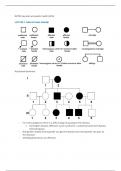
Autosomal dominant:
- For every pregnancy there is a 50% change of passing on the disease.
o Huntington disease, BRCA1/2, Lynch syndrome = autosomal dominant disease,
Achondroplasia
- Not gender related (every gender can get the disease and every gender can pass on
the disease).
- Multiple generations are affected.
,Autosomal recessive:
- Parents are usually not affected; they can be carriers but they will not have the
phenotype.
- Usually 25% change of having a child with the disease.
o First child is usually the one that is affected.
o Most of the time only one person/child is affected.
- One generation is affected; the disease is only displayed in one generation – example
above = 2nd generation.
o Cystic fibrosis, hemoglobinopathies, phenylketonuria.
- Sometimes parents are consanguineous (incest) – both parents are often a carrier of
the same recessive disease, leading to a higher risk of a child with the diseased
phenotype.
We all are carriers of recessive diseases.
X-linked:
- There is no increased risk on passing on the X-linked disorder when there is a healthy
male in between the person with the disorder and the determined person.
- Usually male (sons) are affected and have the diseased phenotype.
,- Woman usually are not affected, they can however be carriers. Therefore, they can
pass on the disease.
- No inheritance from man to man
o Fathers can have daughters that are carriers.
▪ Duchenne Muscular Dystrophy, Haemophilia, colour blindness.
, LECTURE 2. Genes and diseases
Part 1: genetic variation
Gene: function unit that is regulated by transcription and encodes a product (protein/ RNA).
- Only 2% actually encodes for proteins (exons).
o Exons determine our hereditary traits.
- Non-coding have probably more regulatory functions; switching genes on and off.
It is not just the number of genes that makes us who we are and determines the complexity
of the species, but it is probably that one gene encodes for multiple proteins (complexes) –
which then determines the complexity.
Human genetic variation – makes everyone unique; causes people to have different
phenotypes.
- Single nucleotide variant: only one variant that is changed between individuals.
- Insertion-deletion variant: multiple nucleotides involved.
- Block substitutions
- Inversion variant
- Copy number variant
Genetic variation:
- Comparing individuals – every 2 individuals each differ 1 base in 1000 base pairs.
o Handy in forensics and paternity tests.
- If a change in DNA has a higher occurrence; a frequency of >1%, you call it a
polymorphism.
o Most polymorphisms have no phenotypic consequences.
- It is important to distinguish between polymorphisms and (pathogenic) mutations.
Mutations:
- Mutation occur because of DNA damage which can be caused by endogenous causes
– like replication processes – or exogenous causes – like chemical damage
(chemotherapy) or ionizing radiation (radiotherapy).
o A mutation that causes protein disturbances can result in a disease or
disorder.
▪ Somatic cell mutation: cannot be inherited
▪ Germ/ sex cell mutation: can be inherited – cells in offspring will be
affected.
- Types of mutations:
o Chromosome mutation: on the chromosome level; loss of whole chromosome
(monosomy) or gain of whole chromosome (trisomy) – aneuploidy.
▪ Parts of chromosomes can also be changes; like translocations,
deletions, transversions, etc.
• A balanced translocation can be normal – because all the
information is still passed on.
• A unbalanced translocation can be detrimental – because you
lose a part of the information which can cause problems in the
offspring.
LECTURE 1. Meet & Greet: Mendel
Autosomal dominant:
- For every pregnancy there is a 50% change of passing on the disease.
o Huntington disease, BRCA1/2, Lynch syndrome = autosomal dominant disease,
Achondroplasia
- Not gender related (every gender can get the disease and every gender can pass on
the disease).
- Multiple generations are affected.
,Autosomal recessive:
- Parents are usually not affected; they can be carriers but they will not have the
phenotype.
- Usually 25% change of having a child with the disease.
o First child is usually the one that is affected.
o Most of the time only one person/child is affected.
- One generation is affected; the disease is only displayed in one generation – example
above = 2nd generation.
o Cystic fibrosis, hemoglobinopathies, phenylketonuria.
- Sometimes parents are consanguineous (incest) – both parents are often a carrier of
the same recessive disease, leading to a higher risk of a child with the diseased
phenotype.
We all are carriers of recessive diseases.
X-linked:
- There is no increased risk on passing on the X-linked disorder when there is a healthy
male in between the person with the disorder and the determined person.
- Usually male (sons) are affected and have the diseased phenotype.
,- Woman usually are not affected, they can however be carriers. Therefore, they can
pass on the disease.
- No inheritance from man to man
o Fathers can have daughters that are carriers.
▪ Duchenne Muscular Dystrophy, Haemophilia, colour blindness.
, LECTURE 2. Genes and diseases
Part 1: genetic variation
Gene: function unit that is regulated by transcription and encodes a product (protein/ RNA).
- Only 2% actually encodes for proteins (exons).
o Exons determine our hereditary traits.
- Non-coding have probably more regulatory functions; switching genes on and off.
It is not just the number of genes that makes us who we are and determines the complexity
of the species, but it is probably that one gene encodes for multiple proteins (complexes) –
which then determines the complexity.
Human genetic variation – makes everyone unique; causes people to have different
phenotypes.
- Single nucleotide variant: only one variant that is changed between individuals.
- Insertion-deletion variant: multiple nucleotides involved.
- Block substitutions
- Inversion variant
- Copy number variant
Genetic variation:
- Comparing individuals – every 2 individuals each differ 1 base in 1000 base pairs.
o Handy in forensics and paternity tests.
- If a change in DNA has a higher occurrence; a frequency of >1%, you call it a
polymorphism.
o Most polymorphisms have no phenotypic consequences.
- It is important to distinguish between polymorphisms and (pathogenic) mutations.
Mutations:
- Mutation occur because of DNA damage which can be caused by endogenous causes
– like replication processes – or exogenous causes – like chemical damage
(chemotherapy) or ionizing radiation (radiotherapy).
o A mutation that causes protein disturbances can result in a disease or
disorder.
▪ Somatic cell mutation: cannot be inherited
▪ Germ/ sex cell mutation: can be inherited – cells in offspring will be
affected.
- Types of mutations:
o Chromosome mutation: on the chromosome level; loss of whole chromosome
(monosomy) or gain of whole chromosome (trisomy) – aneuploidy.
▪ Parts of chromosomes can also be changes; like translocations,
deletions, transversions, etc.
• A balanced translocation can be normal – because all the
information is still passed on.
• A unbalanced translocation can be detrimental – because you
lose a part of the information which can cause problems in the
offspring.


