

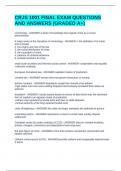
CRJS 1001 FINAL EXAM QUESTIONS
AND ANSWERS (GRADED A+)
criminology - ANSWER-a body of knowledge that regards crime as a social
phenomenon
6 major areas of the discipline of criminology - ANSWER-1. the definition of of crime
and criminals
2. the origins and role of the law
3. the social distribution of crime
4. the causation of crime
5. patterns of criminal behaviour
6. societal reactions to crime
small scale societies and informal social control - ANSWER--cooperation and equality
-collective solidarity
European formalized law - ANSWER-capitalist modes of production
criminal law - ANSWER-formal rules that govern behaviour un society
advisor systems - ANSWER-disputants sought the counsel of an advisor
-high status men who were settling disputes harmoniously increased their status as
advisors
feudalism - ANSWER--social system based on tenure of land which was the dominant
form of capital in an agrarian mode of production
-redress was replaced by feudal lords and laws to settle disputes
-central authority of the king replaced feudal lords
crisis of legitimacy - ANSWER-the state no longer maintains the authority to govern
restorative justice - ANSWER-represents a return to small scale society dispute
settlement
Canadian centre for justice statistics (CCJS) - ANSWER-data on criminal incidents,
arrests, charged, convictions and dispositions have improved
the dark figure of crime - ANSWER-crime that remains unreported, unrecorded and
largely unknown
Uniform crime reports (UCR) - ANSWER-provide uniform and comparable national stats
2 forms
, UCR aggregate survey:
-summary data for 100 separate criminal offences
-criminal incidents for every 100,000 Canadians
-comparisons between jurisdictions or over time
-the more reliable data is, the less valid it becomes
-UCR incident based survey: more detailed info on incidents, victims and accused
victimization surveys - ANSWER-more Canadians are victimized than is in stats
-victims that don't file report
self report studies - ANSWER-administered among certain population
helpful for youth crime
records become stats through aggregation - ANSWER-taking all records and data and
identifying the way their connected, can still be misunderstood/ misinterpreted
pre-18th century theories of crime - ANSWER-inspired by religious beliefs and
superstition
-temptation and possession
-brutal punishments
enlightenment era - ANSWER-scientific and objective
-social contract: scientific approach to understanding crime and behaviour
classical school - ANSWER-liberalism and utilitarianism to the justice system
-rights, fairness and due process
positivist schools - ANSWER-lombroso: stigma and atavism
-physical characteristics, criminals are less evolved
Sheldon: somatotype theory
-body type and criminality
Goddard: intelligence and criminality
critiques of biological theories - ANSWER-associated with racism and eugenics
-overly deterministic and malecentric
psychological theories of crime - ANSWER-personality or leaning that accounts for a
persons behaviour
2 assumptions
1. offender deficit
2. discriminating traits
community psychology - ANSWER-1. individual level: individual deficits
2. small group level: group functioning deficits
3. organizational level: society have not accomplished what they are supposed to
4. institutional or community: social problems are created by institutions
AND ANSWERS (GRADED A+)
criminology - ANSWER-a body of knowledge that regards crime as a social
phenomenon
6 major areas of the discipline of criminology - ANSWER-1. the definition of of crime
and criminals
2. the origins and role of the law
3. the social distribution of crime
4. the causation of crime
5. patterns of criminal behaviour
6. societal reactions to crime
small scale societies and informal social control - ANSWER--cooperation and equality
-collective solidarity
European formalized law - ANSWER-capitalist modes of production
criminal law - ANSWER-formal rules that govern behaviour un society
advisor systems - ANSWER-disputants sought the counsel of an advisor
-high status men who were settling disputes harmoniously increased their status as
advisors
feudalism - ANSWER--social system based on tenure of land which was the dominant
form of capital in an agrarian mode of production
-redress was replaced by feudal lords and laws to settle disputes
-central authority of the king replaced feudal lords
crisis of legitimacy - ANSWER-the state no longer maintains the authority to govern
restorative justice - ANSWER-represents a return to small scale society dispute
settlement
Canadian centre for justice statistics (CCJS) - ANSWER-data on criminal incidents,
arrests, charged, convictions and dispositions have improved
the dark figure of crime - ANSWER-crime that remains unreported, unrecorded and
largely unknown
Uniform crime reports (UCR) - ANSWER-provide uniform and comparable national stats
2 forms
, UCR aggregate survey:
-summary data for 100 separate criminal offences
-criminal incidents for every 100,000 Canadians
-comparisons between jurisdictions or over time
-the more reliable data is, the less valid it becomes
-UCR incident based survey: more detailed info on incidents, victims and accused
victimization surveys - ANSWER-more Canadians are victimized than is in stats
-victims that don't file report
self report studies - ANSWER-administered among certain population
helpful for youth crime
records become stats through aggregation - ANSWER-taking all records and data and
identifying the way their connected, can still be misunderstood/ misinterpreted
pre-18th century theories of crime - ANSWER-inspired by religious beliefs and
superstition
-temptation and possession
-brutal punishments
enlightenment era - ANSWER-scientific and objective
-social contract: scientific approach to understanding crime and behaviour
classical school - ANSWER-liberalism and utilitarianism to the justice system
-rights, fairness and due process
positivist schools - ANSWER-lombroso: stigma and atavism
-physical characteristics, criminals are less evolved
Sheldon: somatotype theory
-body type and criminality
Goddard: intelligence and criminality
critiques of biological theories - ANSWER-associated with racism and eugenics
-overly deterministic and malecentric
psychological theories of crime - ANSWER-personality or leaning that accounts for a
persons behaviour
2 assumptions
1. offender deficit
2. discriminating traits
community psychology - ANSWER-1. individual level: individual deficits
2. small group level: group functioning deficits
3. organizational level: society have not accomplished what they are supposed to
4. institutional or community: social problems are created by institutions


