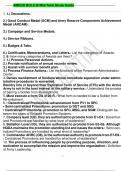
AMEDD BOLC-B Mid-Term Study Guide
1. 1.) Decorations.
2.) Good Conduct Medal (GCM) and Army Reserve Components Achievement
Medal (ARCAM):
3.) Campaign and Service Medals.
4.) Service Ribbons.
5.) Badges & Tabs.
6.) Certificates, Memorandums, and Letters.: List the categories of Awards.
2. 6: How many categories of Awards are there?
3. 1.) Process Personnel Actions.
2.) Provide notification of annual records review.
3.) Assist with survivor benefit plan.
4.) Process Finance Actions.: List the functions of the Personnel Administration
Center.
4. Denies reenlistment of Soldiers whose immediate separation under admin-
istrative procedures is warranted.
Reentry into or beyond their Expiration Term of Service (ETS) with the Active
Army is not in the best interest of the military service.: Understand the process
of barring a Soldier from Reenlistment.
5. Must execute a form DA 4126-R.: What form is needed to bar a Soldier from
Re-enlistment.
6. • Decentralized Promotions: advancement from PV1 to SPC
• Semi-centralized Promotions: promotion to SGT and SSG
• Centralized Promotions: promotion to SFC, MSG, and SGM: Distinguish be-
tween the types of Enlisted Promotion Systems.
7. Company level (O3), they are authorized to promote from E1-E4.: Decentral-
ized Promotions are handled by what level of leadership?
8. Battalion Level (O5), they are authorized to promote from E5-E6. Although
HQDA maintains the promotion standing list and issues the orders.: Semi-cen-
tralized Promotions are handled by what level of leadership?
9. Commander AHRC (O8), is the authorized authority to promote from E7-E9.-
: Centralized Promotions are handled by what level of leadership?
10. The process of influencing people by providing purpose, direction, and
motivation to accomplish the mission and improve the organization.: Definition
of Army Leadership.
, AMEDD BOLC-B Mid-Term Study Guide
11. Tactical, Operational, and Strategic.: What are the different levels of leader-
ship?
12. Tactical - Direct level leadership is where subordinates are accustomed to
seeing their leaders all the time: teams and squads, sections and platoons,
companies and batteries. A direct leader's span of influence can range from a
handful to a several hundred people. NCOs are in direct leadership positions
more often than officers and Army civilians and are crucial in the day-to-day
development and care of Soldiers.
Operational - Operational/organizational leaders influence several hundred to
several thousand people. They have staffs to help them lead their people and
manage their organizations' resources.
Strategic - Strategic level leaders, military and Army civilian, are responsi-
ble for large organizations and influence several thousand to hundreds of
thousands of people. There are roughly 600 authorized military and civilian
positions classified as strategic leaders.
As leaders take on roles with more responsibility, they still perform some
of the leadership functions from the lower levels (e.g. face-to-face, indirect
influence, etc.).: Understand the different levels of leadership.
13. Counseling, Coaching, and Mentoring.: List the methods of providing devel-
opmental feedback to subordinates.
14. Attributes - Character, Presence, and Intellect, which enable a leader to
exemplify competencies.
Competencies - Leads, Develops, and Achieves, which allow a leader to ac-
complish the mission.: Differentiate between the three Attributes and Competen-
cies of Army Leadership.
15. Character, Presence, and Intellect.: What are the Army leadership attributes?
16. Leads, Develops, and Achieves.: What are the Army leadership competen-
cies?
17. Three types of counseling; Event Counseling, Performance Counseling,
and Professional Growth Counseling.
Three Approaches to Counseling; non-directive approach, directive approach,
and combined approach.: Distinguish between the types of Counseling and the
approaches to Counseling.
18. Event Counseling, Performance Counseling, and Professional Growth
Counseling.: What are the three types of counseling?
19. non-directive approach, directive approach, and combined approach.: -
What are the three approaches to counseling?
20. Covers a specific event or situation.
May precede events like a promotion board or attending school.
1. 1.) Decorations.
2.) Good Conduct Medal (GCM) and Army Reserve Components Achievement
Medal (ARCAM):
3.) Campaign and Service Medals.
4.) Service Ribbons.
5.) Badges & Tabs.
6.) Certificates, Memorandums, and Letters.: List the categories of Awards.
2. 6: How many categories of Awards are there?
3. 1.) Process Personnel Actions.
2.) Provide notification of annual records review.
3.) Assist with survivor benefit plan.
4.) Process Finance Actions.: List the functions of the Personnel Administration
Center.
4. Denies reenlistment of Soldiers whose immediate separation under admin-
istrative procedures is warranted.
Reentry into or beyond their Expiration Term of Service (ETS) with the Active
Army is not in the best interest of the military service.: Understand the process
of barring a Soldier from Reenlistment.
5. Must execute a form DA 4126-R.: What form is needed to bar a Soldier from
Re-enlistment.
6. • Decentralized Promotions: advancement from PV1 to SPC
• Semi-centralized Promotions: promotion to SGT and SSG
• Centralized Promotions: promotion to SFC, MSG, and SGM: Distinguish be-
tween the types of Enlisted Promotion Systems.
7. Company level (O3), they are authorized to promote from E1-E4.: Decentral-
ized Promotions are handled by what level of leadership?
8. Battalion Level (O5), they are authorized to promote from E5-E6. Although
HQDA maintains the promotion standing list and issues the orders.: Semi-cen-
tralized Promotions are handled by what level of leadership?
9. Commander AHRC (O8), is the authorized authority to promote from E7-E9.-
: Centralized Promotions are handled by what level of leadership?
10. The process of influencing people by providing purpose, direction, and
motivation to accomplish the mission and improve the organization.: Definition
of Army Leadership.
, AMEDD BOLC-B Mid-Term Study Guide
11. Tactical, Operational, and Strategic.: What are the different levels of leader-
ship?
12. Tactical - Direct level leadership is where subordinates are accustomed to
seeing their leaders all the time: teams and squads, sections and platoons,
companies and batteries. A direct leader's span of influence can range from a
handful to a several hundred people. NCOs are in direct leadership positions
more often than officers and Army civilians and are crucial in the day-to-day
development and care of Soldiers.
Operational - Operational/organizational leaders influence several hundred to
several thousand people. They have staffs to help them lead their people and
manage their organizations' resources.
Strategic - Strategic level leaders, military and Army civilian, are responsi-
ble for large organizations and influence several thousand to hundreds of
thousands of people. There are roughly 600 authorized military and civilian
positions classified as strategic leaders.
As leaders take on roles with more responsibility, they still perform some
of the leadership functions from the lower levels (e.g. face-to-face, indirect
influence, etc.).: Understand the different levels of leadership.
13. Counseling, Coaching, and Mentoring.: List the methods of providing devel-
opmental feedback to subordinates.
14. Attributes - Character, Presence, and Intellect, which enable a leader to
exemplify competencies.
Competencies - Leads, Develops, and Achieves, which allow a leader to ac-
complish the mission.: Differentiate between the three Attributes and Competen-
cies of Army Leadership.
15. Character, Presence, and Intellect.: What are the Army leadership attributes?
16. Leads, Develops, and Achieves.: What are the Army leadership competen-
cies?
17. Three types of counseling; Event Counseling, Performance Counseling,
and Professional Growth Counseling.
Three Approaches to Counseling; non-directive approach, directive approach,
and combined approach.: Distinguish between the types of Counseling and the
approaches to Counseling.
18. Event Counseling, Performance Counseling, and Professional Growth
Counseling.: What are the three types of counseling?
19. non-directive approach, directive approach, and combined approach.: -
What are the three approaches to counseling?
20. Covers a specific event or situation.
May precede events like a promotion board or attending school.