
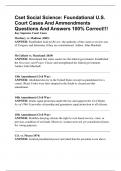
Cset Social Science: Foundational U.S.
Court Cases And Ammendments
Questions And Answers 100% Correct!!!
Key Supreme Court Cases
Marbury vs. Madison (1803)
ANSWER: Established Judicial Review; the authority of the courts to review acts
of Congress and determine if they are constitutional. Author: John Marshall.
McCulloch vs. Maryland (1819)
ANSWER: Determined that states cannot tax the federal government. Established
the Necessary and Proper Clause and strengthened the federal government.
Author: John Marshall.
13th Amendment (Civil War)
ANSWER: Abolished slavery in the United States (except as punishment for a
crime). Black Codes were later adopted in the South to circumvent this
amendment.
14th Amendment (Civil War)
ANSWER: Grants equal protection under the law and supports the Civil Rights
Act of 1866. It provides citizenship and guarantees equal protection to all citizens.
15th Amendment (Civil War)
ANSWER: Prohibits denying citizens the right to vote based on race, color, or
previous condition of servitude. However, women were not yet considered citizens
for voting purposes.
U.S. vs. Nixon (1974)
ANSWER: Limited presidential power and ruled that the president is not above
, the law. President Nixon had to release tape recordings, leading to his resignation.
This case reinforced that the President's power is constrained by the Constitution.
Plessy vs. Ferguson (1896)
ANSWER: Established the "separate but equal" doctrine, allowing racial
segregation in public facilities such as railroads.
Brown vs. Board of Education (1954)
ANSWER: Overturned Plessy vs. Ferguson, declaring that racial segregation in
public schools is unconstitutional. This led to desegregation efforts across the U.S.
Miranda vs. Arizona (1966)
ANSWER: Established the Miranda Rights, requiring law enforcement to inform
arrested individuals of their rights, including the right to remain silent and to have
an attorney present during questioning.
Roe vs. Wade (1973)
ANSWER: Ruled that the right to privacy extends to a woman's decision to have
an abortion, making first-term abortions legal.
California vs. Blakke (1978)
ANSWER: Upheld affirmative action in college admissions but ruled that racial
quotas were unconstitutional.
Adarand Constructors vs. Pena (1995)
ANSWER: Affirmed that affirmative action programs must undergo "strict
scrutiny" to ensure fairness and equal treatment for all individuals.
Court Cases And Ammendments
Questions And Answers 100% Correct!!!
Key Supreme Court Cases
Marbury vs. Madison (1803)
ANSWER: Established Judicial Review; the authority of the courts to review acts
of Congress and determine if they are constitutional. Author: John Marshall.
McCulloch vs. Maryland (1819)
ANSWER: Determined that states cannot tax the federal government. Established
the Necessary and Proper Clause and strengthened the federal government.
Author: John Marshall.
13th Amendment (Civil War)
ANSWER: Abolished slavery in the United States (except as punishment for a
crime). Black Codes were later adopted in the South to circumvent this
amendment.
14th Amendment (Civil War)
ANSWER: Grants equal protection under the law and supports the Civil Rights
Act of 1866. It provides citizenship and guarantees equal protection to all citizens.
15th Amendment (Civil War)
ANSWER: Prohibits denying citizens the right to vote based on race, color, or
previous condition of servitude. However, women were not yet considered citizens
for voting purposes.
U.S. vs. Nixon (1974)
ANSWER: Limited presidential power and ruled that the president is not above
, the law. President Nixon had to release tape recordings, leading to his resignation.
This case reinforced that the President's power is constrained by the Constitution.
Plessy vs. Ferguson (1896)
ANSWER: Established the "separate but equal" doctrine, allowing racial
segregation in public facilities such as railroads.
Brown vs. Board of Education (1954)
ANSWER: Overturned Plessy vs. Ferguson, declaring that racial segregation in
public schools is unconstitutional. This led to desegregation efforts across the U.S.
Miranda vs. Arizona (1966)
ANSWER: Established the Miranda Rights, requiring law enforcement to inform
arrested individuals of their rights, including the right to remain silent and to have
an attorney present during questioning.
Roe vs. Wade (1973)
ANSWER: Ruled that the right to privacy extends to a woman's decision to have
an abortion, making first-term abortions legal.
California vs. Blakke (1978)
ANSWER: Upheld affirmative action in college admissions but ruled that racial
quotas were unconstitutional.
Adarand Constructors vs. Pena (1995)
ANSWER: Affirmed that affirmative action programs must undergo "strict
scrutiny" to ensure fairness and equal treatment for all individuals.


