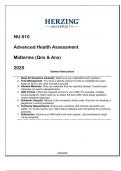
NU 610
Advanced Health Assessment
Midterms (Qns & Ans)
2025
General Instructions
1. Read All Questions Carefully: Make sure you understand each question.
2. Time Management: You have a specific amount of time to complete the exam.
Keep an eye on the clock and pace yourself.
3. Allowed Materials: Only use materials that are explicitly allowed. Unauthorized
materials can lead to disqualification.
4. ANS Format: Follow the required format for your ANS. For example, multiple-
choice questions might need you to select the best ANS, while essay questions
require detailed responses.
5. Academic Integrity: Adhere to the university's honor code. Any form of cheating or
plagiarism is strictly prohibited.
6. Technical Requirements: Ensure your computer and internet connection are
stable. For online exams, you might need a webcam and microphone for proctoring
purposes.
7. Submission: Submit your ANS before the time expires. Late submissions might
not be accepted.
©2024/2025
,1. Which of the following is the most appropriate initial
diagnostic test for a patient presenting with acute chest pain?
- A. Electrocardiogram (ECG)
- B. Chest X-ray
- C. Echocardiogram
- D. Cardiac MRI
- ANS: A. Electrocardiogram (ECG)
- Rationale: An ECG is the first-line diagnostic test for
evaluating acute chest pain to assess for ischemic changes.
2. A 65-year-old male presents with shortness of breath and a
history of smoking. Which physical exam finding is most
indicative of chronic obstructive pulmonary disease (COPD)?
- A. Wheezing
- B. Crackles
- C. Dullness to percussion
- D. Hyperresonance
- ANS: D. Hyperresonance
- Rationale: Hyperresonance on percussion is a common
finding in patients with COPD due to hyperinflation of the lungs.
©2024/2025
,3. Which of the following laboratory tests is most useful in
diagnosing heart failure?
- A. Troponin
- B. B-type natriuretic peptide (BNP)
- C. D-dimer
- D. C-reactive protein (CRP)
- ANS: B. B-type natriuretic peptide (BNP)
- Rationale: Elevated BNP levels are indicative of heart
failure and are used to diagnose and assess the severity of the
condition.
4. A patient presents with jaundice and elevated liver enzymes.
Which of the following conditions is least likely to be the cause?
- A. Hepatitis
- B. Cirrhosis
- C. Cholecystitis
- D. Hemochromatosis
- ANS: C. Cholecystitis
- Rationale: Cholecystitis typically does not cause jaundice or
significantly elevated liver enzymes.
©2024/2025
, 5. Which of the following is the most appropriate management
for a patient with a suspected pulmonary embolism?
- A. Immediate anticoagulation
- B. Bronchoscopy
- C. Thoracentesis
- D. Antibiotics
- ANS: A. Immediate anticoagulation
- Rationale: Immediate anticoagulation is the standard
treatment for suspected pulmonary embolism to prevent further
clot formation.
Fill-in-the-Blank Questions
6. The most common cause of community-acquired pneumonia
in adults is __________.
- ANS: Streptococcus pneumoniae
- Rationale: Streptococcus pneumoniae is the leading cause
of community-acquired pneumonia in adults.
7. The Glasgow Coma Scale (GCS) is used to assess
__________ in patients with head injuries.
- ANS: Level of consciousness
©2024/2025
Advanced Health Assessment
Midterms (Qns & Ans)
2025
General Instructions
1. Read All Questions Carefully: Make sure you understand each question.
2. Time Management: You have a specific amount of time to complete the exam.
Keep an eye on the clock and pace yourself.
3. Allowed Materials: Only use materials that are explicitly allowed. Unauthorized
materials can lead to disqualification.
4. ANS Format: Follow the required format for your ANS. For example, multiple-
choice questions might need you to select the best ANS, while essay questions
require detailed responses.
5. Academic Integrity: Adhere to the university's honor code. Any form of cheating or
plagiarism is strictly prohibited.
6. Technical Requirements: Ensure your computer and internet connection are
stable. For online exams, you might need a webcam and microphone for proctoring
purposes.
7. Submission: Submit your ANS before the time expires. Late submissions might
not be accepted.
©2024/2025
,1. Which of the following is the most appropriate initial
diagnostic test for a patient presenting with acute chest pain?
- A. Electrocardiogram (ECG)
- B. Chest X-ray
- C. Echocardiogram
- D. Cardiac MRI
- ANS: A. Electrocardiogram (ECG)
- Rationale: An ECG is the first-line diagnostic test for
evaluating acute chest pain to assess for ischemic changes.
2. A 65-year-old male presents with shortness of breath and a
history of smoking. Which physical exam finding is most
indicative of chronic obstructive pulmonary disease (COPD)?
- A. Wheezing
- B. Crackles
- C. Dullness to percussion
- D. Hyperresonance
- ANS: D. Hyperresonance
- Rationale: Hyperresonance on percussion is a common
finding in patients with COPD due to hyperinflation of the lungs.
©2024/2025
,3. Which of the following laboratory tests is most useful in
diagnosing heart failure?
- A. Troponin
- B. B-type natriuretic peptide (BNP)
- C. D-dimer
- D. C-reactive protein (CRP)
- ANS: B. B-type natriuretic peptide (BNP)
- Rationale: Elevated BNP levels are indicative of heart
failure and are used to diagnose and assess the severity of the
condition.
4. A patient presents with jaundice and elevated liver enzymes.
Which of the following conditions is least likely to be the cause?
- A. Hepatitis
- B. Cirrhosis
- C. Cholecystitis
- D. Hemochromatosis
- ANS: C. Cholecystitis
- Rationale: Cholecystitis typically does not cause jaundice or
significantly elevated liver enzymes.
©2024/2025
, 5. Which of the following is the most appropriate management
for a patient with a suspected pulmonary embolism?
- A. Immediate anticoagulation
- B. Bronchoscopy
- C. Thoracentesis
- D. Antibiotics
- ANS: A. Immediate anticoagulation
- Rationale: Immediate anticoagulation is the standard
treatment for suspected pulmonary embolism to prevent further
clot formation.
Fill-in-the-Blank Questions
6. The most common cause of community-acquired pneumonia
in adults is __________.
- ANS: Streptococcus pneumoniae
- Rationale: Streptococcus pneumoniae is the leading cause
of community-acquired pneumonia in adults.
7. The Glasgow Coma Scale (GCS) is used to assess
__________ in patients with head injuries.
- ANS: Level of consciousness
©2024/2025