

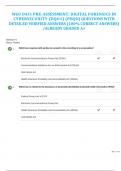
WGU D431 PRE-ASSESSMENT: DIGITAL FORENSICS IN
CYBERSECURITY (DQO1) (PDQO) QUESTIONS WITH
DETAILED VERIFIED ANSWERS (100% CORRECT ANSWERS)
/ALREADY GRADED A+
Attempt #1
Status: Passed
1. Which law requires both parties to consent to the recording of a conversation?
YOUR CORRECT
ANSWER ANSWER
Electronic Communications Privacy Act (ECPA)
Communications Assistance to Law Enforcement Act (CALEA)
USA Patriot Act
Health Insurance Portability and Accountability Act (HIPAA)
2. Which law is related to the disclosure of personally identifiable protected health information (PHI)?
YOUR CORRECT
ANSWER ANSWER
Federal Privacy Act of 1974
Electronic Communications Privacy Act
Health Insurance Portability and Accountability Act (HIPAA)
CAN-SPAM Act
Pge 1 of 1U
,3. Which U.S. law criminalizes the act of knowingly using a misleading domain name with the intent to
deceive a minor into viewing harmful material?
YOUR CORRECT
ANSWER ANSWER
18 U.S.C. 2252B
CAN-SPAM Act
Children’s Online Privacy Protection Act (COPPA)
Communications Decency Act
4. Which U.S. law protects journalists from turning over their work or sources to law enforcement before the
information is shared with the public?
YOUR CORRECT
ANSWER ANSWER
The Privacy Protection Act (PPA)
The Federal Privacy Act
The Communications Assistance to Law Enforcement Act (CALEA)
The Electronic Communications Privacy Act (ECPA)
5. Which law or guideline lists the four states a mobile device can be in when data is extracted from it?
YOUR CORRECT
ANSWER ANSWER
NIST SP 800-72 Guidelines
The USA Patriot Act
NIST SP 101r1 Guidelines
The Electronic Communications Privacy Act (ECPA)
Pge 2 of 1U
, 6. Which law includes a provision permitting the wiretapping of VoIP calls?
YOUR CORRECT
ANSWER ANSWER
Communications Assistance to Law Enforcement Act (CALEA)
USA Patriot Act
Electronic Communications Privacy Act (ECPA)
Sarbanes-Oxley Act (SOX)
7. Which policy is included in the CAN-SPAM Act?
YOUR CORRECT
ANSWER ANSWER
The email sender must provide some mechanism whereby the receiver
can opt out of future emails and that method cannot require the
receiver to pay in order to opt out.
Whoever knowingly uses a misleading domain name on the Internet
with the intent to deceive a person into viewing material constituting
obscenity shall be fined or imprisoned not more than 2 years, or both.
Law enforcement officers may now intercept communications to and
from the computer trespasser if they have reasonable grounds to
believe that the trespasser’s communications will be relevant to the
investigation.
A business can claim the business extension exemption only for
monitoring by certain types of equipment; the recording must occur in
the ordinary course of business.
Pge 3 of 1U
CYBERSECURITY (DQO1) (PDQO) QUESTIONS WITH
DETAILED VERIFIED ANSWERS (100% CORRECT ANSWERS)
/ALREADY GRADED A+
Attempt #1
Status: Passed
1. Which law requires both parties to consent to the recording of a conversation?
YOUR CORRECT
ANSWER ANSWER
Electronic Communications Privacy Act (ECPA)
Communications Assistance to Law Enforcement Act (CALEA)
USA Patriot Act
Health Insurance Portability and Accountability Act (HIPAA)
2. Which law is related to the disclosure of personally identifiable protected health information (PHI)?
YOUR CORRECT
ANSWER ANSWER
Federal Privacy Act of 1974
Electronic Communications Privacy Act
Health Insurance Portability and Accountability Act (HIPAA)
CAN-SPAM Act
Pge 1 of 1U
,3. Which U.S. law criminalizes the act of knowingly using a misleading domain name with the intent to
deceive a minor into viewing harmful material?
YOUR CORRECT
ANSWER ANSWER
18 U.S.C. 2252B
CAN-SPAM Act
Children’s Online Privacy Protection Act (COPPA)
Communications Decency Act
4. Which U.S. law protects journalists from turning over their work or sources to law enforcement before the
information is shared with the public?
YOUR CORRECT
ANSWER ANSWER
The Privacy Protection Act (PPA)
The Federal Privacy Act
The Communications Assistance to Law Enforcement Act (CALEA)
The Electronic Communications Privacy Act (ECPA)
5. Which law or guideline lists the four states a mobile device can be in when data is extracted from it?
YOUR CORRECT
ANSWER ANSWER
NIST SP 800-72 Guidelines
The USA Patriot Act
NIST SP 101r1 Guidelines
The Electronic Communications Privacy Act (ECPA)
Pge 2 of 1U
, 6. Which law includes a provision permitting the wiretapping of VoIP calls?
YOUR CORRECT
ANSWER ANSWER
Communications Assistance to Law Enforcement Act (CALEA)
USA Patriot Act
Electronic Communications Privacy Act (ECPA)
Sarbanes-Oxley Act (SOX)
7. Which policy is included in the CAN-SPAM Act?
YOUR CORRECT
ANSWER ANSWER
The email sender must provide some mechanism whereby the receiver
can opt out of future emails and that method cannot require the
receiver to pay in order to opt out.
Whoever knowingly uses a misleading domain name on the Internet
with the intent to deceive a person into viewing material constituting
obscenity shall be fined or imprisoned not more than 2 years, or both.
Law enforcement officers may now intercept communications to and
from the computer trespasser if they have reasonable grounds to
believe that the trespasser’s communications will be relevant to the
investigation.
A business can claim the business extension exemption only for
monitoring by certain types of equipment; the recording must occur in
the ordinary course of business.
Pge 3 of 1U


