MNGT FINAL EXAM QUESTIONS AND
CORRECT ANSWERS (NEWEST
VERSION) ALREADY GRADED A+
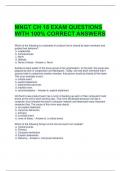
Three important levels of cultural analysis in organizations are
a) unobservable culture, role models, and shared mission.
b) implicit culture, shared values, and common experiences.
c) shared objectives, shared values, and shared mission.
d) observable culture, shared values, and common assumptions.
e) explicit culture, implicit culture, and common assumptions. - Answer-D
All of the following are levels of analysis in studying organizational culture EXCEPT:
a) Observable culture
b) Shared values
c) Inter-organizational conflict
d) Common assumptions
e) Taken-for-granted truths - Answer-C
Julie is working on creating the guidelines so that similar work activities are repeatedly
performed in a similar fashion. Julie is creating which of these?
a) Adhocracy
b) Span of control
c) Standardization
d) Coordination
e) Formalization - Answer-C
A guideline for action that outlines important objectives and broadly indicates how an
activity is to be performed is called a(n) _____________.
a) policy
b) rule
c) procedure
d) formula
e) law - Answer-A
W. Edwards Deming's 14 points for implementing total quality management include all
of the following EXCEPT:
a) learn a new philosophy of quality to improve every system.
b) impose financial controls on production.
,c) institute modern on-the-job training.
d) improve supervision to develop inspired leaders.
e) drive out fear and instill learning. - Answer-B
Deming's system of total quality management seems to work well when it is
implemented in conjunction with __________ and __________.
a) empowerment; narrow spans of control
b) unity of command; participative management
c) centralized decision making; participative management
d) empowerment; participative management
e) wide spans of control; internal staff units - Answer-D
Which of the following increases when the discretion to spend money, to hire people,
and to make similar decisions is moved farther up the hierarchy of authority?
a) Distribution
b) Dissipation
c) Diffusion
d) Centralization
e) Decentralization - Answer-D
The heart of Deming's approach to quality management was to institute a(n)
__________ approach to continual improvement based on statistical analyses of the
firm's operations.
a) process
b) production
c) operations
d) centralized
e) decentralized - Answer-A
__________ is the degree to which the authority to make decisions is delegated to
lower levels in an organization's hierarchy.
a) Bureaucracy
b) Centralization
c) Distribution
d) Span of control
e) Decentralization - Answer-E
Greater __________ is often adopted when a firm faces a single major threat to its
survival.
a) dissipation
b) centralization
c) distribution
d) participation
e) decentralization - Answer-B
Which one of the following statements about decentralization is NOT accurate?
, a) Decentralization assists in the on-the-job training of subordinates for higher-level
positions.
b) Decentralization provides a quicker response to a diverse set of unrelated problems
than does centralization.
c) Decentralization is a popular approach in many industries.
d) Generally speaking, greater decentralization provides lower subordinate satisfaction.
e) Decentralization is the degree to which the authority to make decisions is given to
lower levels in an organization's hierarchy. - Answer-D
__________ is the set of mechanisms used in an organization to link the actions of its
subunits into a consistent pattern.
a) Matrix departmentation
b) Decentralization
c) Centralization
d) Horizontal specialization
e) Coordination - Answer-E
All of the following are advantages of functional departmentation EXCEPT:
a) it is easy to explain.
b) it may reinforce the narrow training of individuals.
c) it yields very clear task assignments, consistent with an individual's training.
d) individuals within a department can easily build on one another's knowledge, training,
and experience.
e) it provides an excellent training ground for new managers. - Answer-B
All of the following are disadvantages of functional departmentation EXCEPT:
a) it yields very clear task requirements, consistent with an individual's training.
b) individuals may look up the organizational hierarchy for direction and reinforcement
rather than focus attention on products, services, or clients.
c) communication across technical areas is complex and difficult.
d) it may reinforce the narrow training of individuals.
e) top management may be overloaded with too much attention being paid to cross-
functional problems. - Answer-A
Organizations that rely heavily on __________ may expect the following tendencies to
emerge over time: an emphasis on quality from a technical standpoint, rigidity to
change, and difficulty in coordinating the actions of different functional areas.
a) divisional departmentation
b) matrix departmentation
c) functional specialization
d) network specialization
e) divisional specialization - Answer-C
The major advantages of the __________ pattern are its flexibility in meeting external
demands, spotting external changes, integrating specialized individuals deep within the
organization, and focusing on the delivery of specific products to specific customers.
CORRECT ANSWERS (NEWEST
VERSION) ALREADY GRADED A+
Three important levels of cultural analysis in organizations are
a) unobservable culture, role models, and shared mission.
b) implicit culture, shared values, and common experiences.
c) shared objectives, shared values, and shared mission.
d) observable culture, shared values, and common assumptions.
e) explicit culture, implicit culture, and common assumptions. - Answer-D
All of the following are levels of analysis in studying organizational culture EXCEPT:
a) Observable culture
b) Shared values
c) Inter-organizational conflict
d) Common assumptions
e) Taken-for-granted truths - Answer-C
Julie is working on creating the guidelines so that similar work activities are repeatedly
performed in a similar fashion. Julie is creating which of these?
a) Adhocracy
b) Span of control
c) Standardization
d) Coordination
e) Formalization - Answer-C
A guideline for action that outlines important objectives and broadly indicates how an
activity is to be performed is called a(n) _____________.
a) policy
b) rule
c) procedure
d) formula
e) law - Answer-A
W. Edwards Deming's 14 points for implementing total quality management include all
of the following EXCEPT:
a) learn a new philosophy of quality to improve every system.
b) impose financial controls on production.
,c) institute modern on-the-job training.
d) improve supervision to develop inspired leaders.
e) drive out fear and instill learning. - Answer-B
Deming's system of total quality management seems to work well when it is
implemented in conjunction with __________ and __________.
a) empowerment; narrow spans of control
b) unity of command; participative management
c) centralized decision making; participative management
d) empowerment; participative management
e) wide spans of control; internal staff units - Answer-D
Which of the following increases when the discretion to spend money, to hire people,
and to make similar decisions is moved farther up the hierarchy of authority?
a) Distribution
b) Dissipation
c) Diffusion
d) Centralization
e) Decentralization - Answer-D
The heart of Deming's approach to quality management was to institute a(n)
__________ approach to continual improvement based on statistical analyses of the
firm's operations.
a) process
b) production
c) operations
d) centralized
e) decentralized - Answer-A
__________ is the degree to which the authority to make decisions is delegated to
lower levels in an organization's hierarchy.
a) Bureaucracy
b) Centralization
c) Distribution
d) Span of control
e) Decentralization - Answer-E
Greater __________ is often adopted when a firm faces a single major threat to its
survival.
a) dissipation
b) centralization
c) distribution
d) participation
e) decentralization - Answer-B
Which one of the following statements about decentralization is NOT accurate?
, a) Decentralization assists in the on-the-job training of subordinates for higher-level
positions.
b) Decentralization provides a quicker response to a diverse set of unrelated problems
than does centralization.
c) Decentralization is a popular approach in many industries.
d) Generally speaking, greater decentralization provides lower subordinate satisfaction.
e) Decentralization is the degree to which the authority to make decisions is given to
lower levels in an organization's hierarchy. - Answer-D
__________ is the set of mechanisms used in an organization to link the actions of its
subunits into a consistent pattern.
a) Matrix departmentation
b) Decentralization
c) Centralization
d) Horizontal specialization
e) Coordination - Answer-E
All of the following are advantages of functional departmentation EXCEPT:
a) it is easy to explain.
b) it may reinforce the narrow training of individuals.
c) it yields very clear task assignments, consistent with an individual's training.
d) individuals within a department can easily build on one another's knowledge, training,
and experience.
e) it provides an excellent training ground for new managers. - Answer-B
All of the following are disadvantages of functional departmentation EXCEPT:
a) it yields very clear task requirements, consistent with an individual's training.
b) individuals may look up the organizational hierarchy for direction and reinforcement
rather than focus attention on products, services, or clients.
c) communication across technical areas is complex and difficult.
d) it may reinforce the narrow training of individuals.
e) top management may be overloaded with too much attention being paid to cross-
functional problems. - Answer-A
Organizations that rely heavily on __________ may expect the following tendencies to
emerge over time: an emphasis on quality from a technical standpoint, rigidity to
change, and difficulty in coordinating the actions of different functional areas.
a) divisional departmentation
b) matrix departmentation
c) functional specialization
d) network specialization
e) divisional specialization - Answer-C
The major advantages of the __________ pattern are its flexibility in meeting external
demands, spotting external changes, integrating specialized individuals deep within the
organization, and focusing on the delivery of specific products to specific customers.