
• Wrong document? Swap it for free
  • Written by students who passed
  • Immediately available after payment
  • Read online or as PDF
Sell
Where do you study
Your language
Document preview thumbnail
Preview 1 out of 3 pages
Exam (elaborations)

Sedimentary Rocks- Exam Questions Answered Correctly Latest Version Fully Solved

Document preview thumbnail
Preview 1 out of 3 pages

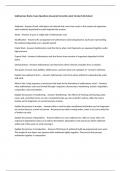
Sedimentary Rocks- Exam Questions Answered Correctly Latest Version Fully Solved Sediment - Answers Small, solid pieces of material that come from rocks or the remains of organisms; earth materials deposited by earth deposited by erosion. Strata - Answers a layer or single bed of sedimentary rock Stratification - Answers the arrangement of sedimentary rocks being layered, each layer representing the sediment deposited over a specific period Clastic Rock - Answers Sedimentary rock that forms when rock fragments are squeezed together under high pressure. Organic Rock - Answers Sedimentary rock that forms from remains of organisms deposited in thick layers. Chemical Rock - Answers Sedimentary rock that forms when minerals crystalize from a solution. Tiny grains of sand, mud, pebbles, shells leaves, and even bone are examples of - Answers sediment. Explain how sediments form. - Answers Sedimentary rocks form when sediment is deposited by water and wind. What is the 5 step sequence of processes that leads to the formation of sedimentary rocks? - Answers Most sedimentary rocks are formed through a sequence of processes: weathering, erosion, deposition, compaction, and cementation. Explain the process of weathering. - Answers Weathering - the effects of freezing and thawing, plant roots, acid, and other forces on rock, constantly breaks up rock on Earth's surface. After the rock is broken up the fragments are carried away by erosion. Explain the process of erosion. - Answers After a rock has been weathered and broken up, the fragments are carried away as a result of erosion - the process by which running water, wind, or ice carry away bits of broken-up rock. Explain the process of deposition. - Answers Water can carry sediment to a lake or ocean. Here, the material is deposited in layers as it sinks to the bottom. Deposition is the process by which sediment settles out of the water or wind carrying it. Explain the process of compaction. - Answers Thick layer of sediment build up progressively over years. The weight of new layers can squeeze older sediments tightly together. The process that presses sediments together is compaction. Explain the process of cementation. - Answers While compaction is taking place, some minerals in the rock slowly dissolve in the water. Cementation is the process in which dissolved minerals crystallize and glue particles of sediment together. How do geologists classify sedimentary rocks? - Answers Geologists classify sedimentary rocks according to the type of sediments that make up the rock. What are the 3 major groups/classifications of sedimentary rocks? - Answers i. Clastic Rocks ii. Organic Rocks iii. Chemical Rocks What are most sedimentary rocks made of? - Answers Most sedimentary rocks are made up of broken pieces of other rocks. Explain how a clastic rock is formed. - Answers A clastic rock is a sedimentary rock formed when rock fragments are squeezed together. Clastic rocks are grouped by the ______ of the rock fragments they contain. - Answers size Name 4 common clastic sedimentary rocks that have different rock fragment sizes. - Answers Shale, sandstone, conglomerate, and breccia. Contrast how fragment size varies with following sedimentary rocks: shale, sandstone, conglomerate, and breccia. - Answers Shale forms from tiny particles of clay. Fossils are often found in shale, which tends to split into flat pieces. Many small holes between sand grains allow sandstone to absorb water. Most of the sand particles consist of quartz. Rock fragments with rounded edges make up conglomerate. Rock fragments with sharp edges form breccia. What are 2 examples of organic sedimentary rocks? - Answers Coal and limestone. Instead of forming by particles of rock, coal and limestone form from - Answers the remains of material that was once living. Explain how organic sedimentary rocks are formed. - Answers Organic rock forms where the remains of plants and animals are deposited in layers. Why are organic sedimentary rocks named "organic"? - Answers The term "organic" refers to substances that once were part of living things or were made by living things. How does coal form? Where does it form? - Answers Coal forms from the remains of swamp plants buried in water. As layer upon layer of plant remains build up, the weight of the layers squeezes the decaying plants together. Over millions of years, they slowly change into coal. How does limestone form? Where does it form? - Answers Limestone forms in the ocean, where many living things, such as coral, clams, and oysters, have hard shells or skeletons made of

Content preview

Sedimentary Rocks- Exam Questions Answered Correctly Latest Version Fully Solved


Sediment - Answers Small, solid pieces of material that come from rocks or the remains of organisms;
earth materials deposited by earth deposited by erosion.

Strata - Answers a layer or single bed of sedimentary rock

Stratification - Answers the arrangement of sedimentary rocks being layered, each layer representing
the sediment deposited over a specific period

Clastic Rock - Answers Sedimentary rock that forms when rock fragments are squeezed together under
high pressure.

Organic Rock - Answers Sedimentary rock that forms from remains of organisms deposited in thick
layers.

Chemical Rock - Answers Sedimentary rock that forms when minerals crystalize from a solution.

Tiny grains of sand, mud, pebbles, shells leaves, and even bone are examples of - Answers sediment.

Explain how sediments form. - Answers Sedimentary rocks form when sediment is deposited by water
and wind.

What is the 5 step sequence of processes that leads to the formation of sedimentary rocks? - Answers
Most sedimentary rocks are formed through a sequence of processes: weathering, erosion, deposition,
compaction, and cementation.

Explain the process of weathering. - Answers Weathering - the effects of freezing and thawing, plant
roots, acid, and other forces on rock, constantly breaks up rock on Earth's surface. After the rock is
broken up the fragments are carried away by erosion.

Explain the process of erosion. - Answers After a rock has been weathered and broken up, the fragments
are carried away as a result of erosion - the process by which running water, wind, or ice carry away bits
of broken-up rock.

Explain the process of deposition. - Answers Water can carry sediment to a lake or ocean. Here, the
material is deposited in layers as it sinks to the bottom. Deposition is the process by which sediment
settles out of the water or wind carrying it.

Explain the process of compaction. - Answers Thick layer of sediment build up progressively over years.
The weight of new layers can squeeze older sediments tightly together. The process that presses
sediments together is compaction.


Document information

Uploaded on
December 16, 2024
Number of pages
3
Written in
2024/2025
Type
Exam (elaborations)
Contains
Questions & answers
$8.89

Wrong document? Swap it for free Within 14 days of purchase and before downloading, you can choose a different document. You can simply spend the amount again.
Written by students who passed
Immediately available after payment
Read online or as PDF

Seller avatar
Reputation scores are based on the amount of documents a seller has sold for a fee and the reviews they have received for those documents. There are three levels: Bronze, Silver and Gold. The better the reputation, the more your can rely on the quality of the sellers work.
TutorJosh
3.5
(76)
Sold
500
Followers
16
Items
32942
Last sold
18 hours ago


Why students choose Stuvia

Created by fellow students, verified by reviews

Quality you can trust: written by students who passed their tests and reviewed by others who've used these notes.

Didn't get what you expected? Choose another document

No worries! You can instantly pick a different document that better fits what you're looking for.

Pay as you like, start learning right away

No subscription, no commitments. Pay the way you're used to via credit card and download your PDF document instantly.

Student with book image

“Bought, downloaded, and aced it. It really can be that simple.”

Alisha Student

Working on your references?

Create accurate citations in APA, MLA and Harvard with our free citation generator.

Working on your references?

Frequently asked questions
