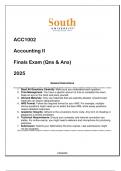
ACC1002
Accounting II
Finals Exam (Qns & Ans)
2025
General Instructions
1. Read All Questions Carefully: Make sure you understand each question.
2. Time Management: You have a specific amount of time to complete the exam.
Keep an eye on the clock and pace yourself.
3. Allowed Materials: Only use materials that are explicitly allowed. Unauthorized
materials can lead to disqualification.
4. ANS Format: Follow the required format for your ANS. For example, multiple-
choice questions might need you to select the best ANS, while essay questions
require detailed responses.
5. Academic Integrity: Adhere to the university's honor code. Any form of cheating or
plagiarism is strictly prohibited.
6. Technical Requirements: Ensure your computer and internet connection are
stable. For online exams, you might need a webcam and microphone for proctoring
purposes.
7. Submission: Submit your ANS before the time expires. Late submissions might
not be accepted.
©2024/2025
,1. Which of the following is most directly associated with the
concept of the time value of money?
- A) Future Value
- B) Historical Cost
- C) Matching Principle
- D) Going Concern
Correct ANS: A) Future Value
Rationale: The time value of money is primarily concerned
with the future value of cash flows, reflecting how money
invested today can grow over time due to compounding.
2. In financial accounting, which of the following best describes
the effect of issuing debt on a firm's balance sheet?
- A) Increases both assets and equity
- B) Increases assets and liabilities
- C) Decreases liabilities and increases cash flows
- D) Decreases net income
Correct ANS: B) Increases assets and liabilities
©2024/2025
, Rationale: Issuing debt increases cash (asset) and creates a
corresponding obligation (liability).
3. Which of the following is NOT a purpose of managerial
accounting?
- A) Planning future operations
- B) Evaluating performance
- C) Complying with GAAP
- D) Budgeting
Correct ANS: C) Complying with GAAP
Rationale: Managerial accounting is more internally focused
and not required to follow GAAP, unlike financial accounting.
4. Which financial statement provides insight into a company's
cash flows from operations?
- A) Income Statement
- B) Statement of Stockholders' Equity
- C) Balance Sheet
- D) Statement of Cash Flows
Correct ANS: D) Statement of Cash Flows
©2024/2025
, Rationale: The Statement of Cash Flows specifically outlines
cash inflows and outflows from operating, investing, and
financing activities.
5. What does the term "depreciation" refer to in financial
accounting?
- A) The decrease in value due to market conditions
- B) The systematic allocation of the cost of a tangible asset
- C) The immediate expensing of a fixed asset
- D) The revaluation of a fixed asset
Correct ANS: B) The systematic allocation of the cost of a
tangible asset
Rationale: Depreciation allocates an asset’s cost over its
useful life.
### Fill-in-the-Blank Questions
6. The difference between a company's current liabilities and
current assets is termed as _____ .
Correct ANS: Working Capital
©2024/2025
Accounting II
Finals Exam (Qns & Ans)
2025
General Instructions
1. Read All Questions Carefully: Make sure you understand each question.
2. Time Management: You have a specific amount of time to complete the exam.
Keep an eye on the clock and pace yourself.
3. Allowed Materials: Only use materials that are explicitly allowed. Unauthorized
materials can lead to disqualification.
4. ANS Format: Follow the required format for your ANS. For example, multiple-
choice questions might need you to select the best ANS, while essay questions
require detailed responses.
5. Academic Integrity: Adhere to the university's honor code. Any form of cheating or
plagiarism is strictly prohibited.
6. Technical Requirements: Ensure your computer and internet connection are
stable. For online exams, you might need a webcam and microphone for proctoring
purposes.
7. Submission: Submit your ANS before the time expires. Late submissions might
not be accepted.
©2024/2025
,1. Which of the following is most directly associated with the
concept of the time value of money?
- A) Future Value
- B) Historical Cost
- C) Matching Principle
- D) Going Concern
Correct ANS: A) Future Value
Rationale: The time value of money is primarily concerned
with the future value of cash flows, reflecting how money
invested today can grow over time due to compounding.
2. In financial accounting, which of the following best describes
the effect of issuing debt on a firm's balance sheet?
- A) Increases both assets and equity
- B) Increases assets and liabilities
- C) Decreases liabilities and increases cash flows
- D) Decreases net income
Correct ANS: B) Increases assets and liabilities
©2024/2025
, Rationale: Issuing debt increases cash (asset) and creates a
corresponding obligation (liability).
3. Which of the following is NOT a purpose of managerial
accounting?
- A) Planning future operations
- B) Evaluating performance
- C) Complying with GAAP
- D) Budgeting
Correct ANS: C) Complying with GAAP
Rationale: Managerial accounting is more internally focused
and not required to follow GAAP, unlike financial accounting.
4. Which financial statement provides insight into a company's
cash flows from operations?
- A) Income Statement
- B) Statement of Stockholders' Equity
- C) Balance Sheet
- D) Statement of Cash Flows
Correct ANS: D) Statement of Cash Flows
©2024/2025
, Rationale: The Statement of Cash Flows specifically outlines
cash inflows and outflows from operating, investing, and
financing activities.
5. What does the term "depreciation" refer to in financial
accounting?
- A) The decrease in value due to market conditions
- B) The systematic allocation of the cost of a tangible asset
- C) The immediate expensing of a fixed asset
- D) The revaluation of a fixed asset
Correct ANS: B) The systematic allocation of the cost of a
tangible asset
Rationale: Depreciation allocates an asset’s cost over its
useful life.
### Fill-in-the-Blank Questions
6. The difference between a company's current liabilities and
current assets is termed as _____ .
Correct ANS: Working Capital
©2024/2025