

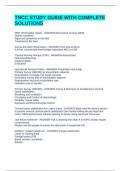
TNCC STUDY GUIDE WITH COMPLETE
SOLUTIONS
MIST (Prehospital report) - ANSWER-Mechanism of injury (MOI)
Injuries sustained
Signs and symptoms in the field
Treatment in the field
Across-the-room Observation - ANSWER-First look at the pt
If pt has uncontrolled hemorrhage reprioritize ABC to CAB
Trauma Nursing Process (TNP) - ANSWER-Assessment
Outcomes/Planning
Implementation
Evaluation
Operational Process Points - ANSWER-Preparation and triage
Primary Survey (ABCDE) w/ resuscitation adjuncts
Reevaluation (consider it pt needs transfer)
Secondary survey (HI) w/ reevaluation adjuncts
Reevaluation and post resuscitation care
Definitive care or transfer
Primary Survey (ABCDE) - ANSWER-Airway & Alertness w/ simultaneous cervical
spinal stabilization
Breathing and ventilation
Circulation and Control of Hemorrhage
Disability (neuro state)
Exposure and Environmental Control
Cervical spine stabilization for c-spine injury - ANSWER-State need for second person
to provide manual cervical spinal stabilization (two hands holding the pts head and
neck) THEN demonstrate manual opening of airway using jaw-thrust maneuver
Jaw-thrust maneuver - ANSWER-If pt is anything less than A in AVPU airway maybe
compromised
Always use two people to assess for obstruction if suspected CSI
AIRWAY: Inspect mouth for: - ANSWER-Tongue obstruction
Loose or missing teeth
Foreign bodies (FB)
Blood, emesis, secretions
Edema
, Is there any snoring, gurgling, or stridor?
Tip - ANSWER-After each intervention, reassess pt
Patent Airway Interventions - ANSWER-Always be alert, can be compromised at
anytime
Look for possible risks that can lead to obstruction:
Injury to mouth
Active bleeding
Blistering of oral mucosa
Air is NOT Patent - ANSWER-1. Jaw-thrust maneuver (two people)
2. Suction
3. Reassess Airway, if auctioning does not work look at tongue
4. Insert airway adjunct (temporary measure)
5. Consider definitive airway
Adjunct Airway - ANSWER-Nasopharyngeal airway: usually in R nares, measure from
tip of pts nose to tip of earlobe, DO NOT USE in pts with facial trauma or suspected
basilar skull fx
oropharyngeal airway: for unresponsive pt, measure by placing proximal end @ corner
of mouth, distal end should reach tip of earlobe
Fluids - ANSWER-Administer warm, isotonic crystalloid w/ blood tubing
CONTROL THE RATE: fluid overload can cause pulmonary edema & increase
myocardial ischemia
DISABILITY: During Disability assessment (AVPU) - ANSWER-A- the pt is alert and
responsive
V- the pt responds to verbal stimulation (consider airway adjunct)
P- the pt responds only to painful stimulation (consider airway adjunct)
U- the pt is unresponsive (announce loudly to team, immediately check pulse, consider
CAB)
Glasgow Coma Scale (GCS) - ANSWER-1 being no response
1-4 score Eye opening: spontaneous, speech, pain, none
1-5 Verbal response: oriented, confused, inappropriate response, incomprehensible,
none
1-6 motor response: obeys, localizes pain, w/d from pain, abnormal flexion
(decorticate), abnormal extension (decerebrate), none
Definitive Airways - ANSWER-Endnote aches Tube (ETT): inserted oral or nasal (NTI),
DO NOT use NTI if pt is: apneic, mid-face fx, or pregnancy
SOLUTIONS
MIST (Prehospital report) - ANSWER-Mechanism of injury (MOI)
Injuries sustained
Signs and symptoms in the field
Treatment in the field
Across-the-room Observation - ANSWER-First look at the pt
If pt has uncontrolled hemorrhage reprioritize ABC to CAB
Trauma Nursing Process (TNP) - ANSWER-Assessment
Outcomes/Planning
Implementation
Evaluation
Operational Process Points - ANSWER-Preparation and triage
Primary Survey (ABCDE) w/ resuscitation adjuncts
Reevaluation (consider it pt needs transfer)
Secondary survey (HI) w/ reevaluation adjuncts
Reevaluation and post resuscitation care
Definitive care or transfer
Primary Survey (ABCDE) - ANSWER-Airway & Alertness w/ simultaneous cervical
spinal stabilization
Breathing and ventilation
Circulation and Control of Hemorrhage
Disability (neuro state)
Exposure and Environmental Control
Cervical spine stabilization for c-spine injury - ANSWER-State need for second person
to provide manual cervical spinal stabilization (two hands holding the pts head and
neck) THEN demonstrate manual opening of airway using jaw-thrust maneuver
Jaw-thrust maneuver - ANSWER-If pt is anything less than A in AVPU airway maybe
compromised
Always use two people to assess for obstruction if suspected CSI
AIRWAY: Inspect mouth for: - ANSWER-Tongue obstruction
Loose or missing teeth
Foreign bodies (FB)
Blood, emesis, secretions
Edema
, Is there any snoring, gurgling, or stridor?
Tip - ANSWER-After each intervention, reassess pt
Patent Airway Interventions - ANSWER-Always be alert, can be compromised at
anytime
Look for possible risks that can lead to obstruction:
Injury to mouth
Active bleeding
Blistering of oral mucosa
Air is NOT Patent - ANSWER-1. Jaw-thrust maneuver (two people)
2. Suction
3. Reassess Airway, if auctioning does not work look at tongue
4. Insert airway adjunct (temporary measure)
5. Consider definitive airway
Adjunct Airway - ANSWER-Nasopharyngeal airway: usually in R nares, measure from
tip of pts nose to tip of earlobe, DO NOT USE in pts with facial trauma or suspected
basilar skull fx
oropharyngeal airway: for unresponsive pt, measure by placing proximal end @ corner
of mouth, distal end should reach tip of earlobe
Fluids - ANSWER-Administer warm, isotonic crystalloid w/ blood tubing
CONTROL THE RATE: fluid overload can cause pulmonary edema & increase
myocardial ischemia
DISABILITY: During Disability assessment (AVPU) - ANSWER-A- the pt is alert and
responsive
V- the pt responds to verbal stimulation (consider airway adjunct)
P- the pt responds only to painful stimulation (consider airway adjunct)
U- the pt is unresponsive (announce loudly to team, immediately check pulse, consider
CAB)
Glasgow Coma Scale (GCS) - ANSWER-1 being no response
1-4 score Eye opening: spontaneous, speech, pain, none
1-5 Verbal response: oriented, confused, inappropriate response, incomprehensible,
none
1-6 motor response: obeys, localizes pain, w/d from pain, abnormal flexion
(decorticate), abnormal extension (decerebrate), none
Definitive Airways - ANSWER-Endnote aches Tube (ETT): inserted oral or nasal (NTI),
DO NOT use NTI if pt is: apneic, mid-face fx, or pregnancy


