

Name: Score:
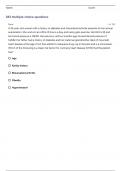
383 Multiple choice questions
Term 1 of 383
A 52-year-old woman with a history of diabetes and rheumatoid arthritis presents for her annual
examination. She works in an office 10 hours a day, and rarely gets exercise. Her BMI is 23 and
her blood pressure is 152/85. Her previous visit two months ago showed blood pressure of
148/82. Her father had a history of diabetes and her maternal grandmother died of rheumatic
heart disease at the age of 42. She admits to marijuana drug use in the past and is a nonsmoker.
Which of the following is a major risk factor for coronary heart disease (CHD) that this patient
has?
Age
Family history
Rheumatoid arthritis
Obesity
Hypertension"
,Term 2 of 383
A 58-year-old female presents to the clinic with concern for chest pain over the past three
months. She describes the pain as sharp and stabbing, in the mid-sternal region, lasting for one
to two minutes, occurring a few times a day. The pain can come on at rest or with exertion and
resolves on its own. It has not become worse since it began. There is no associated diaphoresis,
shortness of breath, nausea, jaw pain, or pain with movement, eating, or laying supine. She has a
10-year history of obesity and hypertension for which she takes chlorthalidone and lisinopril.
She was recently diagnosed with diabetes that has been controlled by diet. Physical
examination shows her pulse is 86 beats/minute, respiration rate is 16 breaths/minute, and blood
pressure is 135/85 mmHg. Her lungs are clear, heart sounds are normal, and there is no chest
wall tenderness to palpation or abdominal tenderness. There is no peripheral edema. How
would you best characterize her chest pain?
Atypical angina
Gastroesophageal reflux
Musculoskeletal
Stable angina
Unstable angina"
,Term 3 of 383
""Now that you have a diagnosis of disc herniation with radiculopathy for Mr. Payne, let's discuss
what would you like to do for him.""
Which of the following are indicated at this time? Select all that apply.
A. Prescribe NSAID and muscle relaxant
B. Strict bed rest
C. Referral to a back surgeon
D. Order a MRI
E. Moist heat
F. Referral to physical therapy" "
A. Decrease in vasomotor symptoms.
C. Improvement in atrophic vaginitis symptoms.
E. Prevention of osteoporosis."
"
A. Pleuritic pain
B. Pulsating pain
C. Positional pain
E. Palpation reproduced pain"
"
A. Prescribe NSAID and muscle relaxant
E. Moist heat
F. Referral to physical therapy
"
"
A. Exercise treadmill testing (ETT)
B. Stress echocardiography
E. Nuclear stress testing (with either Thallium or Sestamibi)"
"
, Term 4 of 383
Mr. Jones is a 67-year-old male brought into your office because he has been having ""dizzy
spells and room spinning"" for the past two days that are intermittent. Your records indicate a
history of back pain, diabetes and hypertension. Upon further questioning, Mr. Jones cannot
identify when these spells come on and nothing seems to relieve them. His temperature is 98.6
Fahrenheit; blood pressure is 165/95 mmHg; heart rate is 78 beats/minute; and respiratory rate is
18 breaths/minute. On physical exam, you notice a slight nystagmus. You ask him to focus on
your nose but the nystagmus continues.
What is the most likely cause of his ""dizzy spells""?
Anemia
Bleeding gastric ulcer
Hyperthyroidism with thyroid storm
Stroke
Vestibular neuritis"
Term 5 of 383
You are seeing a 63-year-old male with hypertension, diabetes, and a history of an NSTEMI two
years ago. His most recent echocardiogram reveals mild hypokinesis of the inferior wall of the
left ventricle and a LV ejection fraction of 40%. Shortly after his MI, he was treated for symptoms
of congestive heart failure, but he has not has any such symptoms since then. His exercise
tolerance is excellent. Today his physical exam is completely unremarkable.
The correct pairing of NYHA functional class and ACCF/AHA Stage of CHF is which of the
following for this man?
NYHA II / Stage C
NYHA I / Stage A
NYHA I / Stage B
NYHA I / Stage C
NYHA II / Stage B"
383 Multiple choice questions
Term 1 of 383
A 52-year-old woman with a history of diabetes and rheumatoid arthritis presents for her annual
examination. She works in an office 10 hours a day, and rarely gets exercise. Her BMI is 23 and
her blood pressure is 152/85. Her previous visit two months ago showed blood pressure of
148/82. Her father had a history of diabetes and her maternal grandmother died of rheumatic
heart disease at the age of 42. She admits to marijuana drug use in the past and is a nonsmoker.
Which of the following is a major risk factor for coronary heart disease (CHD) that this patient
has?
Age
Family history
Rheumatoid arthritis
Obesity
Hypertension"
,Term 2 of 383
A 58-year-old female presents to the clinic with concern for chest pain over the past three
months. She describes the pain as sharp and stabbing, in the mid-sternal region, lasting for one
to two minutes, occurring a few times a day. The pain can come on at rest or with exertion and
resolves on its own. It has not become worse since it began. There is no associated diaphoresis,
shortness of breath, nausea, jaw pain, or pain with movement, eating, or laying supine. She has a
10-year history of obesity and hypertension for which she takes chlorthalidone and lisinopril.
She was recently diagnosed with diabetes that has been controlled by diet. Physical
examination shows her pulse is 86 beats/minute, respiration rate is 16 breaths/minute, and blood
pressure is 135/85 mmHg. Her lungs are clear, heart sounds are normal, and there is no chest
wall tenderness to palpation or abdominal tenderness. There is no peripheral edema. How
would you best characterize her chest pain?
Atypical angina
Gastroesophageal reflux
Musculoskeletal
Stable angina
Unstable angina"
,Term 3 of 383
""Now that you have a diagnosis of disc herniation with radiculopathy for Mr. Payne, let's discuss
what would you like to do for him.""
Which of the following are indicated at this time? Select all that apply.
A. Prescribe NSAID and muscle relaxant
B. Strict bed rest
C. Referral to a back surgeon
D. Order a MRI
E. Moist heat
F. Referral to physical therapy" "
A. Decrease in vasomotor symptoms.
C. Improvement in atrophic vaginitis symptoms.
E. Prevention of osteoporosis."
"
A. Pleuritic pain
B. Pulsating pain
C. Positional pain
E. Palpation reproduced pain"
"
A. Prescribe NSAID and muscle relaxant
E. Moist heat
F. Referral to physical therapy
"
"
A. Exercise treadmill testing (ETT)
B. Stress echocardiography
E. Nuclear stress testing (with either Thallium or Sestamibi)"
"
, Term 4 of 383
Mr. Jones is a 67-year-old male brought into your office because he has been having ""dizzy
spells and room spinning"" for the past two days that are intermittent. Your records indicate a
history of back pain, diabetes and hypertension. Upon further questioning, Mr. Jones cannot
identify when these spells come on and nothing seems to relieve them. His temperature is 98.6
Fahrenheit; blood pressure is 165/95 mmHg; heart rate is 78 beats/minute; and respiratory rate is
18 breaths/minute. On physical exam, you notice a slight nystagmus. You ask him to focus on
your nose but the nystagmus continues.
What is the most likely cause of his ""dizzy spells""?
Anemia
Bleeding gastric ulcer
Hyperthyroidism with thyroid storm
Stroke
Vestibular neuritis"
Term 5 of 383
You are seeing a 63-year-old male with hypertension, diabetes, and a history of an NSTEMI two
years ago. His most recent echocardiogram reveals mild hypokinesis of the inferior wall of the
left ventricle and a LV ejection fraction of 40%. Shortly after his MI, he was treated for symptoms
of congestive heart failure, but he has not has any such symptoms since then. His exercise
tolerance is excellent. Today his physical exam is completely unremarkable.
The correct pairing of NYHA functional class and ACCF/AHA Stage of CHF is which of the
following for this man?
NYHA II / Stage C
NYHA I / Stage A
NYHA I / Stage B
NYHA I / Stage C
NYHA II / Stage B"


