
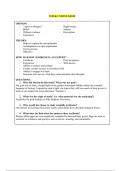
WEEK 1 NOTES 240118
OPINION:
- “Agree to disagree” - Right/wrong
- Belief - Subject
- Without evidence - Description
- Experience
THEORY:
- Helps to explain the unexplainable
- Assumptions to a topic experiment
- Can be proven
- Objective
HOW TO KNOW SOMEONE IS AN EXPERT?
- Certificate - Peer acceptance
- Experience - Well-known
- Ability to analyze and critique
- Credits; creates success in your/their field
- Ability to engage in a topic
- Someone who can say what they mean/articulate their thoughts
QUESTIONS:
1. Why did Martin do this study? What was her goal?
Her goal was to shine a bright light on the gender stereotypes hidden within the scientific
language of biology. Exposed in such a light, she hopes they will lose much of their power to
harm us (to weaken the terms that harm “females”).
2. What was her sight of study? (i.e. what material was she analyzing?)
Textbooks for med students at John Hopkins University.
3. Why would she choose to study scientific textbooks?
Our doctors are learning from these books which helps them develop biological biases.
4. What does she find when she analyzes these textbooks?
Women (their eggs) are seen negatively compared to men and their sperm. Eggs are seen as
wasteful, as a damsel, and sperm is seen as heroic, amazing, and remarkable.
, 240118
HOW DO I KNOW WHAT I KNOW?
EPISTEMOLOGY AND THEORY
FACTS, ASSUMPTIONS, OPINIONS, AND THEORIES
❖ Theory- allows us to explain events and phenomena that we observe about broader
frameworks of understanding.
➢ It helps us to develop new ways of understanding the world
➢ It shapes our analysis of how and why things happen the way they do
➢ Theories define key concepts from which to develop an analysis
❖ Opinion- a statement based on a person’s perspective, understanding, feelings, beliefs,
and desires about an event, issue, or situation.
➢ It is subjective: it is informed by the person or subject who is speaking
➢ Are deeply personal and emotional interpretations rather than objective, unbiased,
and substantiated information or facts
❖ Facts- thoughts that are irrefutable, indisputable, and provable
➢ The basis on which we can make valid arguments
➢ Evidence, commonly published in academic journals, for making particular
claims
❖ Empiricism- the theory that all knowledge is derived from sense-experience
➢ Information discovered through the use of our five senses
■ Sight
■ Hearing
■ Taste
■ Touch
■ Smell
➢ It is an epistemology, a way of knowing, that acknowledges direct observations of
the world as valid ways to generate truths about the world.
EPISTEMOLOGY AND OTHER CONFUSING TERMS
❖ We don’t just remember the in-class lessons; we also think of our life lessons from peers
and family members.
❖ Through our experiences of social institutions (family, education, religion, culture,
customs, and traditions), we learn about the rules, regulations, and social and cultural
expectations that guide our lives.
❖ Epistemology- the study of how we know what we know
➢ It encourages us to ask how we know what we know and to raise questions about
the nature of knowing
■ What is knowledge?
, ■ What knowledge is valuable?
■ How is knowledge acquired?
■ What are the possibilities and limitations of knowing?
THERE’S NO WAY I’M ALREADY DOING THEORY: THEORIZING THE EVERYDAY
❖ We may not recognize everyday decision-making as theory because we are unaware of
the assumptions behind our actions, and we make these choices unconsciously.
❖ We don’t recognize that our choices are grounded in theory.
SUBJECTIVITY AND OBJECTIVITY: THIS IS NOT THE WAY I THOUGHT IT WORKED
❖ Subjective knowledge- the knowledge you have about lateness is influenced by you as a
subject.
❖ The theory is always about something and for someone
➢ Theories have power
➢ They are contextual and subjective
WHAT IS FEMINIST THEORY AND WHY DO WE NEED IT?
❖ Feminist theory provides frameworks for understanding our lives, the means to envision
the way things could be different, and strategies for taking action and making change
❖ 1970s- feminist theorists began to expand their frameworks to address issues of gender,
race, class, sexuality, ability, age, colonialism, imperialism, and power
❖ The feminist lens is a concept that allows us to zoom in for a close-up view of particular
situations and experiences, but it is also a way of zooming out and seeing the world more
broadly
❖ Feminist epistemology is a reinforcing process of knowing and acting as a feminist
➢ Many feminist theorists recognize the dangers of subjectivity and counter it by
insisting on self-reflexivity
❖ Self-reflexivity- a process whereby you critically examine the causes and effects of your
ideas, words, and actions.
➢ For feminists, it necessitates an evaluation of the ways we think and act, as well
as our positions of power and privilege.
➢ It demands that we hold a mirror up to ourselves and question whether we are
measuring up to our feminist principles and goals, however, we define them.
■ Allows for multiple and varied approaches to understanding the world in
which we live
❖ Feminist theories incorporate diverse perspectives and strive to correct past mistakes or
omissions.
➢ Liberal
➢ Socialist
➢ Radical
OPINION:
- “Agree to disagree” - Right/wrong
- Belief - Subject
- Without evidence - Description
- Experience
THEORY:
- Helps to explain the unexplainable
- Assumptions to a topic experiment
- Can be proven
- Objective
HOW TO KNOW SOMEONE IS AN EXPERT?
- Certificate - Peer acceptance
- Experience - Well-known
- Ability to analyze and critique
- Credits; creates success in your/their field
- Ability to engage in a topic
- Someone who can say what they mean/articulate their thoughts
QUESTIONS:
1. Why did Martin do this study? What was her goal?
Her goal was to shine a bright light on the gender stereotypes hidden within the scientific
language of biology. Exposed in such a light, she hopes they will lose much of their power to
harm us (to weaken the terms that harm “females”).
2. What was her sight of study? (i.e. what material was she analyzing?)
Textbooks for med students at John Hopkins University.
3. Why would she choose to study scientific textbooks?
Our doctors are learning from these books which helps them develop biological biases.
4. What does she find when she analyzes these textbooks?
Women (their eggs) are seen negatively compared to men and their sperm. Eggs are seen as
wasteful, as a damsel, and sperm is seen as heroic, amazing, and remarkable.
, 240118
HOW DO I KNOW WHAT I KNOW?
EPISTEMOLOGY AND THEORY
FACTS, ASSUMPTIONS, OPINIONS, AND THEORIES
❖ Theory- allows us to explain events and phenomena that we observe about broader
frameworks of understanding.
➢ It helps us to develop new ways of understanding the world
➢ It shapes our analysis of how and why things happen the way they do
➢ Theories define key concepts from which to develop an analysis
❖ Opinion- a statement based on a person’s perspective, understanding, feelings, beliefs,
and desires about an event, issue, or situation.
➢ It is subjective: it is informed by the person or subject who is speaking
➢ Are deeply personal and emotional interpretations rather than objective, unbiased,
and substantiated information or facts
❖ Facts- thoughts that are irrefutable, indisputable, and provable
➢ The basis on which we can make valid arguments
➢ Evidence, commonly published in academic journals, for making particular
claims
❖ Empiricism- the theory that all knowledge is derived from sense-experience
➢ Information discovered through the use of our five senses
■ Sight
■ Hearing
■ Taste
■ Touch
■ Smell
➢ It is an epistemology, a way of knowing, that acknowledges direct observations of
the world as valid ways to generate truths about the world.
EPISTEMOLOGY AND OTHER CONFUSING TERMS
❖ We don’t just remember the in-class lessons; we also think of our life lessons from peers
and family members.
❖ Through our experiences of social institutions (family, education, religion, culture,
customs, and traditions), we learn about the rules, regulations, and social and cultural
expectations that guide our lives.
❖ Epistemology- the study of how we know what we know
➢ It encourages us to ask how we know what we know and to raise questions about
the nature of knowing
■ What is knowledge?
, ■ What knowledge is valuable?
■ How is knowledge acquired?
■ What are the possibilities and limitations of knowing?
THERE’S NO WAY I’M ALREADY DOING THEORY: THEORIZING THE EVERYDAY
❖ We may not recognize everyday decision-making as theory because we are unaware of
the assumptions behind our actions, and we make these choices unconsciously.
❖ We don’t recognize that our choices are grounded in theory.
SUBJECTIVITY AND OBJECTIVITY: THIS IS NOT THE WAY I THOUGHT IT WORKED
❖ Subjective knowledge- the knowledge you have about lateness is influenced by you as a
subject.
❖ The theory is always about something and for someone
➢ Theories have power
➢ They are contextual and subjective
WHAT IS FEMINIST THEORY AND WHY DO WE NEED IT?
❖ Feminist theory provides frameworks for understanding our lives, the means to envision
the way things could be different, and strategies for taking action and making change
❖ 1970s- feminist theorists began to expand their frameworks to address issues of gender,
race, class, sexuality, ability, age, colonialism, imperialism, and power
❖ The feminist lens is a concept that allows us to zoom in for a close-up view of particular
situations and experiences, but it is also a way of zooming out and seeing the world more
broadly
❖ Feminist epistemology is a reinforcing process of knowing and acting as a feminist
➢ Many feminist theorists recognize the dangers of subjectivity and counter it by
insisting on self-reflexivity
❖ Self-reflexivity- a process whereby you critically examine the causes and effects of your
ideas, words, and actions.
➢ For feminists, it necessitates an evaluation of the ways we think and act, as well
as our positions of power and privilege.
➢ It demands that we hold a mirror up to ourselves and question whether we are
measuring up to our feminist principles and goals, however, we define them.
■ Allows for multiple and varied approaches to understanding the world in
which we live
❖ Feminist theories incorporate diverse perspectives and strive to correct past mistakes or
omissions.
➢ Liberal
➢ Socialist
➢ Radical


