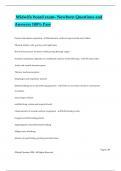
Midwife board exam- Newborn Questions and
Answers 100% Pass
Factors that initiate respiration - ✔✔Biochemical- relative hypoxia at the end of labor
Physical stimuli- cold, gravity, pain, light noise
Rocoil from pressure on thorax while passing through vagina
Sustained respiration depends on coordinated response of the following - ✔✔CNS resp center
Aortic and carotid chemoreceptors
Thoracic mechanoreceptors
Diaphragm and respiratory muscles
Initial breathing serves the following purposes - ✔✔Assits in conversion of fetal to extrauterine
circulation
clears lungs of fluids
establish lung volume and expand alveoli
Characteristics of normal newborn respiration - ✔✔30-60 breath per min
irregular and fluctuating pattern
diaphragmatic and abdominal breathing
obligate nose breathing
absence of nasal flaring, grunting and retractions
Page 1/37
©EmilyCharlene 2024. All Rights Reserved.
,When does change to from fetal to extrauterine circulation occur? - ✔✔from clamming the umbilical cord
throughout first weeks of life.
Characterisstic of fetal circulation - ✔✔low-pressure system, including placenta (low resistance circuit)
Minimal circulation to lungs; bypassed via foramen oval and ductus ateriousus
foramen ovale favors circulation of most oxygen rich blood to the brain
Transition from Fetal to neonatal circulation - ✔✔Increases systematic resistance d/t. loss of placental
circuit
increased pressure in LEFT ATRIUM causes functional closure of the foramen ovale
Intail respiration opens pulmonary vasculature, favoring circulation to the lungs
increased oxygenation of ciculating blood causes construction and functional closure of the ductus
arteriosus
Absence of placental circulation closes ductus venous
mechanisms of neonatal heat loss - ✔✔convection
conduction
evaporation
radiation
Page 2/37
©EmilyCharlene 2024. All Rights Reserved.
,3 ways a neonate creates heat - ✔✔shivering (inefficient)
Muscle activity (limited benefit)
Thermogenesis by metabolism of brown adipose tissue
1) BAT stores are decreased in PTM and IUGR infants
2) hypoglycemia reduces efficiency of BAT metabolism
Consequences of cold stress - ✔✔Increased oxygen consumption, leading to relative hypoxia and acidosis
metabolism of BAT and release of fatty acids decreases pH
increased use of glucose, depletion of glycogen stores and hypoglycemia
Worsening hypoglycemia and acidosis may result in respiratory distress
Cold stress management - ✔✔skin to skin with mothers chest with blanket over both
prewarm blankets and resuscitation area
dry newborn immediately and replace wet blankets
regulate room temp and minimize exposure to air convection
postpone newborn bath for at least 2 hours
keep newborn warm and wrapped
Glycogen stores - ✔✔predominately in the liver
accumulated in third trimester
Risk factors for neonatal hypoglycemia - ✔✔infants of DM mothers
SGA or LGA
Preterm or Postterm
Page 3/37
©EmilyCharlene 2024. All Rights Reserved.
, Intrapartum -perinatal acidemia, beta-agonit tocolysis, IV glucose administration
Maternal substance abuse
Glucose regulation in the healthy neonate - ✔✔Normal physiologic decrease in blood glucoses appears to
be essential to stimulate physiologic processes promoting glucose production
1) lowest at 1-1.5 - 5 hours after birth
2) stabilizes 3-4 hours after birth
3) IF SYMPTOMATIC and < 40 mg/dL, IV glucoses is recommended
4) if there are NO symptoms, ideally infant should feed within one hour of birth and glucose should be
screened 30 min after feeding by 4-24 hours blood glucose levels should remain over 45 mg/dL
Indications for IV dextrose - ✔✔Symptomatic infants < 40 mg/ dL or those with serum glucose less than
25 mg/dL regardless of symptoms
Asymptomatic infants with persistent serum glucose below 45 mg/dL
Mean glucose levels from 4-72 hours - ✔✔60-70 mg/dL
Sources and mechanisms of glucose maintenance - ✔✔Intake of human milk or formula
glycogenolysis (use of glycogen stores0
Gluconeogensis (Production of glucose from free fatty acids), glycerol and amino acids
S/S of hypoglycemia - ✔✔Weak cry, jitteriness, cyanosis, apnea, lethargy, poor feeding
Hemoglobin F - ✔✔predominant hemoglobin present at birth
High affinity of O2
Page 4/37
©EmilyCharlene 2024. All Rights Reserved.
Answers 100% Pass
Factors that initiate respiration - ✔✔Biochemical- relative hypoxia at the end of labor
Physical stimuli- cold, gravity, pain, light noise
Rocoil from pressure on thorax while passing through vagina
Sustained respiration depends on coordinated response of the following - ✔✔CNS resp center
Aortic and carotid chemoreceptors
Thoracic mechanoreceptors
Diaphragm and respiratory muscles
Initial breathing serves the following purposes - ✔✔Assits in conversion of fetal to extrauterine
circulation
clears lungs of fluids
establish lung volume and expand alveoli
Characteristics of normal newborn respiration - ✔✔30-60 breath per min
irregular and fluctuating pattern
diaphragmatic and abdominal breathing
obligate nose breathing
absence of nasal flaring, grunting and retractions
Page 1/37
©EmilyCharlene 2024. All Rights Reserved.
,When does change to from fetal to extrauterine circulation occur? - ✔✔from clamming the umbilical cord
throughout first weeks of life.
Characterisstic of fetal circulation - ✔✔low-pressure system, including placenta (low resistance circuit)
Minimal circulation to lungs; bypassed via foramen oval and ductus ateriousus
foramen ovale favors circulation of most oxygen rich blood to the brain
Transition from Fetal to neonatal circulation - ✔✔Increases systematic resistance d/t. loss of placental
circuit
increased pressure in LEFT ATRIUM causes functional closure of the foramen ovale
Intail respiration opens pulmonary vasculature, favoring circulation to the lungs
increased oxygenation of ciculating blood causes construction and functional closure of the ductus
arteriosus
Absence of placental circulation closes ductus venous
mechanisms of neonatal heat loss - ✔✔convection
conduction
evaporation
radiation
Page 2/37
©EmilyCharlene 2024. All Rights Reserved.
,3 ways a neonate creates heat - ✔✔shivering (inefficient)
Muscle activity (limited benefit)
Thermogenesis by metabolism of brown adipose tissue
1) BAT stores are decreased in PTM and IUGR infants
2) hypoglycemia reduces efficiency of BAT metabolism
Consequences of cold stress - ✔✔Increased oxygen consumption, leading to relative hypoxia and acidosis
metabolism of BAT and release of fatty acids decreases pH
increased use of glucose, depletion of glycogen stores and hypoglycemia
Worsening hypoglycemia and acidosis may result in respiratory distress
Cold stress management - ✔✔skin to skin with mothers chest with blanket over both
prewarm blankets and resuscitation area
dry newborn immediately and replace wet blankets
regulate room temp and minimize exposure to air convection
postpone newborn bath for at least 2 hours
keep newborn warm and wrapped
Glycogen stores - ✔✔predominately in the liver
accumulated in third trimester
Risk factors for neonatal hypoglycemia - ✔✔infants of DM mothers
SGA or LGA
Preterm or Postterm
Page 3/37
©EmilyCharlene 2024. All Rights Reserved.
, Intrapartum -perinatal acidemia, beta-agonit tocolysis, IV glucose administration
Maternal substance abuse
Glucose regulation in the healthy neonate - ✔✔Normal physiologic decrease in blood glucoses appears to
be essential to stimulate physiologic processes promoting glucose production
1) lowest at 1-1.5 - 5 hours after birth
2) stabilizes 3-4 hours after birth
3) IF SYMPTOMATIC and < 40 mg/dL, IV glucoses is recommended
4) if there are NO symptoms, ideally infant should feed within one hour of birth and glucose should be
screened 30 min after feeding by 4-24 hours blood glucose levels should remain over 45 mg/dL
Indications for IV dextrose - ✔✔Symptomatic infants < 40 mg/ dL or those with serum glucose less than
25 mg/dL regardless of symptoms
Asymptomatic infants with persistent serum glucose below 45 mg/dL
Mean glucose levels from 4-72 hours - ✔✔60-70 mg/dL
Sources and mechanisms of glucose maintenance - ✔✔Intake of human milk or formula
glycogenolysis (use of glycogen stores0
Gluconeogensis (Production of glucose from free fatty acids), glycerol and amino acids
S/S of hypoglycemia - ✔✔Weak cry, jitteriness, cyanosis, apnea, lethargy, poor feeding
Hemoglobin F - ✔✔predominant hemoglobin present at birth
High affinity of O2
Page 4/37
©EmilyCharlene 2024. All Rights Reserved.